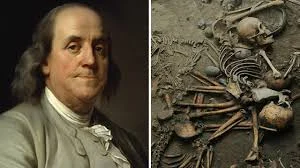
When renovations began at 36 Craven Street in London—the former residence of Benjamin Franklin—no one expected to uncover a secret that had been buried beneath the floorboards for more than two centuries. In 1998, archaeologists working with the Benjamin Franklin House restoration project made a startling discovery: more than 1,200 human bones, belonging to at least ten individuals, hidden in the basement. To the casual observer, such a find might immediately spark macabre speculation. Had one of America’s most revered Founding Fathers lived a double life? Was there a hidden crime beneath the legacy of invention, diplomacy, and scientific curiosity? Yet the truth, while far from sinister, opened a fascinating window into the world of 18th-century science, medical training, and social taboos. These bones were not evidence of murder—they were remnants of a covert anatomy school that operated in Franklin’s home. And the story behind their presence is deeply intertwined with the history of medical education, the rise of Enlightenment thought, and the complexities of Franklin’s personal circle.
How Ben Franklin Came to Live at Craven Street—and Why That Matters
Before exploring the bones themselves, it is essential to understand the setting in which they were found. Franklin lived at 36 Craven Street for nearly twenty years, from 1757 to 1775, during his extended diplomatic missions in London. The house was owned by Margaret Stevenson, a widowed landlady who ran a respectable and intellectually vibrant boarding residence. Franklin quickly bonded with Margaret and her daughter Polly, forging a quasi-family relationship far from his wife and children in Pennsylvania. The household became a hub of conversation, study, and Enlightenment exchange.
Craven Street, located near the Strand, was an area bustling with merchants, craftsmen, and intellectuals. Many of Franklin’s most important political and scientific ideas developed within those walls. He wrote extensively at Craven Street, conducted experiments on electricity, and built relationships with influential British figures. But while Franklin’s activities were well-known, something else was happening in the same house—a clandestine venture that only came to light two centuries later.
Margaret Stevenson had another longtime resident: William Hewson, a brilliant young anatomist often called “the father of hematology.” Hewson married Polly Stevenson in 1770 and established a small anatomy school in the house. His work focused on groundbreaking research into lymphatic systems, blood clotting, and the structure of human tissues. But in the 18th century, anatomy training was fraught with legal and ethical challenges. There were few legitimate channels for procuring bodies for dissection; only executed criminals could legally be used, and even those corpses were in short supply.
Anatomists often resorted to the shadowy world of body-snatching. “Resurrection men” dug up freshly buried corpses and sold them to anatomy schools. It was a grim but common reality in a time when medical science desperately needed to understand the human body but lacked the legal frameworks to support such study. Hewson was part of this world, not out of malice, but necessity. And because of this, he conducted his work quietly, discreetly, and often out of public view. Franklin, ever curious about science and anatomy, likely knew of and even quietly supported Hewson’s endeavors, though no evidence suggests he directly participated in dissections.
It was in this environment—half laboratory, half diplomatic residence—that the bones eventually found their way into the basement. Franklin’s house was not a crime scene. It was a hidden classroom, a place where the future of medical science was literally taking shape.
What Archaeologists Discovered Beneath the Floorboards
The excavation at Craven Street began as a conservation effort, aiming to restore the house to its 18th-century condition. Yet soon after work commenced, researchers found something unexpected: a dark, narrow pit beneath the basement floorboards, filled with dozens of bones. Further digging revealed more. Human femurs, skull fragments, ribs, vertebrae—ultimately more than 1,200 pieces emerged from the soil. Some bones showed clear signs of dissection: saw marks, drill holes, and clean cuts that revealed the use of medical tools. Others had been broken for study or preparation.
The bones came from both adults and children. Forensic analysis estimated at least ten individuals, though the exact number remains uncertain due to fragmentation. Evidence suggested that many bones had been deliberately disposed of, likely after dissection and anatomical practice were complete. The pit also contained several animal bones—probably from small mammals such as dogs or birds—commonly used for anatomical comparison.
Among the most revealing finds were skulls with holes cut into them, consistent with 18th-century trepanation techniques. One femur bore signs of a surgical amputation, likely part of Hewson’s experiments with new techniques. Bone saw marks indicated methodical dissection rather than violence. These were teaching specimens, not victims of foul play.
The archaeological report concluded that the bones were almost certainly associated with Hewson’s anatomy school. Historical documents corroborated this. Hewson advertised anatomy courses and dissections in London newspapers. He had studied under the famous William Hunter, who operated his own school using similar clandestine methods. Hewson’s early death in 1774, caused by infection contracted during dissections, cut short a promising career—but his scientific legacy lived on.
The bones beneath Franklin’s house provided tangible evidence of an era when medicine was advancing rapidly, yet legal and moral systems lagged behind. Dissection was vital, but secrecy was equally necessary. Dumping bones in a basement pit was not unusual; anatomical waste had to be disposed of discreetly to avoid public panic or legal repercussions. In this sense, the pit became a silent time capsule, preserving a moment when the human body itself was a frontier of scientific discovery.
Why Anatomy Schools Operated in Secret—and What That Reveals About 18th-Century Society
The presence of bodies in Franklin’s basement might seem shocking today, but in the 18th century it reflected the uneasy cultural status of anatomical science. Dissection was widely feared and morally stigmatized. Many people believed that cutting open a corpse desecrated the body and jeopardized the soul’s resurrection. Graveyards were sacred places, and interfering with them sparked outrage. Yet the need for anatomical knowledge—especially in cities battling epidemics, poor sanitation, and high mortality rates—was undeniable.
Medical students could not learn surgery or diagnostics without firsthand knowledge of human anatomy. Doctors needed to understand the structures they operated on. But the law provided only one legitimate source: executed criminals. This supply was woefully inadequate. As a result, anatomists turned to grave robbers, who dug up newly buried bodies under cover of darkness. Families sometimes guarded graves overnight to prevent theft. Some cemeteries built watchtowers or iron cages over plots. Public horror stories circulated about missing loved ones found on anatomy tables.
Anatomists, therefore, adopted secrecy. Schools operated in private homes, rented lofts, or hidden basements. Hewson’s use of Craven Street was not unusual; many anatomy teachers ran clinics out of their residences. Franklin’s house was an ideal location—centrally located, discreet, and occupied by people sympathetic to scientific exploration.
This clandestine culture created tension between scientific progress and societal fear. Yet it also led to extraordinary breakthroughs. The 18th century was a transformative era in medical history, when modern clinical training began to emerge. Anatomy students who learned in these hidden classrooms would become the doctors who shaped future generations.
Understanding this context helps explain why so many bones ended up beneath Franklin’s floorboards. Anatomy schools typically disposed of remains quietly—sometimes in rivers, sometimes in shallow pits. Since the goal was discretion rather than preservation, materials were buried quickly and forgotten. Over time, the soil resealed itself, and the activities left no trace—until archaeologists arrived centuries later.
In the case of Craven Street, the bones were not merely anatomical waste; they were evidence of a transitional moment in science, when curiosity outpaced law, and education required moral compromises that seem startling by modern standards.
Ben Franklin’s Relationship to the Anatomy School: What We Know and Don’t Know
One of the most intriguing questions raised by the discovery is Franklin’s own involvement. Was he aware of the dissections happening beneath his feet? Did he approve, tolerate, or participate? The answers, while nuanced, reveal much about Franklin’s character.
There is no evidence that Franklin personally dissected human bodies in his home. While he had a scientific mind and experimented with electricity, ocean currents, and meteorology, his interests did not extend into anatomy. He was, however, closely connected to William Hewson through the Stevenson family. Franklin respected Hewson’s intellect and supported scientific inquiry. He helped Hewson secure patronage, provided letters of recommendation, and praised his research. It is highly unlikely Franklin was unaware of the anatomy school given its location in the same building and the unmistakable smells and activities associated with dissection.
Franklin was also a pragmatic thinker. He believed deeply in scientific progress and saw firsthand how Europe’s medical advancements far exceeded those in the American colonies. He often advocated for improved education, public health measures, and scientific research. If Hewson needed a safe environment to conduct anatomy lessons, Franklin would almost certainly have understood the necessity.
Still, the absence of written evidence raises interesting questions. Franklin kept meticulous journals and corresponded regularly. Yet he never mentioned the anatomy school explicitly. Was this silence deliberate? Possibly. Discussing dissections openly in letters could have risked legal trouble or public scandal. Many anatomists avoided writing the specifics of their work for this reason.
It is equally possible Franklin simply did not dwell on it. The house had multiple residents, and Franklin spent long periods away on diplomatic business. For him, Craven Street was a place of intellectual exchange and domestic comfort. Hewson’s work may have been part of that environment but not a central concern.
Ultimately, the bones do not implicate Franklin in wrongdoing. Instead, they highlight his willingness to support scientific advancement—even when it operated in morally ambiguous territory. They illustrate the complexity of Enlightenment thinking, where curiosity sometimes outweighed convention, and the pursuit of knowledge required navigating social and legal gray areas.
How the Discovery Changed Our Understanding of Franklin and 18th-Century Medicine
The 1998 excavation at Craven Street reshaped scholarly understanding of Franklin’s London years. Not because it revealed scandal, but because it exposed the rich, interconnected world of Enlightenment science that flourished behind closed doors. The bones offered physical evidence of the intellectual ecosystem Franklin inhabited—a world where electricity, anatomy, chemistry, and political theory coexisted in the same household.
The discovery illuminated several key insights:
1. Franklin lived at the intersection of politics and science.
His London home was not solely a diplomatic residence; it was a hub of experimentation and learning. The anatomy school was part of a broader pattern of scientific exchange.
2. Anatomy schools were more widespread than previously understood.
Craven Street provided rare archaeological confirmation of practices long documented only in written sources. It demonstrated how embedded anatomy was in domestic spaces.
3. Medical science advanced despite legal obstacles.
Hewson’s work contributed to fundamental knowledge about blood and lymphatic systems. These breakthroughs were made possible through clandestine dissection—complicated, ethically fraught, but necessary.
4. The Enlightenment involved moral ambiguity.
Progress often required actions that today seem disturbing. The bones remind us that scientific revolutions emerge from imperfect contexts.
5. Franklin’s support networks enabled innovation.
By offering space and discretion, Franklin indirectly supported the advancement of anatomical education.
The find also enriched the Benjamin Franklin House museum experience. Thanks to the excavation, the house became not only a historical landmark but an archaeological site that visually and scientifically connects modern visitors with the hidden stories of the past.
What Happened to the Bones After Their Discovery—and Why Their Preservation Matters
After archaeologists exhumed and catalogued the bones, they were studied extensively to determine age, sex, pathology, and evidence of medical procedures. Many bones displayed saw cuts or drilling that aligned with anatomical training practices. Others showed healed fractures or deformities, offering a glimpse into the health conditions of Londoners during the 18th century.
Rather than removing the remains permanently, conservators chose to rebury most bones within the site, preserving the historical integrity of the house. Select bones used for educational purposes were displayed in a controlled museum setting, contextualized carefully to avoid sensationalism. The goal was not shock, but understanding.
Preserving these remains serves multiple purposes:
- It honors the individuals who, willingly or not, contributed to medical advancement.
- It provides an irreplaceable archive for future scientific study.
- It highlights the intertwined histories of medicine, ethics, and urban life.
- It anchors the site in authentic archaeological evidence.
Most importantly, it reminds visitors that history is not constructed solely from documents and monuments. Sometimes it emerges from what is buried, forgotten, or hidden—waiting centuries to be rediscovered.
Bones That Tell a Story of Science, Not Scandal
The discovery of human remains beneath Benjamin Franklin’s London home could have easily fueled sensational tales of hidden crimes or dark secrets. Instead, careful analysis revealed something far more meaningful: a snapshot of a pivotal moment in scientific history. The bones belonged not to victims of violence, but to participants—willing or otherwise—in the earliest stages of modern anatomical research.
Their presence reveals:
- the ingenuity and desperation of 18th-century medical education,
- the invisible labor of anatomists like William Hewson,
- the moral complexities of Enlightenment-era science, and
- the intellectual environment that shaped Benjamin Franklin.
Far from tarnishing Franklin’s reputation, the find enriches our understanding of his world. His house was a place where boundaries blurred—between science and domestic life, between legality and necessity, between moral discomfort and the pursuit of knowledge.
The bones beneath Craven Street whisper an important message: that progress often begins in the shadows, carried forward by those willing to challenge convention. And sometimes, history’s most extraordinary stories lie hidden beneath the floorboards, waiting for discovery.
Leave a Reply