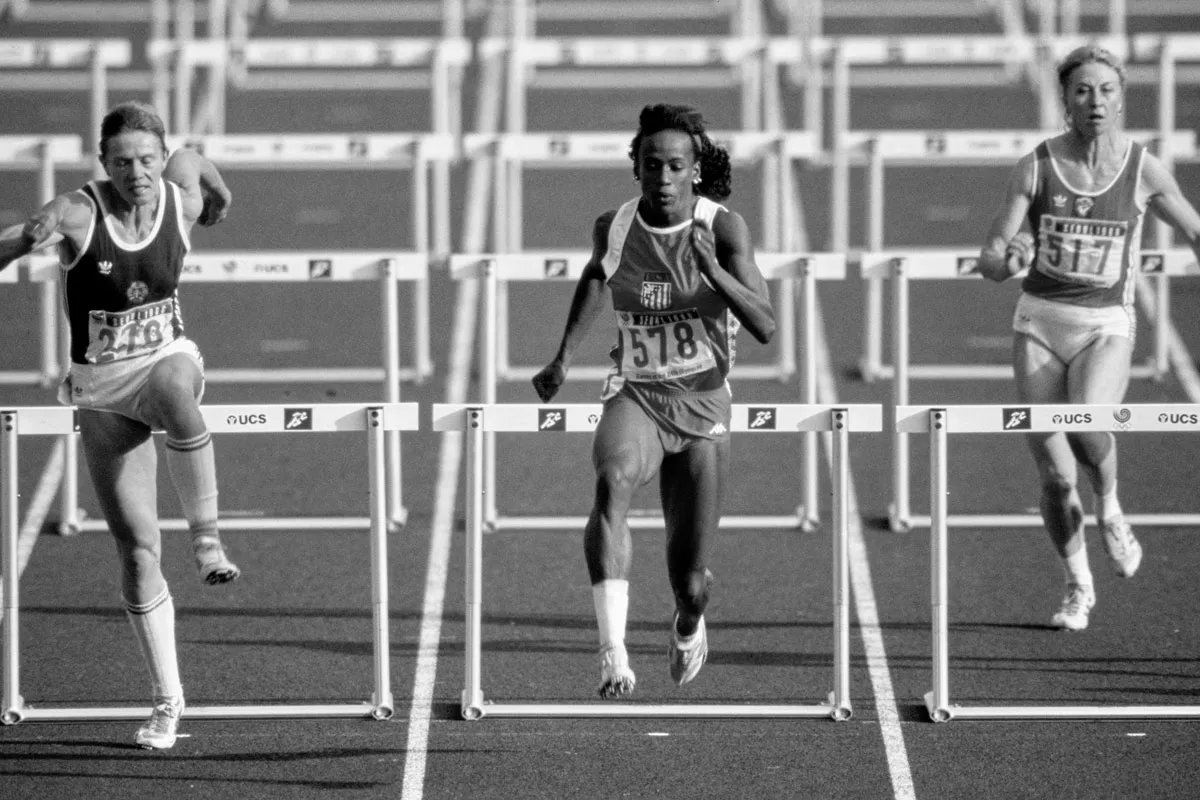
Every four years, the Olympic Games captivate a global audience as the world’s greatest athletes chase gold — and sometimes history. Records are meant to be broken, but a few performances tower so far above the rest that they feel almost untouchable. While nothing in sport is truly “unbreakable,” the following five Olympic feats are so extraordinary that surpassing them anytime soon seems highly unlikely.
Usain Bolt – 100 Meters (9.63 seconds, 2012)
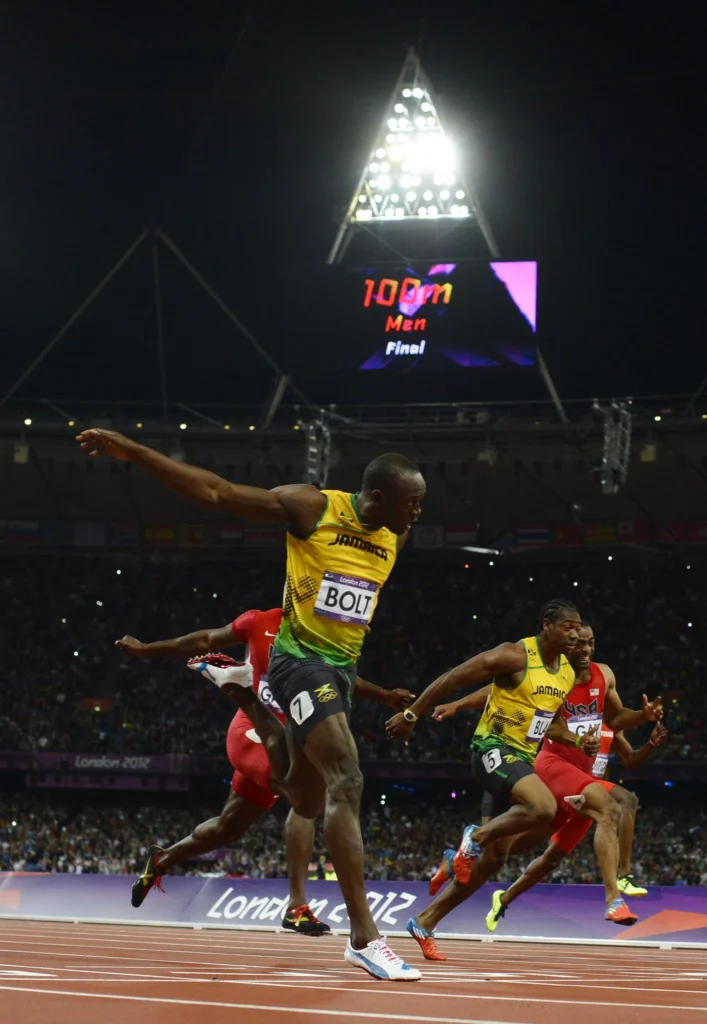
At the 2012 London Olympics, Usain Bolt delivered what many consider the greatest sprint in Olympic history, clocking 9.63 seconds in the 100 meters — an Olympic record that still stands.
Remarkably, this wasn’t even his fastest run. Bolt’s world record of 9.58 seconds, set at the 2009 World Championships in Berlin, remains the fastest time ever recorded by a human. At top speed, Bolt reached approximately 27.8 mph.
Standing 6 feet 5 inches tall, Bolt defied conventional sprinting wisdom. Elite sprinters are typically shorter and more compact, yet his long stride allowed him to complete the race in about 41 steps — three to four fewer than his rivals. Combined with flawless mechanics and peak competitive form, Bolt’s unique biomechanics may represent a once-in-a-generation anomaly.
His Olympic 100m record has yet to be seriously threatened, and many believe it could stand for decades.
Bob Beamon – Long Jump (8.90 meters, 1968)
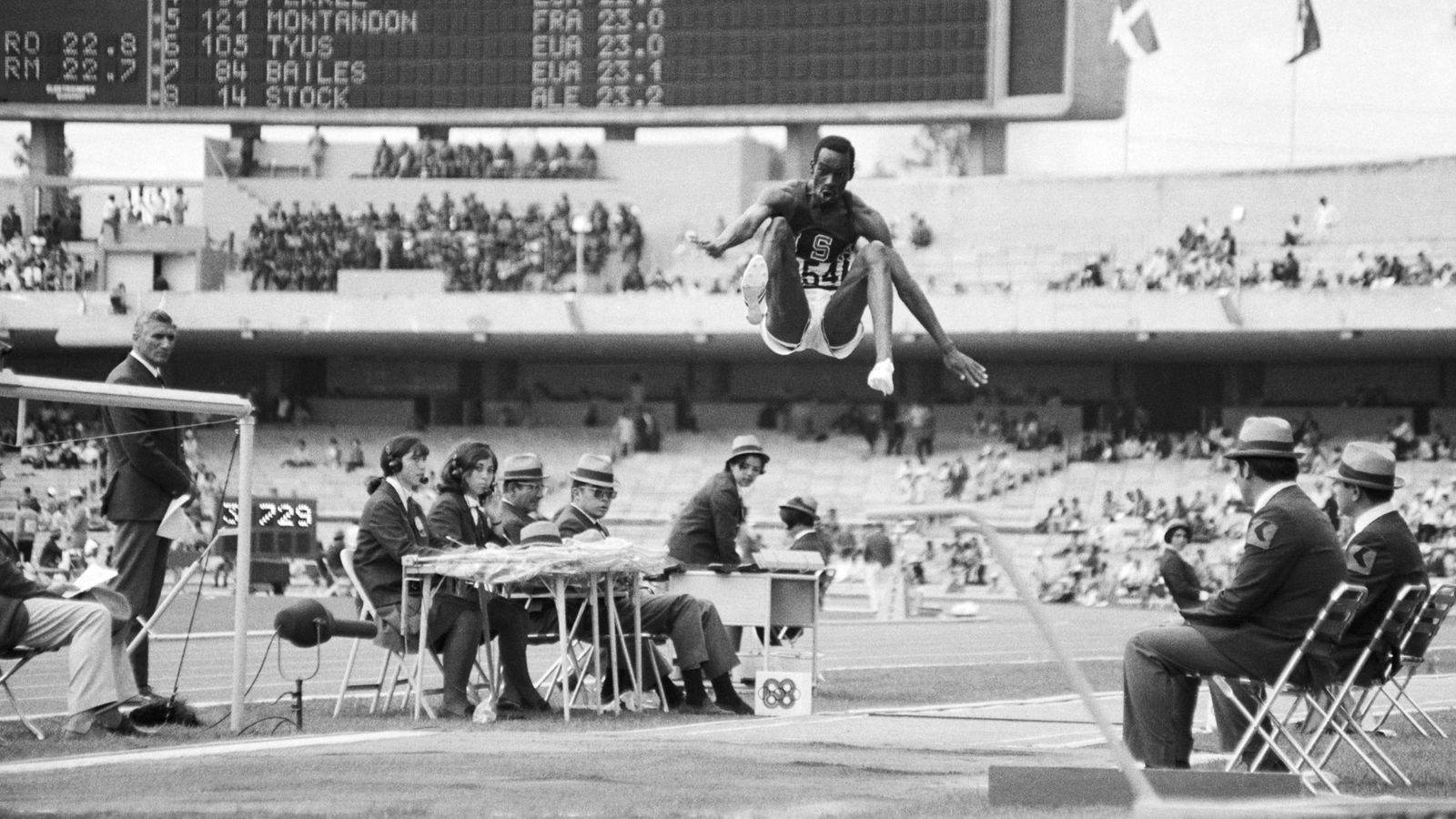
At the 1968 Mexico City Olympics, Bob Beamon produced what became known as the “Leap of the Century.”
His jump of 8.90 meters didn’t just break the existing record — it shattered it by an astonishing 55 centimeters. Prior improvements in the long jump had typically been measured in mere centimeters. Beamon’s leap was so unexpected that officials had to retrieve a steel tape measure because electronic equipment couldn’t measure that far.
Although Mike Powell surpassed Beamon’s world record in 1991 with 8.95 meters, Beamon’s mark remains the Olympic record more than 50 years later. No athlete has come close to matching it on the Olympic stage.
Jackie Joyner-Kersee – Heptathlon (7,291 points, 1988)

At the 1988 Seoul Olympics, Jackie Joyner-Kersee delivered a masterclass in all-around athleticism. Competing in the seven-event heptathlon, she amassed 7,291 points, breaking her own world record — one she had already reset four times since 1986.
At the time, no other woman had even surpassed 7,000 points. Joyner-Kersee had now done it five times.
Nearly four decades later, her Olympic record remains intact. In 2005, Olympic champion Carolina Klüft described it as “probably unbeatable.”
American athlete Anna Hall has come closest in recent years, scoring 7,032 points in 2025, tying for the second-highest total ever recorded. Yet she still trails Joyner-Kersee’s Olympic and world record by 259 points — a massive margin in combined events competition.
Adding a poetic twist: Hall’s mentor is Jackie Joyner-Kersee herself.
Nadia Comăneci – First Perfect 10 (1976)

At just 14 years old, Nadia Comăneci made Olympic history at the 1976 Montreal Games by becoming the first gymnast ever to receive a perfect 10.00.
Her uneven bars routine was so extraordinary that the scoreboard — incapable of displaying four digits — showed 1.00 instead. Officials had never anticipated perfection.
Comăneci would go on to score six additional perfect 10s at those Games and became the youngest Olympic all-around champion in gymnastics history.
While other gymnasts have since earned perfect 10s under the old scoring system, there will only ever be one first — and Comăneci owns that forever.
Michael Phelps – 28 Olympic Medals

No discussion of untouchable Olympic records is complete without Michael Phelps.
Over the course of his career, the American swimmer amassed an astonishing 28 Olympic medals, including 23 golds — more than double that of any other athlete in history.
The previous medal record belonged to Larisa Latynina, who won 18 medals (nine gold) between 1956 and 1964 — a record that stood for decades before Phelps eclipsed it.
After the 2016 Rio Games, Phelps retired, leaving behind a medal haul that may be mathematically possible to surpass — but practically unreachable. Modern specialization, increased global competition, and limited event entries make such dominance extraordinarily difficult to replicate.
Will They Ever Be Broken?
Sport evolves. Training improves. Technology advances. Yet some achievements exist at the outer boundary of human capability.
Whether through biomechanical uniqueness, historic circumstance, or sheer dominance, these five Olympic records represent moments when athletes didn’t just win — they redefined what seemed possible.
And for now, they stand alone.