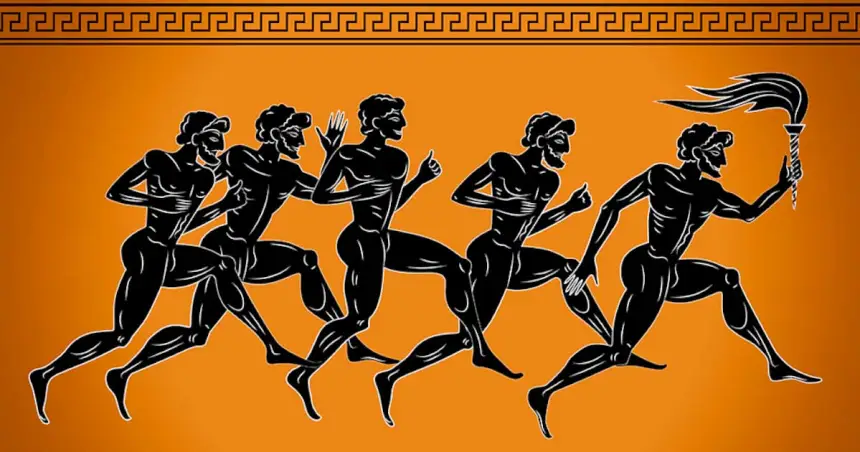
The image of modern Olympic athletes wrapped in national uniforms, protected by advanced gear, and competing under tightly regulated conditions feels completely natural to us today. Yet in the ancient world, the Olympic Games followed a radically different philosophy—one that placed the human body itself at the center of spiritual, athletic, and cultural meaning. In Ancient Greece, athletes competed entirely naked. This was not a prank, not a scandal, and not an odd exception. It was the norm, deeply rooted in religious belief, philosophical thought, and medical theory. The naked body symbolized purity, equality, closeness to the gods, and physical perfection. Even the very word “gymnastics” comes from the Greek gumnasía (athletic training) and gumnós (naked), preserving this forgotten tradition in our everyday language. Naked competition was believed not only to honor the gods but also to cleanse and detoxify the body through sweating, making athletic performance a spiritual, medical, and moral act at once. What seems shocking now was once considered the highest expression of human excellence.
Why Nudity Was Sacred in Ancient Athletic Culture
To fully understand why Greek athletes competed without clothing, one must first understand how the ancient Greeks viewed the body itself. Unlike later religious traditions that often treated the body as something to hide or control, Greek philosophy celebrated the physical form as a reflection of divine order. The human body was seen as something inherently noble, harmonious, and worthy of admiration. Strength, symmetry, and movement were not merely practical qualities but moral and spiritual virtues as well. By competing naked, athletes were not exposing themselves—they were honoring the ideal form crafted by nature and shaped by discipline.
Religious belief played a central role in this perspective. Athletic contests were not merely entertainment; they were sacred rituals dedicated to the gods. Competing naked symbolized purity and vulnerability before divine powers. Clothing could conceal imperfections, status, and identity. Nudity removed these barriers, placing all competitors before the gods as equal human beings. The lack of clothing erased markers of wealth, nationality, and class, ensuring that victory could belong only to skill, strength, and dedication.
There was also a powerful symbolic distinction between Greek citizens and outsiders. Greeks associated nudity with culture, discipline, and civilized identity. In contrast, they often depicted non-Greeks as cowardly or inferior for wearing trousers and coverings during physical activity. Competing nude became a statement of Greek identity itself—an expression of superiority in both physical and cultural terms.
Medical thinking reinforced these beliefs. Greek physicians believed that the pores of the skin needed to open through sweating to release harmful substances from the body. Exercise performed naked was thought to maximize this purification process. Athletes typically coated their bodies in olive oil before competing, which helped regulate temperature, protect the skin, and enhance the detoxifying effect of sweating. After events, they scraped off the mixture of oil, sweat, and dirt using a tool called a strigil. This residue was sometimes even collected and sold for supposed medicinal use.
Thus, nudity in ancient athletics was not an accident or a novelty. It was a deliberate expression of religious devotion, philosophical worldview, medical theory, and cultural identity. To cover the body during sacred competition would have seemed unnatural—almost sacrilegious—to those who lived within this system of belief.
The Practical Origins of Nude Competition and How It Became Tradition
Although nudity in the ancient games eventually became sacred tradition, historical evidence suggests it may have started for practical reasons before being ritualized. Early athletic contests likely involved simple garments such as loincloths. According to one widely repeated story, an athlete once lost his garment during a race and continued competing without it—only to win. This incident, whether entirely factual or partly mythical, highlights a core practical principle: clothing hindered movement.
In ancient events such as sprinting, wrestling, boxing, and long jumping, fabric could snag, restrict joints, or offer opponents something to grab. Naked skin provided freedom of motion and reduced the risk of entanglement. Over time, athletes likely realized that removing clothing offered a genuine performance advantage. What began as a functional decision gradually evolved into an accepted standard and, eventually, into a ritual law of competition.
Once nudity was normalized, it became embedded into training culture as well. Greek athletic schools, called gymnasia, were explicitly designed for naked exercise. Young men trained in the nude under the supervision of coaches, philosophers, and physicians. These spaces were not merely physical training centers but also social and intellectual institutions where ideas about citizenship, ethics, and discipline were passed from one generation to the next. To train clothed in such an environment would have seemed not only impractical but socially deviant.
The transition from practical convenience to spiritual necessity happened as athletics merged more deeply with religious worship. Athletic festivals became offerings to the gods, and athletes themselves were viewed as living sacrifices of strength and endurance. Nudity enhanced this symbolism, reinforcing the idea that nothing stood between human effort and divine judgment.
It is important to note that this tradition applied almost exclusively to male athletes. Women were barred from attending or competing in the most sacred athletic festivals, and in some cases were forbidden even from watching. The naked male body became the central object of athletic and cultural admiration, reinforcing gender boundaries that were rigid and unequal by modern standards.
What is remarkable is how quickly this practice became unquestioned. By the classical period, the idea of clothed competition would have seemed strange, cowardly, or even immoral. Nudity had moved far beyond convenience into the realm of moral expectation. It became one of the defining features of Greek athletic life—so much so that centuries later, language itself preserved the connection between nakedness and structured physical training.
The Spiritual Purpose: Competing as an Offering to the Gods
In the ancient world, sport and religion were inseparable. Athletic festivals were not staged for entertainment alone; they were acts of worship. Every race, wrestling match, and throwing event was performed as an offering to the gods, particularly those associated with strength, war, and vitality. To compete was to enter into a sacred dialogue with divine forces.
Nudity played a critical role in this religious relationship. Standing naked before the gods symbolized honesty, humility, and absolute exposure. The athlete could not hide behind armor, fabric, or symbols of rank. Victory meant that the gods had judged one’s natural physical form—and its training—as worthy. Defeat, likewise, was interpreted as divine verdict. The body became a living prayer.
This connection was reinforced through ritual. Before competitions, athletes made sacrifices and prayers. After victories, they dedicated trophies, statues, and offerings to the gods. Some champions even commissioned sculptures of their naked bodies to stand in sacred spaces, immortalizing physical perfection as evidence of divine favor. These statues did not represent shame—they represented ideal humanity elevated by divine approval.
Even pain and injury took on religious meaning. Blood spilled during competition was considered a form of sacrifice. Endurance through suffering demonstrated a willingness to confront the limits of mortal flesh in pursuit of divine approval. Nudity intensified this symbolism by transforming every bruise, scar, and strain into visible testimony of devotion.
The connection between nudity and divine closeness was not abstract. The Greeks believed that the gods themselves possessed perfected, immortal bodies. By displaying the human form in its most refined athletic state, competitors were believed to mirror the gods themselves—bridging the gap between humanity and divinity through disciplined flesh.
Thus, naked competition was not indecent within its original context. It was sacred. To conceal the body would have implied distrust of the gods or shame in one’s physical form. The athlete’s nakedness was an act of faith as much as of strength.
Detoxification, Sweat, and Ancient Medical Beliefs
Beyond spiritual symbolism, ancient medical theory gave nudity an important health function. Greek medicine was built around the idea of balancing bodily fluids, regulating internal heat, and expelling harmful substances. Sweat was considered one of the body’s most powerful cleansing mechanisms. Exercise without clothing allowed sweat to flow freely, opening pores and flushing out what physicians believed were toxic humors.
Olive oil played a crucial role in this process. Athletes massaged oil into their skin before training and competition. This oil protected against sun exposure, reduced friction, and enhanced the warming of muscles. As the athlete exercised, sweat mixed with the oil and trapped dirt, dead skin, and impurities. Afterward, they scraped the mixture off with a strigil in long, deliberate strokes. The result was a thorough external cleansing ritual tied directly to physical exertion.
This process was believed not just to clean the skin but also to regulate internal health. Sweating was thought to release excess heat and harmful substances that caused disease. Exercise performed naked was therefore seen as superior medicine to exercise performed clothed, because garments were believed to block the skin’s ability to breathe and release impurities.
Public bathing was another extension of this philosophy. After training, athletes often bathed in cold or warm pools to further regulate bodily balance. Nakedness remained essential throughout this entire health cycle—exercise, scraping, and bathing. Clothing was viewed as something that trapped corruption against the skin rather than protecting it.
Even diet and athletic performance were shaped by these principles. Foods were classified by their perceived effects on heat, moisture, and bodily balance. Training regimes were carefully designed to harmonize movement, sweat, and nutrition. All of this rested on the assumption that the naked body, properly exercised, represented the healthiest possible human state.
While modern science interprets detoxification very differently, the cultural logic of the time was coherent and deeply influential. Nudity was not merely tolerated in sport—it was essential to both spiritual closeness and physical purification.
The Language of Nudity: How “Gymnastics” Preserved This Forgotten Reality
One of the most enduring traces of this ancient tradition exists quietly in our modern vocabulary. The word “gymnastics” comes directly from gumnasía, which meant athletic training, and gumnós, which meant naked. In other words, the original meaning of gymnastics was literally “naked training.”
This linguistic root reveals how deeply nudity was embedded in the very concept of structured physical exercise. To train the body meant to train it without concealment. Training naked was not an optional variation—it was the defining feature of proper athletic practice.
The same root appears in other related words as well. Gymnasium originally referred not to a modern indoor workout facility, but to a public complex where naked youths were trained in physical and intellectual disciplines. Over time, cultural attitudes shifted. As Roman influence spread and later Christian moral frameworks reshaped European societies, public nudity in athletics gradually disappeared. Clothing returned as a marker of modesty, social order, and gender separation.
Yet the language remained. Even now, when people attend a gym fully clothed and separated by strict codes of decorum, the word they use traces directly back to a world where naked bodies were the foundation of athletic excellence.
This linguistic survival is important because it preserves a truth that visual culture often forgets. Ancient athletics were not merely earlier versions of modern sports. They operated under fundamentally different assumptions about the body, morality, and the sacred. Every time the word “gymnastics” is spoken, it unintentionally carries with it the memory of naked training—that original fusion of sweat, devotion, and exposure.
Language, in this sense, becomes a historical fossil. It holds evidence of cultural meanings long after those meanings themselves have disappeared. The fact that so few people today associate gymnastics with nudity demonstrates how completely Western attitudes toward the body have been transformed over two millennia.
Why Modern Society Finds Ancient Nude Competition So Shocking
For modern audiences, the idea of thousands of naked athletes competing publicly feels scandalous, even absurd. This reaction reveals how deeply contemporary cultural values differ from those of the ancient world. Today, nudity is often associated with sexuality, vulnerability, or indecency. Public nakedness is typically restricted to specific adult contexts or categorized as social deviance.
In the ancient Greek world, however, nudity was not primarily sexualized in the modern sense. It was normalized within specific social and ritual boundaries. The athlete’s nakedness did not invite erotic interpretation in the same way that modern media often does. Instead, it symbolized discipline, health, youth, and civic honor.
This difference highlights how moral meaning is shaped by cultural framing rather than the body itself. The same human form that ancient Greeks celebrated as sacred performance now triggers discomfort because modern societies attach different meanings to exposure.
It is also worth noting that ancient athletic nudity was highly exclusive. It applied only to male citizens training for competition. Women were systematically excluded from both showcasing and observing these events. Their bodies were not celebrated in the same public athletic manner. This double standard reveals that ancient athletic nudity was not simply natural—it was political and hierarchical.
As modern societies became increasingly shaped by religious traditions that emphasized modesty, sin, and bodily control, the naked athlete transformed from a sacred symbol into a taboo image. When modern Olympic organizers revived international athletics in the 19th century, they deliberately rejected ancient nudity in favor of uniforms that reflected contemporary moral values. In doing so, they preserved the competitions but discarded the worldview that originally defined them.
The shock we feel today when imagining naked Olympic athletes is not a sign that ancient practices were more “primitive.” It is evidence that our symbolic relationship with the body has been radically transformed.
When Sweat, Skin, and the Sacred Were One
In the ancient world, to compete naked was not an act of scandal—it was an act of devotion. Athletes stripped away clothing not for provocation, but to stand as purified offerings before the gods, to cleanse their bodies through sweat, and to display the disciplined form as a reflection of divine harmony. The body itself was sacred, and nudity was the language through which humanity approached the divine.
The legacy of this practice survives quietly in our words, our sports, and our continued fascination with physical excellence. Even though modern values have dressed athletes in layers of fabric and cultural expectation, the ancient truth remains hidden beneath the surface: the first great athletic traditions of Western civilization were built on naked bodies, sacred sweat, and the belief that physical perfection brought humanity closer to the gods.
What once symbolized purity and reverence now feels shocking because civilizations change, meanings shift, and bodies acquire new moral boundaries. Yet for centuries, the naked athlete stood at the heart of sacred competition, proving that the earliest ideals of sport were not about modesty, but about exposure to both the limits of human flesh and the judgment of the divine.
Research and further reading
For readers who want to verify details or continue researching this subject, these external reference collections provide useful starting points: