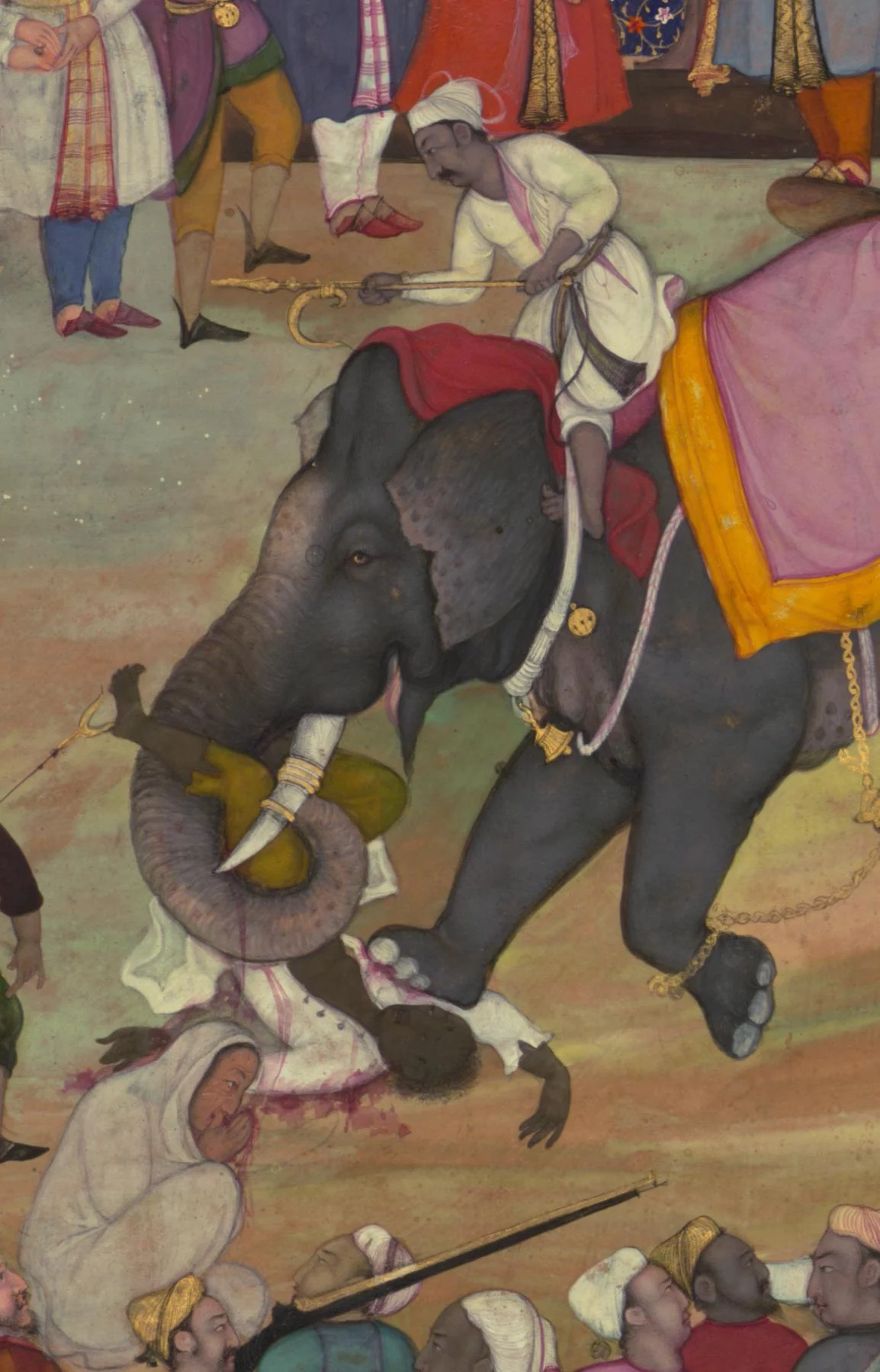
In the ancient world, methods of execution were often designed to convey far more than death alone. They were statements of power, authority, and cosmic order, intended to terrify spectators and reinforce the ruler’s absolute control over life and body. Among the most striking and unsettling of these practices was execution by elephant, a method used across large parts of Asia for centuries. Unlike swift executions meant to end life quickly, death by elephant was often slow, deliberate, and ritualized, turning punishment into public theater.
Elephants were not merely animals in these societies; they were symbols of royal power, divine authority, and military dominance. Kings rode them into battle, paraded them in religious ceremonies, and used them as living instruments of justice. Their immense size and intelligence made them uniquely suited to controlled executions. With training, elephants could crush limbs one by one, shatter skulls instantly, or prolong suffering at the command of their handler. In some regions, metal blades were even attached to tusks, transforming the animal into a mobile execution device.
What makes this practice especially remarkable is its longevity. While often associated with antiquity, execution by elephant persisted well into the early modern period and, in some regions, survived until the late nineteenth century. European observers recorded these executions with a mix of horror and fascination, struggling to comprehend a system in which punishment, spectacle, and symbolism were so deeply intertwined. Understanding this practice requires more than shock; it demands a careful look at the political, cultural, and psychological worlds that sustained it for so long.
Elephants as Symbols of Power and Cosmic Authority
To understand why elephants were used as executioners, it is essential to grasp their symbolic role in ancient Asian societies. Across South and Southeast Asia, elephants represented far more than brute strength. They were associated with kingship, divine favor, and cosmic balance. In Hindu and Buddhist traditions, elephants appeared as sacred beings, most famously in the form of Ganesha, the remover of obstacles. This spiritual significance made them ideal instruments for enforcing royal justice.
In ancient India, rulers of the Maurya Empire and later dynasties maintained large stables of war elephants. These animals were seen as extensions of the king’s will. When an elephant carried out an execution, it was not perceived as an act of random violence but as a manifestation of lawful authority. Death delivered by such a creature symbolized the crushing weight of state power descending upon those who disrupted social order.
Elephants were also uniquely suited to controlled violence. Unlike predators driven by instinct, elephants could be trained to respond precisely to commands. Mahouts, their handlers, developed complex systems of cues that allowed them to dictate how and when an execution unfolded. This control reinforced the idea that justice was deliberate, measured, and sanctioned by the ruler. The elephant was not acting on its own; it was enforcing the law.
Public executions by elephant were often staged in central squares or palace grounds. The spectacle served as a warning, reminding subjects of the consequences of rebellion, treason, or sacrilege. At the same time, the use of a revered animal lent an aura of inevitability to the punishment. The condemned was not simply killed by human hands but was crushed by a force that seemed both natural and divinely ordained.
Training Elephants to Kill on Command
The effectiveness of execution by elephant depended entirely on training, and this training was both sophisticated and chilling. Elephants used for executions were typically adult males, chosen for their size, strength, and temperament. From a young age, they were conditioned to obey specific verbal commands, gestures, and tools wielded by their mahout. Over time, these commands could be refined to control the exact manner of execution.
Historical accounts describe elephants trained to place a foot gently on a victim’s chest, applying gradual pressure until bones began to crack. This slow method prolonged suffering and heightened the spectacle for onlookers. In other cases, elephants were instructed to crush the skull instantly, ending life in seconds. The choice of method often reflected the nature of the crime. Traitors and rebels might be subjected to prolonged deaths, while lesser offenders received quicker executions.
In some regions, elephants were taught even more precise actions. They could seize limbs with their trunks and tear them from the body or toss victims into the air before trampling them. These displays were not random acts of cruelty but carefully choreographed performances. The elephant responded only when commanded, stopping immediately if ordered to do so. This ability to halt an execution at the last moment reinforced the ruler’s image as the ultimate arbiter of mercy and death.
European travelers were particularly struck by the intelligence elephants displayed during these executions. Many noted that the animals appeared aware of their role and executed commands with unsettling calmness. This perception further elevated the symbolic power of the act. The elephant was not merely a beast but a disciplined servant of the state, capable of carrying out justice with terrifying precision.
Regional Variations Across Asia
Execution by elephant was not confined to a single culture or region. Variations of the practice appeared across South Asia, Southeast Asia, and parts of the Middle East, each shaped by local traditions and political structures. In the Indian subcontinent, the method was widely used by Hindu, Buddhist, and later Muslim rulers, including emperors of the Mughal Empire.
Mughal emperors used elephants as both symbols of imperial grandeur and tools of punishment. Court chroniclers recorded executions in which elephants crushed criminals underfoot before assembled crowds. Some Mughal rulers were known to spare condemned prisoners at the last moment, ordering the elephant to stop. This dramatic display emphasized the emperor’s absolute authority and capacity for mercy.
In Southeast Asia, particularly in regions corresponding to modern-day Thailand and Myanmar, elephants were deeply embedded in royal culture. Executions by elephant were often tied to offenses against the crown or violations of sacred law. The ritual nature of these punishments reflected local beliefs about harmony between ruler, land, and cosmos.
On the island of Sri Lanka, elephants played a prominent role in both warfare and justice. Historical records describe executions carried out in ceremonial contexts, sometimes accompanied by religious rites. These regional variations demonstrate that while the method was widespread, its meaning and presentation were shaped by local values and power structures.
Bladed Tusks and the Evolution of Execution Techniques
One of the most striking evolutions in execution by elephant was the use of metal blades attached to tusks. These blades transformed the elephant into an even more lethal and precise executioner. Accounts from India and Persia describe curved or straight blades affixed securely to the tusks, allowing the animal to dismember or decapitate victims with a single motion.
The introduction of bladed tusks reflected both technological innovation and shifting attitudes toward punishment. While crushing deaths emphasized overwhelming force, bladed executions highlighted efficiency and spectacle. A swift sweep of the head could sever a limb or end a life instantly, producing a dramatic and unforgettable display. These executions were often reserved for high-profile criminals or political enemies.
European observers in the eighteenth and nineteenth centuries were particularly fascinated by these devices. Travel journals and colonial reports described them in vivid detail, often with illustrations that circulated widely in Europe. These images contributed to the exoticized and sensationalized view of Asian justice systems, reinforcing stereotypes while overlooking the cultural logic behind the practice.
Despite their brutality, bladed tusk executions were still governed by strict control. The elephant acted only on command, and the blades were symbols of royal authorization. Their use underscored the ruler’s ability to innovate in matters of punishment, adapting ancient traditions to new political realities while maintaining the underlying message of absolute power.
Survival into the Nineteenth Century and Colonial Reactions
Although often labeled an ancient practice, execution by elephant survived far longer than many assume. In parts of India and Southeast Asia, it continued into the eighteenth and nineteenth centuries, well into the era of European colonial expansion. British officials in India recorded instances of elephant executions, sometimes with disapproval, sometimes with grim fascination.
Colonial authorities generally viewed the practice as barbaric, using it to justify claims of moral and civilizational superiority. At the same time, they recognized its effectiveness as a deterrent. In some regions, British administrators initially tolerated or even allowed traditional punishments to continue under indirect rule. Over time, however, colonial legal reforms sought to abolish such practices and replace them with European-style judicial systems.
The decline of execution by elephant was gradual rather than abrupt. As centralized colonial administrations expanded and modern penal codes were introduced, public spectacles of punishment became less acceptable. Elephants were increasingly relegated to ceremonial roles, labor, or military display rather than instruments of justice.
By the late nineteenth century, execution by elephant had largely disappeared, surviving only in historical memory and scattered accounts. Its longevity, however, speaks to its deep integration into systems of power, symbolism, and social control. It was not merely a method of killing but a language through which rulers communicated authority.
Violence, Symbolism, and the Nature of Justice
Execution by elephant stands as one of the most haunting examples of how justice, power, and symbolism intertwined in ancient and early modern Asia. Far from being an act of uncontrolled cruelty, it was a carefully managed ritual designed to reinforce social order and royal authority. The elephant’s immense strength, intelligence, and cultural significance made it the perfect embodiment of state power.
While modern sensibilities rightly recoil at such punishments, understanding them requires stepping beyond moral shock and examining the worlds that produced them. These executions were messages, not just deaths. They reminded subjects of the ruler’s reach, the consequences of defiance, and the fragile boundary between mercy and destruction.
The eventual disappearance of execution by elephant reflects broader transformations in legal thought, governance, and human rights. Yet its legacy remains a powerful reminder that justice has not always been about fairness or rehabilitation. In many societies, it was about spectacle, fear, and the visible assertion of control. Studying this practice offers a sobering glimpse into humanity’s past and the evolving meaning of punishment.
Research and further reading
For readers who want to verify details or continue researching this subject, these external reference collections provide useful starting points: