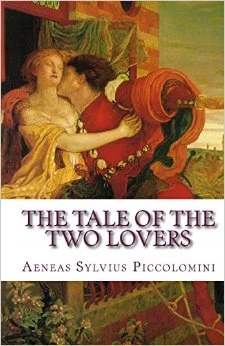
Few works from the fifteenth century feel as surprising to modern readers as The Tale of Two Lovers. Known in its original Latin as Historia de duobus amantibus, this short novel once circulated across Europe with remarkable speed, earning a reputation as one of the true bestsellers of its age. What makes it even more striking is not only its romantic and sensual subject matter, but also its author: Aeneas Silvius Piccolomini, the man who would later ascend the papal throne as Pope Pius II. The contrast between the worldly humanist writer and the future head of the Catholic Church has fascinated historians for centuries, and it invites deeper questions about morality, literature, and cultural taste in the late Middle Ages. Far from being an embarrassing youthful mistake, The Tale of Two Lovers offers a window into the intellectual and emotional life of Renaissance Europe as it stood on the threshold between medieval tradition and modern sensibility.
Aeneas Silvius Piccolomini Before the Papacy
To understand The Tale of Two Lovers, it is essential to understand the man who wrote it before he became Pope Pius II. Aeneas Silvius Piccolomini was born in 1405 in the Tuscan town of Corsignano, later renamed Pienza in his honor. He came from a noble but impoverished family, and his early life was shaped by the need to secure patronage through education and talent. Piccolomini studied classical literature, rhetoric, and philosophy, immersing himself in the humanist revival that swept through Italy in the fifteenth century. At this stage of his life, he was far removed from the image of a stern churchman. He worked as a secretary, diplomat, poet, and orator, traveling widely across Europe and absorbing the customs and ideas of different courts.
During these years, Piccolomini wrote prolifically. His output included political treatises, personal letters, historical works, poems, and fictional narratives. He was deeply influenced by classical Roman authors such as Ovid, Virgil, and Cicero, whose works treated love and desire as central elements of human experience. Writing about romance was not, for him, a transgression but a continuation of a respected literary tradition. His personal correspondence from this period reveals a man who understood love not only as a spiritual bond but also as a powerful emotional and physical force. This worldview shaped The Tale of Two Lovers, which he composed around 1444 while serving at the imperial court of Frederick III.
It is important to note that Piccolomini’s later religious career did not erase his earlier identity. When he became Pope Pius II in 1458, he acknowledged his youthful writings openly. Rather than denying them, he framed his life as a moral journey, reflecting the medieval Christian ideal of personal transformation. This context helps modern readers see The Tale of Two Lovers not as a scandal, but as a product of a complex and intellectually vibrant era.
The Story and Its Literary Character
The Tale of Two Lovers centers on the doomed romance between Euryalus, a young nobleman, and Lucretia, a married woman living in Siena. Set against the backdrop of real historical events, the narrative blends fiction and reality in a way that appealed strongly to contemporary audiences. The lovers meet through social connections, exchange letters filled with longing and wit, and pursue their relationship despite the social and moral constraints surrounding them. Although the story contains erotic undertones, its sensuality is conveyed through suggestion, emotion, and psychological tension rather than explicit description. This approach allowed the work to circulate widely without provoking outright condemnation.
What distinguishes the novel is its emotional realism. Piccolomini devotes considerable attention to the inner lives of his characters, especially Lucretia, whose conflict between desire, duty, and reputation is portrayed with unusual sensitivity for the time. Rather than presenting her simply as a moral warning, the author allows readers to sympathize with her struggle. Euryalus, too, is depicted as more than a reckless seducer; he is a young man torn between ambition and affection. Their correspondence forms the heart of the story and reflects Piccolomini’s mastery of rhetorical style.
The tragic ending reinforces the moral complexity of the tale. The lovers’ relationship cannot survive the pressures of society, and separation leads to illness and death. This conclusion aligns the novel with medieval moral traditions, in which illicit love often ends in suffering. At the same time, the vivid depiction of passion and loss gives the story a human depth that feels strikingly modern. Readers were invited not only to judge the lovers, but also to feel their pain. This balance between moral reflection and emotional engagement was key to the book’s enduring popularity.
Eroticism, Morality, and Medieval Taste
Modern readers may wonder how an erotic novel could become a bestseller in a deeply religious society. The answer lies in how sexuality and literature were understood in the fifteenth century. Medieval culture did not draw the same sharp line between sacred and secular that exists today. While the Church officially promoted chastity and marital fidelity, literature often explored desire as a powerful, even dangerous, aspect of human nature. Works about love served both as entertainment and as moral instruction, showing the consequences of passion when it defied social norms.
In The Tale of Two Lovers, eroticism functions as an emotional force rather than a visual spectacle. Piccolomini uses longing, anticipation, and secrecy to create intimacy between his characters. These elements were familiar to readers of courtly romance, a genre that had flourished since the twelfth century. What made Piccolomini’s work stand out was its realism. The lovers inhabit recognizable cities, face believable risks, and express themselves in language that feels personal and immediate. This realism gave the story a sense of authenticity that resonated with readers across social classes.
The book’s popularity also reflects the growing influence of humanism. Humanist writers emphasized individual experience, emotional expression, and the study of classical texts. Piccolomini’s treatment of love owed much to ancient Roman models, particularly Ovid’s Heroides and Ars Amatoria, which explored desire through letters and poetic reflection. By framing erotic love within a learned literary tradition, he made it respectable as well as compelling. This blend of moral seriousness and emotional candor explains why The Tale of Two Lovers could circulate widely without being dismissed as mere scandal.
Bestseller Status in Fifteenth-Century Europe
Calling The Tale of Two Lovers a bestseller is not an exaggeration, even by modern standards. In the fifteenth century, before the widespread use of the printing press, a text’s popularity was measured by how often it was copied, shared, and referenced. Piccolomini’s novel survives in numerous manuscript copies, indicating a broad and enthusiastic readership. After the advent of print in the second half of the century, the work was among the early texts to be published repeatedly, further expanding its reach.
The reasons for its success were multiple. The story’s emotional intensity made it appealing to readers seeking more than dry moral instruction. At the same time, its Latin prose ensured that it circulated among educated elites, including clerics, scholars, and courtiers. This dual appeal was rare. Many medieval love stories were written in vernacular languages and aimed at a popular audience, while Latin texts often remained scholarly and detached. Piccolomini bridged this gap, offering a sophisticated narrative that still felt intimate and engaging.
Another factor was the author’s growing fame. As Piccolomini advanced in his political and ecclesiastical career, interest in his earlier writings increased. Readers were intrigued by the idea that a respected diplomat and future pope had once written such a passionate story. Rather than diminishing the novel’s reputation, this biographical detail enhanced it, turning the book into a conversation piece. In a culture where texts were often read aloud and discussed socially, The Tale of Two Lovers became both entertainment and intellectual stimulus, securing its place as one of the most widely read fictional works of its century.
Reassessment After Piccolomini Became Pope Pius II
When Aeneas Silvius Piccolomini was elected pope in 1458, his earlier writings inevitably came under renewed scrutiny. As Pope Pius II, he adopted a more openly moralizing tone, particularly in his later works, which emphasized Church reform and Christian unity. However, he did not repudiate The Tale of Two Lovers. Instead, he treated it as part of his personal history, acknowledging that it reflected a different stage of his life. This honesty was unusual and contributed to his reputation as one of the most humanly complex popes of the Renaissance.
Over time, the novel’s reputation shifted. In more conservative periods, it was sometimes viewed as an embarrassing relic, while in others it was celebrated as evidence of the Church’s engagement with human experience. Modern historians tend to see it as a key text for understanding the cultural transition from medieval to Renaissance values. It reveals how educated Europeans could appreciate sensuality, emotional depth, and literary artistry without abandoning moral reflection.
Today, The Tale of Two Lovers is studied not primarily for its erotic content, but for what it reveals about authorship, readership, and identity in the fifteenth century. The fact that its author later became pope adds a layer of irony, but also of insight. It reminds us that historical figures were not static symbols but evolving individuals shaped by their experiences. In this sense, the novel continues to speak to modern readers, offering a nuanced portrait of love, ambition, and personal transformation.
Conclusion
The Tale of Two Lovers stands as one of the most intriguing literary works of the fifteenth century. Its combination of emotional realism, moral tension, and elegant prose explains why it captivated so many readers in its own time. Written by a man who would later become Pope Pius II, the novel challenges modern assumptions about medieval attitudes toward love and literature. Rather than existing in opposition to religious life, the story reflects a culture in which human experience, including desire, was explored thoughtfully and artistically. As both a bestseller and a historical document, The Tale of Two Lovers continues to offer valuable insight into a world on the edge of profound cultural change.
Research and further reading
For readers who want to verify details or continue researching this subject, these external reference collections provide useful starting points: