Before the legions ever set foot on the misty shores beyond Gaul, Britain occupied a strange place in the Roman imagination. It hovered somewhere between myth and geography, rumor and ambition. For many Romans of the late Republic, Britain was not a clearly defined island at the edge of the known world, but a vague northern idea, shaped by sailors’ tales, traders’ exaggerations, and the limits of Mediterranean knowledge. Some believed it was merely the northern extension of the European mainland, a cold and windswept fringe of an unknown continent. Others imagined it as a land of extraordinary wealth, rich in metals, pearls, and untapped resources. A great many simply doubted that it existed at all. Into this fog of uncertainty stepped Julius Caesar, whose decision to cross the Channel in 55 BC would permanently alter how Rome understood the world beyond its frontiers.
Britain at the Edge of the Roman World
In the first century BC, Roman geographical knowledge was impressive by Mediterranean standards, yet deeply uneven. The empire-in-the-making understood the lands around the Mediterranean Sea with considerable precision, but areas beyond were often defined more by speculation than observation. Britain lay at the extreme northwest of this mental map. Greek writers such as Pytheas of Massalia had claimed to visit the island centuries earlier, but their accounts were controversial and frequently dismissed by later scholars as fantasy. Pytheas spoke of tides, frozen seas, and distant islands, ideas that sounded implausible to readers who had never experienced such phenomena. By Caesar’s time, these older texts survived more as curiosities than as trusted sources.
For Roman elites, Britain represented the ultimate edge of the known world, a place where familiar rules might not apply. The Atlantic itself was viewed with suspicion, imagined as a vast, dangerous ocean very different from the relatively calm Mediterranean. This sense of distance and danger fed doubts about Britain’s very existence. Many Romans assumed that if such a large island truly existed, it would have been conquered or colonized long before. Others believed Britain was simply the northern coast of Gaul, poorly understood and exaggerated by sailors who mistook peninsulas for islands.
At the same time, trade contacts complicated this skepticism. British tribes had long-standing commercial ties with Gaul, exporting metals, hides, and slaves. These goods reached Roman markets indirectly, suggesting a real land somewhere beyond the Channel. Yet indirect trade did little to clarify Britain’s geography. Merchants were more interested in profit than in accurate descriptions, and their stories often grew richer with each retelling. As a result, Britain remained both present and unreal in Roman thought: economically relevant, yet geographically elusive.
Myths, Rumors, and Imagined Riches
The uncertainty surrounding Britain made it fertile ground for myth-making. In Roman society, distant lands were often imagined as extremes, either barbaric wastelands or places of extraordinary abundance. Britain managed to be both at once. Some writers described its inhabitants as fierce, tattooed warriors living in a harsh climate, barely touched by civilization. Others emphasized the island’s supposed wealth, especially its tin, a crucial component in bronze production. Tin from the far west had been traded since the Bronze Age, and Britain was rumored to be one of its primary sources.
These tales of wealth fed Roman curiosity and ambition. The idea that Britain might be overflowing with resources conveniently aligned with Rome’s expansionist mindset. Conquest was often justified not only by security concerns but also by promises of economic gain. A land of “unbelievable riches” made for an appealing target, even if those riches were largely imaginary. Exaggeration played a key role here. Pearls from British rivers, for instance, were said to rival those of the East, though in reality they were dull and unimpressive compared to Mediterranean standards.
At the same time, myths about Britain’s geography persisted. Some believed it was so large that it extended far into the northern ocean, perhaps even connecting to unknown lands beyond. This idea of Britain as the “foot” of a massive northern continent reflected Rome’s limited understanding of northern Europe. Without reliable maps or firsthand accounts, imagination filled the gaps. These rumors were not harmless curiosities; they shaped strategic thinking. A vast, connected landmass might pose future threats or opportunities, making Britain more than just an isolated curiosity.
Julius Caesar’s Motives for Crossing the Channel
When Julius Caesar decided to invade Britain, his motives were complex and deeply political. Officially, he claimed that British tribes had supported his Gallic enemies, providing warriors and refuge. From a military standpoint, this offered a plausible justification for intervention. However, the timing and scale of his expeditions suggest that reputation mattered just as much as security. By the mid-50s BC, Caesar was already a celebrated commander in Gaul, but he needed new achievements to maintain his political momentum back in Rome.
Invading Britain promised something unprecedented. No Roman general had ever led an army there. Even a limited expedition would allow Caesar to claim that he had crossed the boundaries of the known world. In a competitive political environment, symbolic victories could be as valuable as territorial ones. Britain’s mysterious reputation amplified this effect. Conquering a well-known enemy was impressive, but venturing into a land many doubted existed was extraordinary.
There was also an element of reconnaissance. Caesar understood that knowledge itself was power. Even if Britain could not be conquered outright, gathering intelligence about its people, terrain, and resources would benefit Rome in the long term. His expeditions were relatively small compared to his Gallic campaigns, suggesting caution rather than full commitment. He was testing the waters, both literally and figuratively.
Finally, personal ambition cannot be ignored. Caesar was acutely aware of how history remembered great men. Alexander the Great had reached the edges of the known world in the east; Britain represented a western equivalent. By sailing north into the Atlantic, Caesar positioned himself as a conqueror of boundaries, not just of armies. This desire for lasting fame would shape how his invasions were recorded and remembered.
The First Invasion of 55 BC
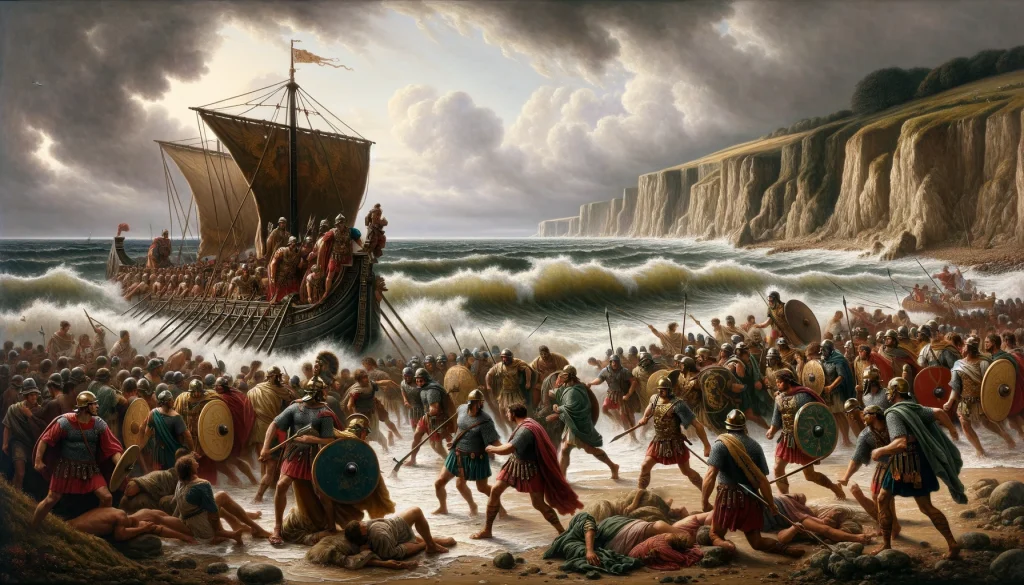
Caesar’s first crossing to Britain in 55 BC was brief, risky, and far from a clear success. He departed from the Gallic coast with a relatively small force, uncertain of what awaited him on the other side. Even the crossing itself was challenging. Roman ships, designed for Mediterranean conditions, struggled in the Channel’s unfamiliar tides and currents. When the fleet arrived, it faced immediate resistance from British warriors gathered along the shore, forcing the Romans to land under fire.
The encounter revealed how unprepared Caesar was for Britain’s environment. The Britons used chariots effectively, a form of warfare unfamiliar to Roman troops. Combined with difficult terrain and limited cavalry support, this made establishing a secure foothold difficult. Matters worsened when a storm damaged many Roman ships, threatening Caesar’s ability to return to Gaul. Faced with these challenges, he opted for a cautious approach, engaging in skirmishes rather than attempting a decisive battle.
Despite its limitations, the first invasion achieved important symbolic goals. Caesar demonstrated that Britain was real, reachable, and inhabited by organized societies capable of resisting Rome. He negotiated hostages and alliances with some tribes, framing the expedition as a diplomatic and military success upon his return. In Rome, news of the crossing was celebrated with public thanksgiving, reinforcing Caesar’s image as a trailblazer.
However, the reality was more ambiguous. The Romans withdrew without establishing permanent control, and many of the agreements made were fragile. Yet the psychological barrier had been broken. Britain was no longer a mythical land beyond the edge of the world; it was a place Roman soldiers had seen, fought in, and survived.
The Second Invasion of 54 BC
Determined to solidify his achievement, Caesar returned to Britain the following year with a larger and better-prepared force. The second invasion of 54 BC was more ambitious, involving multiple legions and improved logistical planning. Caesar had learned from his earlier mistakes, bringing more cavalry and taking greater precautions to protect his fleet. This time, the landing was less contested, allowing the Romans to push inland more effectively.
The campaign brought Caesar into contact with powerful British leaders, most notably Cassivellaunus, who coordinated resistance across several tribes. The fighting was intense but uneven. Roman discipline and organization proved superior in open engagements, yet the Britons avoided direct confrontation whenever possible, relying on mobility and local knowledge. Caesar responded with a mix of force and diplomacy, punishing hostile groups while rewarding those willing to submit.
Once again, the goal was not permanent conquest. Caesar advanced far enough to demonstrate Roman dominance, crossed major rivers, and forced Cassivellaunus to seek terms. Hostages were taken, and promises of tribute were made. With winter approaching and unrest brewing in Gaul, Caesar chose to withdraw. His departure marked the end of direct Roman military involvement in Britain for nearly a century.
From a strategic perspective, the second invasion reinforced the lessons of the first. Britain was not an easy target, and full conquest would require sustained commitment. From a symbolic standpoint, however, Caesar had succeeded. He could now claim to have subdued Britain, however loosely, and expanded Rome’s influence beyond any previous limit.
How Rome Reimagined Britain After Caesar
Caesar’s expeditions transformed Britain’s place in Roman thought. Doubt gave way to a new, more concrete image of the island. It was no longer a rumored extension of some unknown continent but a distinct land with identifiable peoples, leaders, and landscapes. Caesar’s own writings played a crucial role in shaping this perception. His accounts described Britain’s geography, climate, and customs with an air of authority, even when details were selective or exaggerated.
These descriptions entered Roman education and literature, influencing how later generations understood the island. Britain became part of Rome’s mental map, even if it remained beyond direct control. The idea of future conquest lingered, turning Britain into a kind of unfinished project. Emperors could look back to Caesar’s achievements as both precedent and challenge, a reminder that the island had been reached but not fully claimed.
Economically and diplomatically, contacts continued. Trade expanded, and Roman goods became more common among British elites, subtly extending Roman influence without formal annexation. This gradual integration set the stage for the eventual conquest under Emperor Claudius in AD 43. When Roman legions returned decades later, they did so with better knowledge and clearer expectations, thanks in large part to Caesar’s earlier ventures.
Perhaps most importantly, Caesar’s invasions reshaped Roman confidence. If Britain existed and could be reached, then the limits of the world were broader than once believed. This shift encouraged further exploration and expansion, reinforcing Rome’s self-image as a civilization destined to master the unknown.
Why this episode still matters
The story of Rome’s first encounters with Britain is one of imagination giving way to experience. Before Julius Caesar, Britain existed in Roman minds as a rumor, a fantasy, or a convenient exaggeration. His invasions in 55 and 54 BC did not conquer the island, but they did something arguably more important: they made Britain real. By crossing the Channel, Caesar turned speculation into knowledge and myth into history.
These expeditions reveal much about the Roman worldview. They show how uncertainty, ambition, and storytelling shaped decisions at the highest levels. Britain’s imagined riches and doubtful existence made it an ideal stage for a commander seeking glory. In confronting the unknown, Caesar not only expanded Rome’s horizons but also his own legacy. Long after his legions withdrew, the idea of Britain remained firmly anchored in Roman consciousness, waiting for the moment when myth would finally give way to empire.
Research and further reading
For readers who want to verify details or continue researching this subject, these external reference collections provide useful starting points: