John Snow Broad Street pump is a revealing historical subject because it opens a clear path into the people, events, and wider changes that shaped its era.
On a warm September day in 1854, a neighborhood in Soho was quietly turning into one of the most important laboratories in the history of medicine. Families lived above workshops, children played in narrow streets, and everyone depended on the same shared water source: the Broad Street pump. Then cholera struck with terrifying speed. Within days, the area around the pump was filled with illness and panic, and a London physician named John Snow saw in the chaos something that others had missed. This was not just a tragedy. It was a clue.
The Broad Street outbreak became famous because it did more than reveal the source of one deadly epidemic. It helped change how people thought about disease itself. At a time when many doctors still believed cholera floated through foul air, Snow argued that it was being carried through contaminated water. To prove it, he did something remarkably modern: he mapped the cases, searched for patterns, compared locations, and used evidence to trace an invisible threat. In effect, he treated an outbreak like a crime scene.
That approach did not instantly end debate, and Snow did not see all of his ideas accepted in his lifetime. But the Broad Street pump investigation became a landmark in the History of Science & Technology because it showed how data, geography, and careful observation could expose the true path of disease. It was a turning point not just for cholera, but for public health as a whole.
The Soho outbreak that turned a neighborhood into a scientific test case
The cholera outbreak centered on Broad Street, now Broadwick Street, in the summer and early autumn of 1854. Soho was a densely packed part of London, full of workers, artisans, lodging houses, shops, and shared courtyards. Like much of the city, it was crowded, dirty by modern standards, and vulnerable to disease. Cholera was especially feared because it could kill with shocking speed. Victims suffered violent diarrhea, dehydration, collapse, and often death within hours or days. To Londoners, it seemed almost supernatural in its cruelty.
When the outbreak began, alarm spread quickly. Snow, already skeptical of traditional explanations, began asking practical questions. Where did the sick live? Where had they gotten their water? Were the victims linked by common habits or shared surroundings? The answers pointed again and again to the Broad Street pump. Families who drank its water were among the hardest hit, while some nearby residents who used different sources were less affected. This pattern mattered more than rumor or assumption. It suggested an external source of infection, one that was being consumed rather than breathed.
The neighborhood itself made the problem harder to see. Soho had multiple wells, various water suppliers, and many households that relied on one source for drinking but another for washing or cooking. People moved about for work, errands, and social life. In such a setting, an outbreak could look random to the eye even while following an underlying pattern. Snow understood that a careful investigator had to read the city like a map, not just observe it from street level. That insight would become one of the defining achievements of his career.
What made the outbreak so powerful as a historical event was not simply its severity. Cholera had occurred before, and London had already endured repeated epidemics. What made Broad Street different was that Snow seized the moment to test an argument. If contaminated water was spreading disease, he needed to show where the cases clustered and how they related to the pump. In a city that still leaned on theories of bad air and moral decay, that was a bold move. It turned suffering into evidence.
John Snow against the miasma theory: a doctor who thought like an investigator
John Snow was not a fringe dreamer stumbling into a lucky discovery. He was a serious and methodical physician who had already built a reputation for careful work. He was deeply engaged with the science of anesthesia and known for his precision. That background mattered, because it shaped how he approached cholera. Snow did not merely suspect that the prevailing wisdom was wrong; he wanted to prove a better explanation using observation, comparison, and logic.
At the time, the dominant theory was miasma—the idea that disease arose from poisonous or foul-smelling air. Miasma theory had the advantage of seeming intuitive. Bad smells and unhealthy environments often went together, so many people assumed the odor itself was the cause. This idea influenced sanitation reforms and urban planning, but it also misdirected attention away from waterborne transmission. Snow saw the problem clearly: air might explain the smell of a district, but not the highly specific paths along which cholera seemed to travel.
Snow’s challenge to miasma theory was scientific, but it was also practical. He understood that epidemics could be studied through patterns of contact and exposure. He compared households, examined who drank from which source, and looked for exceptions. Why were some institutions spared? Why did certain groups seem less affected? One of the clearest examples he and later commentators noted was the unusual case of the Broad Street workhouse, where residents drank water from a different well and had relatively few cases despite being close to the outbreak. Such exceptions were crucial because they tested the rule. If miasma were the cause, proximity and stench alone should have been enough. But the evidence kept pointing toward ingestion.
Snow’s contemporaries did not all accept his conclusions. Scientific change rarely arrives as a clean victory. But the genius of his approach was that it allowed disease to be treated as a problem of transmission rather than atmosphere. That shift sounds obvious now, but in 1854 it was revolutionary. It helped open the door to germ theory, surveillance, and the idea that public health could be advanced not just by cleaning streets but by identifying chains of exposure. In that sense, Snow was helping invent a new kind of medical reasoning.
If this story has the feel of a detective tale, that is because Snow worked like a detective. He asked who, what, where, and how. He distrusted assumptions. He followed the evidence even when it contradicted popular beliefs. For a history of science and technology, that makes him a pivotal figure: not because he had a final answer to every disease, but because he demonstrated a method that future scientists would refine and expand.
The map that changed everything: how disease became visible
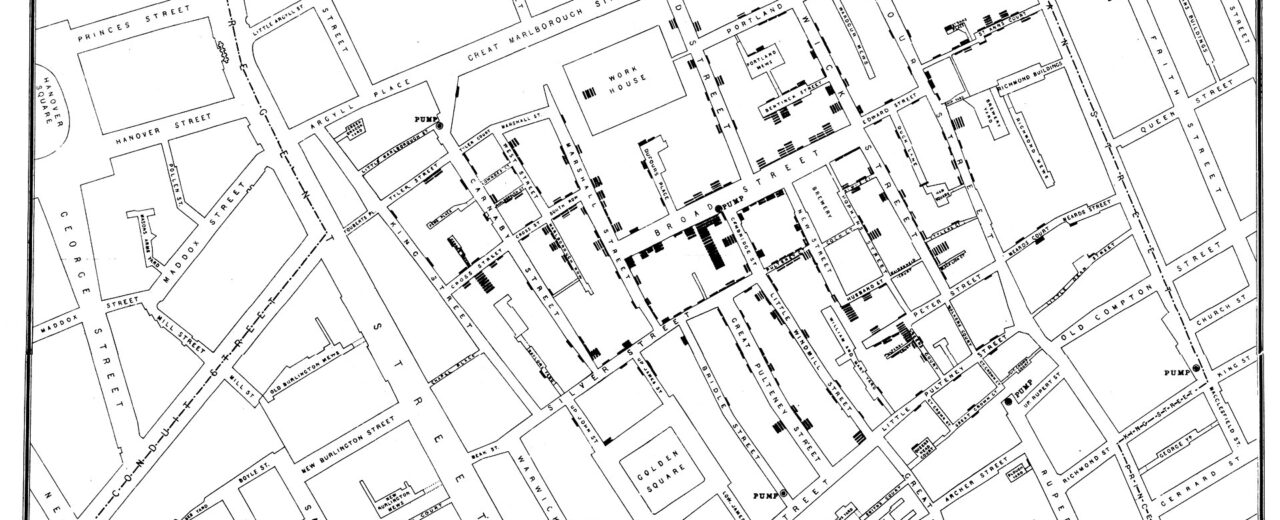
The Broad Street episode is remembered not only for Snow’s conclusions, but for the visual power of his evidence. He created a map showing cholera deaths clustered around the pump, and that image became one of the most famous in medical history. The map was not decorative. It was an analytical tool. By placing deaths in geographic relation to the water source, Snow made a hidden pattern visible at a glance. Today we take such spatial analysis for granted in public health, but in the 1850s it was a strikingly new way to reason about illness.
The map’s power lay in its simplicity. Instead of relying on abstract theory alone, Snow grounded his argument in place. The streets, buildings, and deaths formed a pattern that a reader could inspect. This was epidemiology before the discipline had a formal name in the modern sense: the disciplined study of who gets sick, where, and under what conditions. Snow’s map showed that disease could be tracked through geography, and that the spatial distribution of cases could reveal the source of an outbreak.
This method anticipated tools now used in contact tracing, outbreak modeling, and geographic information systems. Modern epidemiologists may use satellites, databases, and digital dashboards, but the logic is similar. They look for clusters. They compare exposures. They use location to understand spread. Snow’s map also helped establish that public health could benefit from visualization, not just statistics or anecdotes. In other words, he showed that seeing can be a form of knowing.
It is worth remembering that the map did not work because it was perfect. It worked because it organized evidence in a way that made the outbreak intelligible. The Broad Street cases were not randomly distributed; they radiated around a source of contamination. Snow’s map captured that structure more clearly than a page of testimony could have done. It made the disease legible to officials, physicians, and later generations of historians. In the history of science, that matters enormously. Many breakthroughs are not just new ideas; they are new ways of making reality visible.
That visual logic echoes across later scientific and technical history. Just as a machine like the Jacquard Loom helped turn patterns into programmable instructions, Snow’s map turned scattered deaths into a readable system. In both cases, pattern recognition changed what humans could understand and control. The Broad Street map was not a gadget, but it was technological in spirit: an instrument for organizing complexity.
The pump handle, the public response, and what really happened next
One of the best-known details of the story is the removal of the Broad Street pump handle. This dramatic gesture has sometimes been told as if Snow personally “solved” the outbreak in one decisive stroke. The reality is more nuanced, and that nuance makes the story even more interesting. Snow presented his evidence to local officials, and the handle was removed, which prevented people from using the pump in the ordinary way. But by then, the outbreak was already fading. Cholera is not defeated by symbolism alone, and the timing of the action means historians are careful not to overstate its immediate effect.
Still, the removal mattered. It showed that evidence could influence public action, even in a period when scientific certainty was difficult to achieve. The pump handle became a powerful emblem because it represented intervention based on inference. Officials did not need to understand every microscopic detail of disease transmission to act on the pattern Snow had identified. They could respond to risk by restricting access to a contaminated source. That is a foundational idea in public health: when the stakes are high, waiting for perfect proof can cost lives.
The broader significance of the Broad Street response was that it helped legitimize a new style of decision-making. Instead of relying only on general theories about city air, reformers could consider local evidence, distribution of cases, and specific sources of exposure. That shift made future sanitary reforms more targeted and more effective. It also strengthened the idea that government and medicine had to work together when confronting epidemics. Disease was no longer just a private misfortune or a moral failing; it was a public problem requiring organized investigation.
There is a human side to this episode that should not be lost. Behind the map were real families who suffered terrible losses. The story can be told as scientific triumph, but it was also about grief, urgency, and the desperate search for meaning. Snow’s work gave that suffering a pattern, and patterns can lead to prevention. That is part of why the Broad Street pump remains so memorable. It is a story where analysis did not stay in the study; it reached the street, the well, and the lives of ordinary people.
Why Broad Street still matters: the birth of modern epidemiology
More than any single cholera case, the Broad Street outbreak became a foundation stone for modern epidemiology because it showed how evidence could be used to trace disease in space and time. Snow did not invent public health, and he did not single-handedly end cholera. But he helped establish the method that future investigators would use to fight infectious disease: identify the source, map the spread, test competing explanations, and intervene where transmission occurs. That is the logic behind outbreak investigation today.
His work also helped shift medicine toward population-based thinking. Instead of asking only what was wrong with one patient, Snow asked how illness moved through communities. That change seems subtle, but it transformed the field. Epidemiology would eventually rely on statistics, field investigation, and geographic analysis to understand outbreaks of everything from cholera to influenza to foodborne illness. The principle remains Snow’s: disease patterns are clues, and clues can be traced.
The Broad Street story also reminds us that scientific breakthroughs often begin as challenges to common sense. Miasma theory was persuasive because smell and sickness often appeared together, but Snow was willing to ask whether correlation meant causation. That question remains central to science. It is the kind of question that has driven later advances across disciplines, from engineering to computing to public health. In that sense, Snow belongs to a larger history of people who learned to see hidden systems beneath surface appearances.
For modern readers, the enduring fascination of the Broad Street pump lies in how familiar the method now feels. We live in a world of dashboards, outbreak maps, and contact tracing. During public health crises, officials still ask where cases cluster, what people shared, and how exposure happened. Snow’s work can be read as an early blueprint for that process. It reminds us that science advances not only through laboratory discovery, but through the disciplined interpretation of the real world.
John Snow’s achievement was not just about cholera. It was about a way of thinking that could cross from one epidemic to the next. By turning a single London neighborhood into a model for investigation, he showed that public health could be evidence-driven, spatially aware, and grounded in practical intervention. That is why the Broad Street pump still occupies such an honored place in the history of science. It is the moment when disease became, in a very modern sense, mappable.
And that is why the story remains compelling today. A crowded street, a water pump, a physician with a sharp mind, and a map made from tragedy combined to change how the world understood cholera and countless diseases after it. In the end, Snow’s legacy is not a handle removed from a pump, but a method removed from ignorance. He helped transform fear into inquiry, and inquiry into public action.
Related reading: Hertha Ayrton and the mystery of the electric arc: how one overlooked engineer made public lighting safer, steadier, and less noisy, The Jacquard Loom: How a Silk-Weaving Machine Helped Invent the Logic of Modern Computing.
Research and further reading
For readers who want to verify details or continue researching this subject, these external reference collections provide useful starting points: