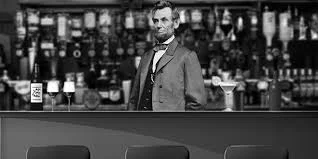
Abraham Lincoln is remembered as the rail-splitter president, the Great Emancipator, and the steady hand who guided the United States through its darkest hour. His image is carved into marble and etched into national memory as a symbol of moral clarity and perseverance. Yet long before the White House, before the law books, and before Gettysburg, Lincoln lived a life filled with experiments, failures, and unexpected turns. One of the most surprising chapters in that early life is his brief career as a licensed bartender. In 1833, at just 24 years old, Lincoln co-owned a general store and tavern known as Berry and Lincoln in the small frontier village of New Salem, Illinois. The establishment sold food, goods, and alcohol—and Lincoln himself held a legal license to sell spirits. The venture ultimately collapsed, largely because his business partner, William F. Berry, struggled with severe alcoholism and consumed much of the inventory. Though often treated as a footnote or curiosity, Lincoln’s time behind the bar offers revealing insight into his character, his relationship with alcohol, and the formative failures that shaped one of America’s most consequential leaders.
New Salem, Illinois, and Lincoln’s Life on the Frontier
In the early 1830s, New Salem was a rough-and-tumble frontier settlement perched along the Sangamon River in central Illinois. Founded with hopes of becoming a thriving commercial hub, the village was home to farmers, merchants, laborers, and ambitious young men seeking opportunity on the edge of American expansion. It was here that Abraham Lincoln arrived in 1831, fresh from a flatboat journey down the Mississippi and searching for direction in life.
New Salem offered Lincoln something he had lacked growing up on isolated farms: community. The village had a mill, blacksmith shop, schoolhouse, and several stores. Social life revolved around these spaces, particularly the tavern, which functioned as a gathering place for news, politics, and local gossip. Alcohol consumption was common and culturally accepted, especially in frontier towns where hard labor and isolation defined daily life.
Lincoln quickly became a well-known figure in New Salem. Tall, awkward, and good-humored, he impressed locals with his strength, storytelling ability, and sharp intellect. He worked various jobs, including clerk, postmaster, surveyor, and millhand. His reputation for honesty earned him the nickname “Honest Abe” long before it became a national slogan.
Despite his intelligence, Lincoln had little formal education and no clear career path at the time. Like many young men on the frontier, he experimented with business ventures in hopes of establishing financial stability. One such opportunity arose in 1833, when Lincoln partnered with William F. Berry to open a combined general store and tavern.
The decision to enter the alcohol business may seem ironic given Lincoln’s later reputation for moderation and moral seriousness. Yet in the context of New Salem, it was a practical move. Taverns were central to community life, and selling spirits was a legitimate and often profitable enterprise. Lincoln did not see bartending as undignified; he saw it as a step toward independence.
Berry and Lincoln: The Store That Sold Spirits
The business officially known as Berry and Lincoln was more than just a bar. It was a general store that sold dry goods, groceries, and liquor—typical for frontier establishments of the time. The sale of alcohol was regulated, and Lincoln held a valid license to retail spirits, making him, by definition, a licensed bartender.
William F. Berry, Lincoln’s partner, was a local man with charm and ambition but a deeply problematic relationship with alcohol. Berry handled much of the store’s operations, while Lincoln served as clerk and public-facing representative. Customers remembered Lincoln as polite, attentive, and fair. He was known for measuring drinks accurately and refusing to cheat patrons—behavior that contrasted sharply with the looser practices of many frontier taverns.
Despite Lincoln’s integrity, the business struggled almost immediately. New Salem was small, competition was fierce, and the store was undercapitalized. Worse still, Berry’s alcoholism quickly became destructive. He drank heavily, often consuming the store’s own liquor supply instead of selling it. This behavior not only drained inventory but also undermined the store’s finances and reputation.
Lincoln, who was never a heavy drinker himself, found the situation deeply frustrating. He believed in personal responsibility and self-control, values that Berry consistently violated. Yet Lincoln remained loyal to his partner longer than was wise, perhaps out of friendship or a sense of obligation.
By 1834, the store was failing. Berry and Lincoln closed their doors, leaving behind unpaid debts. For Lincoln, the collapse was financially devastating. He assumed responsibility for much of the debt—a burden that would follow him for years and which he later referred to as the “national debt,” joking grimly about its size relative to his income.
Though the venture ended in failure, Lincoln’s conduct during this period earned him respect. He did not flee or shirk responsibility. Instead, he worked tirelessly to repay creditors, reinforcing the reputation for honesty that would define his political life.
Lincoln’s Personal Relationship With Alcohol
Lincoln’s experience as a bartender did not make him a drinker. In fact, it appears to have reinforced his aversion to alcohol. Unlike many men of his time, Lincoln rarely drank and showed little interest in intoxication. Those who knew him well consistently described him as sober, restrained, and uncomfortable around excessive drinking.
His close exposure to William Berry’s alcoholism likely played a significant role in shaping these attitudes. Berry’s decline was rapid and tragic. After the store closed, Berry’s health deteriorated, and he died in 1835 at a young age, likely due to complications related to alcohol abuse. The experience left a lasting impression on Lincoln.
Throughout his life, Lincoln viewed alcohol as a potential source of personal ruin. While he did not condemn moderate drinking outright, he was deeply skeptical of excess. This perspective aligned with the growing temperance movement of the mid-19th century, which framed alcohol abuse as a moral and social danger.
As a politician, Lincoln took a measured stance. He supported temperance causes but opposed prohibition enforced through moral condemnation or legal coercion. In an 1842 temperance address, he argued that shaming drinkers only deepened their suffering and alienated them from reform. His empathy reflected personal understanding rather than abstract theory.
Lincoln’s time as a bartender gave him firsthand insight into how alcohol functioned in society—not as an abstract vice, but as a daily reality affecting real people. He saw how it brought men together, but also how it destroyed lives when unchecked. This balanced perspective allowed him to speak on the issue with unusual nuance for his era.
Rather than hypocrisy, Lincoln’s bartending chapter illustrates growth. He did not reject his past or pretend it never happened. Instead, he absorbed its lessons and carried them forward into a life defined by restraint, compassion, and responsibility.
Failure, Debt, and the Making of Character
The collapse of Berry and Lincoln was one of several early failures that shaped Abraham Lincoln’s resilience. Unlike many figures who rise smoothly to prominence, Lincoln’s path was marked by setbacks. His business failed. He fell into debt. He lost elections. He endured profound personal grief. Each experience hardened his resolve and deepened his understanding of human struggle.
The debt from the store lingered for years, forcing Lincoln to live frugally and work relentlessly. He took on surveying jobs, practiced law, and gradually rebuilt his financial standing. He never denied the debt or blamed Berry publicly, even though Berry’s alcoholism was the clear cause of the failure. This sense of accountability became a defining trait.
Frontier Illinois valued character as much as success. The fact that Lincoln honored his obligations earned him trust. Voters remembered that he paid his debts and treated people fairly—even when circumstances were against him. This trust later translated into political support.
Importantly, the store failure did not embitter Lincoln. Instead, it expanded his empathy. He understood what it meant to fail publicly, to struggle financially, and to be judged by others. These experiences made him particularly sensitive to the suffering of ordinary Americans.
When Lincoln later spoke about perseverance, humility, and moral responsibility, he did so not as an abstract philosopher but as someone who had lived those lessons. The bartender who once measured whiskey in a failing store would one day measure words carefully as president, acutely aware of how individual choices ripple outward.
Why This Story Matters to Lincoln’s Legacy
The idea of Abraham Lincoln as a bartender often surprises people because it clashes with his marble-statue image. Yet this contrast is precisely why the story matters. It reminds us that great leaders are not born fully formed; they are shaped by experience, including failure.
Lincoln’s bartending years reveal several key truths about his character. First, he was willing to work hard at ordinary jobs without shame. Second, he valued honesty even in small transactions. Third, he learned from observing human weakness rather than condemning it. Finally, he accepted responsibility when things went wrong.
These traits later defined his presidency. As the nation fractured, Lincoln refused to assign blame lightly. He understood that moral clarity did not require moral arrogance. His compassion for human frailty—visible in his approach to alcohol reform, political opposition, and even the defeated Confederacy—can be traced back to experiences like New Salem.
Rather than diminishing Lincoln, the bartender story humanizes him. It shows that the man who preserved the Union once struggled to preserve a small frontier business—and failed. That failure did not disqualify him from greatness. It prepared him for it.
From Frontier Bar to the White House
Abraham Lincoln was, indeed, a licensed bartender. In 1833, he co-owned a bar and general store in New Salem, Illinois, and legally sold alcohol to frontier customers. The business failed, largely due to his partner’s severe alcoholism, leaving Lincoln in debt and disillusioned. Yet from that failure emerged lessons that would shape his life.
Lincoln learned responsibility, restraint, empathy, and perseverance—not in the halls of power, but behind a counter measuring whiskey. He witnessed firsthand the destructive potential of addiction and the importance of personal accountability. These experiences did not vanish as he moved on; they became part of the moral foundation that guided him as lawyer, legislator, and president.
Far from being an embarrassing footnote, Lincoln’s bartending past is a reminder that greatness often grows out of humble, imperfect beginnings. The road from Berry and Lincoln to the White House was long and difficult—but every step mattered.
Leave a Reply