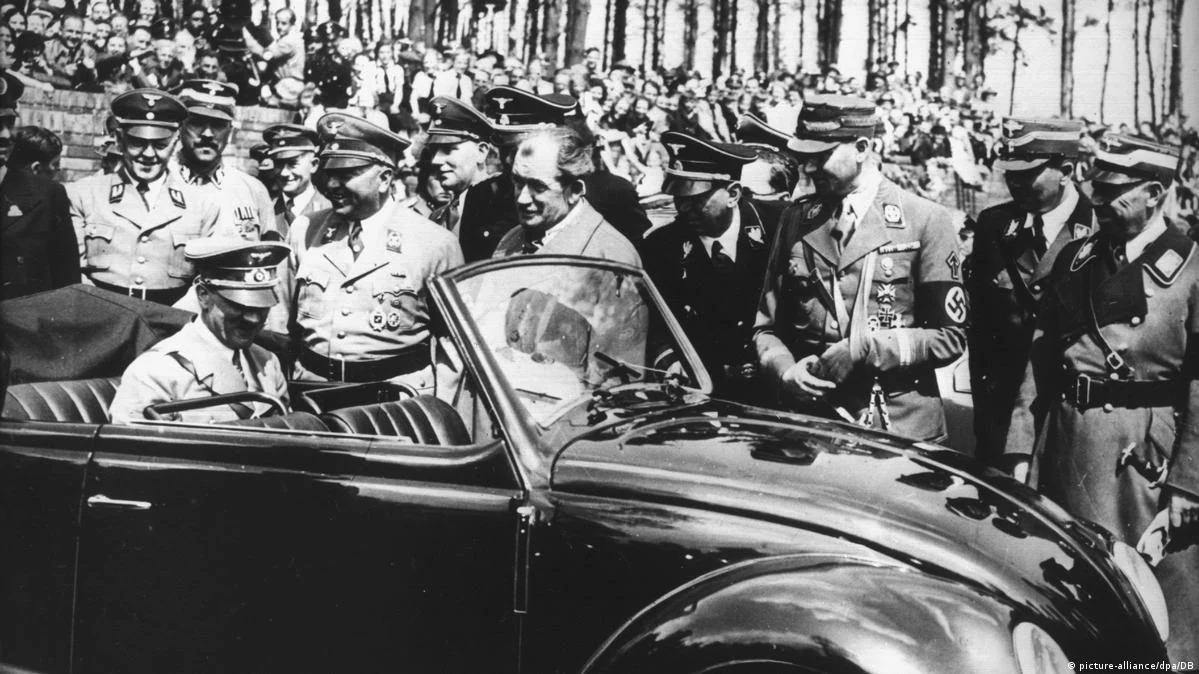
In the turbulent decades between the two world wars, Germany became a laboratory of radical political ideas, sweeping economic reforms, and ambitious industrial projects. Among the most unexpected legacies of that era is a small, rounded automobile that would eventually become one of the most recognizable cars in the world. The story of the Volkswagen Beetle is not simply about clever engineering or clever marketing. It is deeply intertwined with the ambitions of Adolf Hitler and the technical genius of Ferdinand Porsche. Together, they played central roles in the creation of a “people’s car,” conceived as part of a broader state-driven initiative to motorize Germany and reshape society.
The Beetle’s origins reveal a complex intersection of propaganda, engineering innovation, and political ideology. It began as a symbol of national renewal under a totalitarian regime, yet after the war it transformed into a global icon of affordability, reliability, and even counterculture. To understand how such a transformation occurred, one must look closely at the political climate of 1930s Germany, the vision behind the so-called “people’s car,” and the partnership—however unequal—between Hitler and Porsche.
A Nation in Crisis and the Promise of a “People’s Car”
When the National Socialist regime came to power in 1933, Germany was still reeling from the Great Depression. Unemployment was staggering, industry was struggling, and public morale was fragile. The leadership of the Nazi Party sought not only political control but also economic revival. Massive public works programs, rearmament, and infrastructure projects such as the autobahn network were central to this strategy. In this environment, the concept of a car affordable to ordinary citizens emerged as both a practical and symbolic goal.
At the time, automobile ownership in Germany was limited primarily to the wealthy. Compared to the United States, where mass production had already put cars within reach of many families, Germany lagged far behind. Hitler admired American industrial efficiency and understood the social impact of widespread car ownership. He envisioned a Germany in which workers could drive on modern highways in vehicles built by German hands, reinforcing national pride and economic self-sufficiency.
The proposed car needed to meet strict criteria. It had to be inexpensive, durable, capable of carrying a family, and simple enough to maintain. It also had to align with the regime’s broader message: that the state would improve the lives of ordinary citizens. The idea was marketed as a gift of modernity to the German worker, reinforcing loyalty to the government. In reality, it was part of a carefully orchestrated effort to tie consumer aspirations to political ideology.
Thus, the groundwork was laid for a state-sponsored automotive project that would become one of the most ambitious industrial undertakings of its time. What began as a promise of affordable mobility would soon take physical form under the guidance of a visionary engineer.
Adolf Hitler’s Personal Interest in Automotive Design
Although not an engineer, Adolf Hitler took an unusually direct interest in the development of the people’s car. He had long been fascinated by automobiles and understood their symbolic power. Cars represented technological progress, national strength, and modern identity. In speeches at international auto shows, he described in detail what he expected from the future German car, outlining performance standards and price limits with surprising specificity.
Hitler insisted the car should cost no more than 1,000 Reichsmarks, making it accessible to average workers. It had to carry two adults and three children, achieve a reasonable top speed, and consume fuel efficiently. These requirements were ambitious given the technological and economic constraints of the time. Nevertheless, he pushed forward, determined to prove that Germany could compete with the industrial giants of the United States.
His involvement went beyond rhetoric. He reviewed sketches, commented on prototypes, and maintained ongoing communication with engineers. While he did not draft technical blueprints himself, his expectations shaped the project’s direction. The vehicle was officially called the “KdF-Wagen,” named after the regime’s leisure organization “Kraft durch Freude” (Strength Through Joy). It was presented as part of a broader vision in which workers would enjoy state-sponsored vacations, cultural events, and modern conveniences.
However, the political context cannot be separated from the engineering ambition. The project served propaganda purposes, reinforcing the narrative that the regime cared for ordinary citizens. In reality, few Germans would receive their promised cars before the outbreak of war. Still, Hitler’s personal enthusiasm ensured that the initiative remained a high priority, laying the foundation for what would later evolve into the Volkswagen Beetle.
Ferdinand Porsche and the Engineering Breakthrough
If Hitler supplied the vision and political backing, Ferdinand Porsche provided the technical expertise that turned ambition into reality. Porsche was already a respected automotive engineer with experience designing innovative vehicles for various manufacturers. His engineering philosophy emphasized efficiency, simplicity, and performance—qualities perfectly suited to the people’s car concept.
In 1934, Porsche was officially contracted to develop the new vehicle. He and his team faced enormous challenges. The car had to be cheap, reliable, and easy to mass-produce. Porsche chose an air-cooled, rear-mounted engine, which simplified construction and reduced maintenance needs. The rounded, aerodynamic shape improved efficiency and stability while also giving the car its distinctive appearance.
Prototypes were rigorously tested, often under demanding conditions. Porsche refined the suspension, engine configuration, and chassis design to meet the strict requirements laid out by the regime. The result was a compact yet surprisingly capable vehicle that combined durability with mechanical elegance. Its curved body, sloping hood, and integrated fenders would later become defining features of the Beetle’s identity.
While Porsche’s collaboration with the regime remains controversial, his engineering contribution is undeniable. He managed to create a vehicle that balanced cost constraints with performance expectations. The KdF-Wagen embodied his belief that good design should serve practical needs without unnecessary complexity. Though born in a politically charged environment, the technical foundations he established would prove adaptable and resilient long after the original political context had vanished.
The Birth of Volkswagen and the Wolfsburg Factory
To bring the people’s car to the masses, an entirely new industrial infrastructure was required. In 1938, construction began on a massive factory complex near the town that would later become Wolfsburg. The company behind the project was named Volkswagen, literally meaning “people’s car.” The factory was intended to produce hundreds of thousands of vehicles annually, a bold goal for its time.
The plant symbolized industrial ambition and national pride. Ceremonial events marked its groundbreaking, with Hitler personally attending and presenting the project as a gift to German workers. A savings scheme was introduced, allowing citizens to purchase stamps toward eventual ownership of a KdF-Wagen. Many workers enthusiastically participated, believing they would soon receive their cars.
Yet history intervened. With the outbreak of World War II in 1939, civilian production halted almost entirely. The factory shifted to military manufacturing, producing vehicles and equipment for the war effort. The promised cars were never delivered to most of those who had invested in the savings plan.
Despite this interruption, the physical infrastructure survived the war. When Allied forces took control of the factory, they recognized its potential. Under British administration, production resumed in the late 1940s, this time focusing on civilian needs. The same basic design conceived under the regime became the foundation for a postwar industrial revival, transforming Wolfsburg into a symbol of reconstruction rather than propaganda.
From Propaganda Tool to Global Icon
The end of the war marked a dramatic shift in the Beetle’s destiny. What had begun as the KdF-Wagen was rebranded and gradually reintroduced to the world as the Volkswagen Beetle. Stripped of overt political symbolism, it was valued for its practicality and affordability. The car’s modest size, reliable engine, and simple maintenance appealed to a generation rebuilding their lives after conflict.
In the 1950s and 1960s, exports expanded rapidly. The Beetle entered markets across Europe, the Americas, and beyond. Its rounded silhouette became instantly recognizable. In an unexpected twist, a vehicle conceived under authoritarian rule became associated with freedom of movement and personal independence. In the United States, it even gained popularity among countercultural communities, who appreciated its unpretentious design and mechanical honesty.
This transformation highlights the adaptability of industrial products beyond their original context. While the regime that initiated the project collapsed, the engineering principles endured. The Beetle’s longevity stemmed from its simplicity and reliability. Over time, it shed its origins in propaganda and took on new meanings shaped by different societies and generations.
The story of the Beetle therefore cannot be reduced to a single narrative. It is both a product of state ambition and a testament to engineering skill. Its global success demonstrates how technology can outlive—and transcend—the political systems that created it.
The Complex Legacy of Hitler and Porsche
The partnership between Hitler and Porsche remains historically complex. Hitler’s political motivations and ideological goals are inseparable from the car’s early development. Porsche’s role, meanwhile, reflects the ethical dilemmas faced by engineers working under authoritarian regimes. While Porsche focused on technical challenges, his work was enabled and directed by state power.
Today, historians examine this collaboration within the broader framework of industrial mobilization in 1930s Germany. The people’s car initiative illustrates how consumer aspirations were integrated into political strategy. It also reveals how technological innovation can serve multiple purposes, from propaganda to genuine public utility.
The Beetle’s later success does not erase its origins, nor does it diminish the engineering achievement behind it. Instead, it invites a nuanced understanding of history. Objects can carry layered meanings, shaped by the contexts in which they are produced and the ways they are later reinterpreted.
In reflecting on the Beetle’s creation, one must acknowledge both the ambition that drove its development and the regime that enabled it. The car stands as a reminder that technological progress often emerges from complex and sometimes troubling historical circumstances.
The story of how Adolf Hitler helped inspire the creation of an affordable German automobile, and how Ferdinand Porsche transformed that vision into mechanical reality, belongs firmly to the Modern period of history. It reflects the industrial, political, and social transformations of the twentieth century—an era defined by rapid innovation, ideological conflict, and global change.