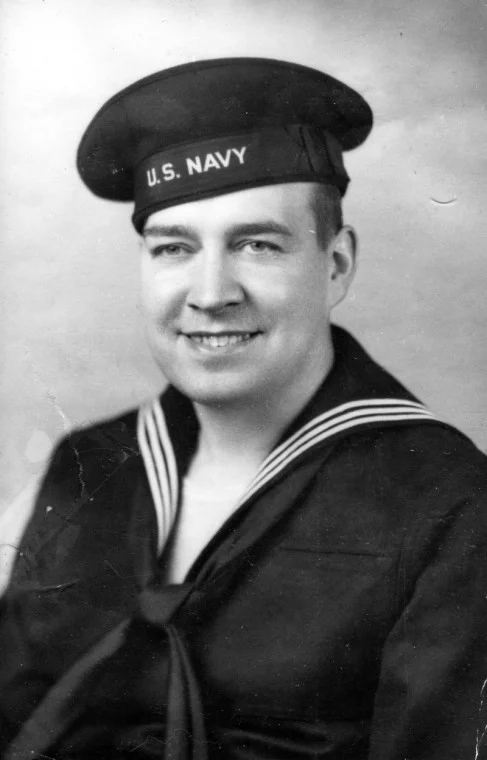
Few figures in modern history cast a shadow as long and dark as Adolf Hitler. His name became synonymous with tyranny, genocide, and global devastation during the Second World War. Yet hidden within that infamous family tree is a story so improbable it almost feels fictional. Adolf Hitler’s own nephew fought against the Nazi regime, wore the uniform of the United States Navy, was wounded in action, and received the Purple Heart for his service.
His name was William Patrick Hitler, though later in life he would change it to William Patrick Stuart-Houston. His journey from the uneasy fringes of the Hitler family to an American serviceman fighting against Nazi Germany is one of the most unusual personal narratives to emerge from the war. It is a story shaped by family tension, political opportunism, moral decisions, and ultimately a deliberate effort to distance oneself from one of history’s most reviled surnames.
A Complicated Beginning in the Hitler Family
William Patrick Hitler was born in 1911 in Liverpool, England. His father, Alois Hitler Jr., was Adolf Hitler’s half-brother, making William the nephew of the future German dictator. Unlike his infamous uncle, William grew up largely outside of Germany. His upbringing in Britain gave him a cultural and political environment very different from the nationalist fervor that would later grip Germany in the 1930s.
During the early years of Adolf Hitler’s rise to power in Germany, William saw opportunity rather than danger. In the 1930s, as his uncle’s influence grew, William traveled to Germany in hopes of benefiting from the family connection. It was a bold and somewhat opportunistic move. He sought employment and advancement, leveraging the power of his surname in a country that increasingly idolized his uncle.
For a time, the strategy appeared to work. William secured jobs in German banks and even in the automotive industry. However, his relationship with Adolf Hitler was strained. Accounts suggest that William was seen as somewhat unreliable and possibly manipulative. At one point, he allegedly hinted that he might embarrass the regime with family secrets if he was not given better opportunities. Whether exaggerated or not, such behavior would have made him suspect in the eyes of Nazi leadership.
As the Nazi regime tightened its grip and Germany moved toward war, William found himself in an increasingly precarious position. His British citizenship and foreign upbringing made him an outsider, while his family ties made him a potential political liability. Eventually, he left Germany and returned to Britain, distancing himself from the growing storm.
From Europe to America
With tensions rising in Europe and the threat of war becoming undeniable, William chose not to remain in Germany. In 1939, shortly before the outbreak of the Second World War, he traveled to the United States on a lecture tour. In his talks, he discussed his experiences in Nazi Germany and his complicated relationship with his uncle. The tour positioned him as a curious insider—someone connected by blood to Hitler but not aligned with his ideology.
When war erupted in 1939 and later expanded with the United States’ entry after the attack on Pearl Harbor in 1941, William faced a pivotal decision. Remaining in America meant committing to a country that would soon be at war with his uncle’s regime. He applied to join the U.S. military, though his surname understandably raised eyebrows. After investigation and reportedly even direct review by authorities concerned about security risks, he was permitted to enlist.
William was drafted into the United States Navy. His acceptance into service was no small matter. At a time when espionage fears were high and loyalty was scrutinized, the idea of Hitler’s nephew serving in the American armed forces was extraordinary. Yet William’s background and public stance against Nazi ideology helped reassure officials.
Rather than serving in a glamorous or symbolic role, William became a Hospital Corpsman. This position placed him in the medical field, assisting doctors and providing care to wounded servicemen. It was demanding, often dangerous work that required both skill and resilience.
Service, Sacrifice, and the Purple Heart
Throughout the war, William Patrick Hitler served faithfully in the Pacific theater. As a Hospital Corpsman, he would have been stationed close to combat zones, where casualties were frequent and conditions were harsh. Medical personnel in such environments were exposed to enemy fire and the chaos of battle just as much as frontline troops.
During his service, William was wounded in action. Details of the specific incident are limited, but the injury was serious enough to earn him the Purple Heart, awarded to American service members wounded or killed in action. The symbolism is striking. The nephew of the man orchestrating Germany’s war effort was wounded while serving the country fighting against him.
He continued his naval career until 1947, serving beyond the official end of the Second World War in 1945. His extended service demonstrated that his commitment was not merely symbolic or opportunistic. By remaining in uniform during the transitional post-war years, he reinforced his identity as an American serviceman rather than as a relative of a defeated dictator.
His wartime record stands in sharp contrast to the ideology and destruction associated with his uncle. While Adolf Hitler was responsible for policies that led to unprecedented devastation and genocide, William worked in a role dedicated to saving lives. The juxtaposition is as powerful as it is ironic.
Reinventing Himself in America
After leaving the Navy, William chose to make a permanent break from the Hitler name. In 1947, he legally changed his surname to Stuart-Houston. The decision was understandable. In the post-war world, the name “Hitler” carried unbearable weight. Changing it allowed him and his future family to live without the constant burden of association.
He became a naturalized American citizen and settled on Long Island, New York. There, he pursued a quieter life, working as a medical laboratory technician. In many ways, his post-war existence was intentionally ordinary. He married and raised a family, keeping a low profile and avoiding publicity.
The choice to embrace American citizenship and a new surname was more than a practical step; it was a symbolic rejection of his uncle’s legacy. William’s life in the United States reflected integration and contribution rather than notoriety. He lived until 1987, largely removed from the global stage that had once been shaped so dramatically by his family name.
A Story of Identity and Choice
The story of William Patrick Hitler raises compelling questions about identity, loyalty, and moral agency. Blood relation does not determine ideology, and family connection does not dictate personal values. In an era when millions were swept up in nationalist fervor or coerced into complicity, William’s decision to serve in the armed forces of a nation fighting against his uncle’s regime stands out.
His life also illustrates how individuals can redefine themselves despite heavy historical baggage. The act of changing his surname to Stuart-Houston was not an attempt to erase history but to move forward from it. By serving in the Navy and earning the Purple Heart, he established a record defined by service rather than infamy.
It would be simplistic to portray his life as entirely heroic or entirely opportunistic. Like many historical figures, William was complex. In his earlier years, he attempted to benefit from his connection to Adolf Hitler. Yet when confronted with the moral reality of Nazi Germany and the global conflict it unleashed, he chose a different path.
Legacy in the Shadow of History
History often reduces people to symbols, especially when they are connected to notorious figures. Yet William Patrick Hitler’s life resists simple categorization. He was neither a perpetrator nor a passive bystander in the story of the Second World War. Instead, he actively participated on the opposing side of the regime that bore his family name.
His story reminds us that history is not only about sweeping ideologies and mass movements but also about individual decisions. In a conflict defined by unprecedented destruction, it is remarkable to find a narrative that underscores personal choice over inherited identity.
The fact that Adolf Hitler’s nephew fought against the Nazis, served honorably in the U.S. Navy, was wounded in action, and earned the Purple Heart is one of those historical ironies that feels almost too striking to be true. Yet it is documented fact. It highlights the unpredictable human dimensions within even the darkest chapters of the twentieth century.
Ultimately, William Patrick Stuart-Houston’s life belongs firmly within the Modern period of history, shaped by the global upheaval of the Second World War and its aftermath. His journey from Liverpool to the Pacific theater, from the Hitler surname to American citizenship, stands as a testament to the power of personal choice in the face of overwhelming historical forces.