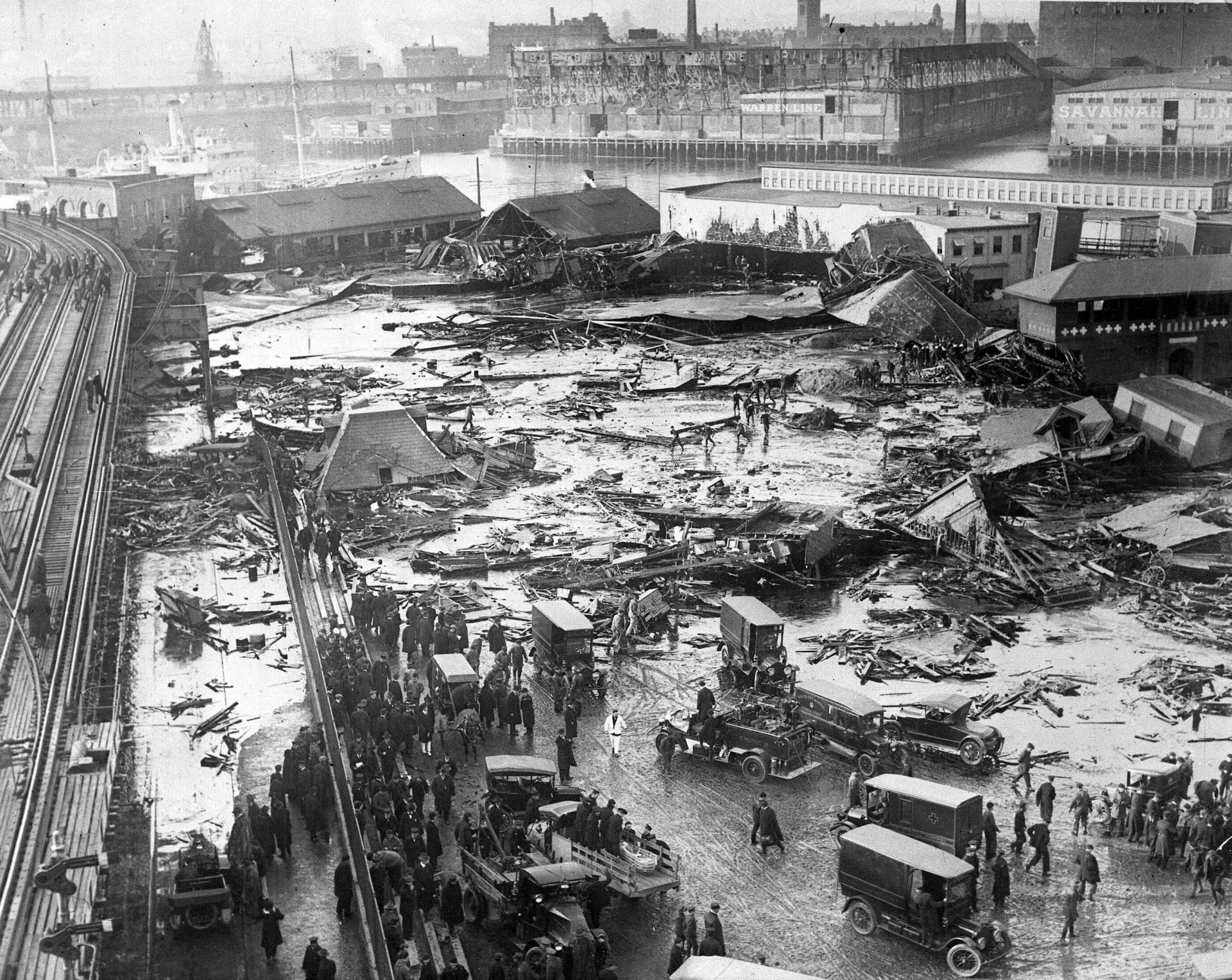
Boston is famous for its revolutionary past, its universities, and its enduring role in American history. Most people immediately think of the Boston Tea Party when they hear the city’s name spoken alongside the word “disaster.” Yet, just over a century ago, Boston was the site of one of the strangest and deadliest industrial accidents in U.S. history—an event so surreal that it sounds almost fictional. On January 15, 1919, the city’s North End neighborhood was overwhelmed not by fire, floodwater, or earthquake, but by molasses.
What began as an ordinary winter afternoon ended in chaos when a massive storage tank ruptured without warning. In seconds, millions of gallons of thick, brown molasses surged through the streets with terrifying force. Buildings collapsed, people were swept away, horses drowned in the sticky flood, and rescue workers struggled to move through streets that had turned into glue. The disaster killed 21 people, injured around 150 more, and left a permanent mark on Boston’s history. Though often overshadowed by more conventional tragedies, the Boston Molasses Disaster remains one of the most bizarre—and revealing—industrial catastrophes of the modern era.
Boston in the Early 20th Century: Industry, Growth, and Risk
In 1919, Boston was a rapidly growing industrial city shaped by immigration, wartime production, and expanding urban infrastructure. The North End, where the molasses tank stood, was a densely populated neighborhood filled with working-class families, many of them recent immigrants. Narrow streets, crowded tenements, and factories existed side by side, creating an environment where industrial activity and daily life were inseparably intertwined.
Molasses was an essential commodity at the time. It was used not only as a sweetener but also as a key ingredient in the production of industrial alcohol and explosives. During World War I, demand for molasses surged because it could be fermented into ethanol, which was then used to manufacture munitions. Even after the war ended in November 1918, the molasses trade remained lucrative, particularly as companies prepared for the possibility of Prohibition, which would limit alcohol production.
The massive tank that would later explode was owned by the United States Industrial Alcohol Company through one of its subsidiaries. It loomed over the neighborhood, rising about 50 feet tall and stretching 90 feet across, capable of holding 2.5 million gallons of crude molasses. Despite its size and the potential danger it posed, the tank had been poorly constructed, inadequately tested, and rarely inspected. Residents had long complained about leaks, hearing ominous groans and watching molasses ooze down its sides. Children even collected the dripping syrup in cans—a chilling detail in hindsight.
This environment of lax oversight and unchecked industrial expansion set the stage for disaster. The molasses tank was not just a storage container; it was a symbol of an era when profit often outweighed public safety, and when working-class neighborhoods bore the greatest risks of industrial progress.
The Day the Tank Exploded: January 15, 1919
On the afternoon of January 15, 1919, Boston experienced unseasonably warm temperatures following a period of intense cold. This sudden change played a critical role in what was about to happen. Inside the tank, molasses had recently been delivered from the Caribbean and was fermenting, producing gases that increased internal pressure. Combined with the expansion caused by rising temperatures, the stress on the tank reached a breaking point.
At approximately 12:40 p.m., the tank burst apart with a deafening roar. Witnesses described a sound like machine-gun fire or thunder as rivets shot through the air and steel plates tore loose. Almost instantly, a massive wave of molasses surged outward, reaching heights of up to 15 feet. Moving at speeds estimated to be as high as 35 miles per hour, the sticky flood barreled through the streets of the North End with unstoppable force.
Buildings were crushed or knocked off their foundations. A nearby firehouse collapsed, trapping firefighters beneath the wreckage. Elevated railway tracks were bent and twisted by the sheer weight of the molasses. Horses pulling wagons were swept away and drowned, unable to free themselves from the thick syrup. People caught in the wave were knocked down, pinned against structures, or buried under debris and molasses.
The most terrifying aspect of the disaster was the molasses itself. Unlike water, it did not flow freely. It clung to everything it touched, making movement nearly impossible. Victims struggled to breathe as the viscous liquid filled their mouths and noses. Rescue efforts were slow and agonizing, as responders found themselves stuck in knee-deep syrup, fighting exhaustion and cold as the molasses began to harden.
Chaos, Rescue, and the Struggle to Save Lives
In the immediate aftermath of the explosion, the North End descended into chaos. Survivors screamed for help, while others wandered the streets in shock, covered head to toe in molasses. The air was filled with the smell of sugar and fermentation, a sickening contrast to the devastation unfolding across the neighborhood. First responders, including police officers, firefighters, soldiers, and volunteers, rushed to the scene, but they were unprepared for the unique challenges they faced.
Rescuers quickly discovered that ordinary emergency techniques were ineffective. Stretchers became useless when they stuck to the ground. Boots were pulled off feet by the suction of the molasses. Horses and early motor vehicles could not move through the streets, forcing responders to work on foot. Many victims were so thoroughly coated that they appeared indistinguishable from the debris around them, making it difficult to locate survivors.
The cold winter air worsened conditions. As temperatures dropped, the molasses thickened, turning from a flowing liquid into a nearly solid mass. People trapped beneath it had little chance of survival. It took days to recover all the bodies, some of which were found months later, hidden beneath layers of hardened syrup and wreckage. In total, 21 people lost their lives, ranging in age from a 10-year-old boy to elderly residents, while approximately 150 others were injured.
Cleanup efforts lasted weeks. Workers used saltwater from Boston Harbor to wash away the molasses, but even then, it seeped into buildings, sidewalks, and the harbor itself. For years afterward, residents claimed the area still smelled faintly sweet on hot days. The disaster became a shared trauma for the city, a reminder that even mundane industrial materials could become deadly under the wrong circumstances.
Who Was Responsible? Negligence and the Fight for Justice
Almost immediately, questions arose about who was to blame for the disaster. Investigations revealed that the molasses tank had been built hastily and cheaply. It had never been properly tested when first filled, and no qualified engineer had approved its design. Instead of fixing known leaks, the company had simply painted the tank brown to hide them. Safety warnings from workers and residents had been ignored.
The company initially claimed that anarchists were responsible, suggesting that a bomb had caused the explosion. This theory reflected the tense political climate of the time, as the United States was gripped by fear of radical movements following World War I and the Russian Revolution. However, thorough investigations found no evidence of sabotage. The failure was structural and entirely preventable.
What followed was one of the longest and most significant civil lawsuits of its era. Survivors and families of victims filed claims against the company, leading to years of hearings, expert testimony, and legal battles. Engineers and scientists meticulously analyzed the tank’s construction, setting new standards for forensic engineering in courtrooms.
In 1925, the company was found liable and ordered to pay substantial damages—equivalent to millions of dollars today. More importantly, the case set a powerful precedent. It reinforced the principle that corporations could be held legally responsible for negligence and unsafe practices, helping to shape modern building codes, safety regulations, and corporate accountability in the United States.
The Lasting Impact on Boston and American Industry
The Boston Molasses Disaster faded from national headlines relatively quickly, but its impact endured in quieter, more profound ways. In Boston, it became part of local memory, passed down through generations as a story both tragic and unbelievable. The site of the tank was eventually redeveloped, but the disaster left an invisible imprint on the city’s identity.
Nationally, the incident contributed to a growing awareness of industrial safety. At the time, many factories and storage facilities operated with minimal oversight. The molasses flood exposed the human cost of this negligence in a way that statistics and reports could not. It showed that regulatory failures were not abstract problems but life-and-death issues for ordinary people.
Engineering standards evolved in response. Requirements for professional oversight, material testing, and safety inspections became more rigorous. While the disaster was not the sole catalyst for these changes, it played a significant role in shifting public and legal expectations. Corporations could no longer rely on ignorance or cost-cutting as excuses when lives were lost.
Today, the Boston Molasses Disaster is studied not only as a historical curiosity but as a case study in risk management and corporate responsibility. It reminds us that progress without safeguards can have catastrophic consequences—and that even something as seemingly harmless as molasses can become lethal when negligence is allowed to thrive.
Why the Boston Molasses Disaster Still Matters
The story of the Boston Molasses Disaster endures because it defies expectations. Disasters are usually associated with natural forces or violent events, not food products. Yet this very absurdity makes the tragedy more unsettling. It forces us to confront how easily everyday infrastructure can become dangerous when oversight fails.
More than a century later, the disaster resonates in conversations about industrial safety, environmental risk, and corporate ethics. It serves as a warning against complacency and a reminder that regulations are often written in blood. Behind every safety code lies a history of suffering that demanded change.
Ultimately, the molasses flood is not just a bizarre footnote in history. It is a human story—of workers ignored, communities harmed, lives lost, and hard-won accountability. Remembering it honors the victims and reinforces the lesson that safety must never be sacrificed for speed or profit.