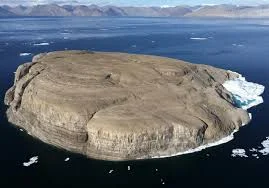
It may be one of the most charming territorial disputes in modern history. For more than three decades, two peaceful nations—Canada and Denmark—engaged in a whimsical, good-natured standoff over a barren, uninhabited island in the icy waters between Greenland and the Canadian Arctic. At just 1.3 square kilometers, Hans Island is little more than a rock in the Kennedy Channel, a narrow strait dividing the two nations’ Arctic jurisdictions. Yet somehow, this small patch of land became the center of a centuries-late “whiskey war,” in which each visiting government official planted their national flag and left behind a symbolic bottle of liquor—Canadian whisky or Danish schnapps—as a playful reminder of their competing claim. Rather than hostility, the dispute became a delightful example of diplomatic humor, cooperation, and the extraordinarily peaceful relationships that define both nations. What emerged was not a fight for resources or land, but a uniquely friendly contest that would ultimately end in an unprecedented joint agreement.
Why Hans Island Became a Point of Contention in the First Place
To understand how something as unremarkable as Hans Island became a diplomatic chess piece, we must first look at the geography and politics of the Arctic. Hans Island lies almost exactly halfway between Canada’s Ellesmere Island and Greenland, an autonomous territory of Denmark. The waters surrounding it form part of the Nares Strait, a historically important region for explorers navigating the Arctic Archipelago. Despite its stark emptiness, the island occupies a meaningful position in the complex web of boundaries that define territorial waters, exclusive economic zones, and national sovereignty.
In 1973, Canada and Denmark negotiated a maritime boundary agreement covering most of the region between their territories. The agreement was considered a diplomatic success, laying out clear demarcations for areas that had long been ambiguous. Yet one small complication remained unresolved: Hans Island. Both nations claimed it, and neither side wished to relinquish their assertion of sovereignty. The two countries chose to set the issue aside temporarily, focusing on larger priorities. But the unresolved status left a gap—a diplomatic loose end waiting to be tugged.
The island itself offered no economic advantage. There was no oil, no mining potential, no habitable land, and no strategic military importance. What mattered instead was principle. Sovereignty, even over an empty rock, represented a nation’s ability to define its borders. For Canada, protecting northern sovereignty has long been tied to national identity, especially regarding its Arctic presence. For Denmark, establishing authority over Greenland’s surrounding islands was part of a long-standing responsibility toward its Arctic territories. Thus, while the island may have been small, the symbolism was not insignificant.
Complicating matters was the island’s ambiguous position: both nations could claim historical discovery and cartographic documentation dating back to the early 20th century. Indigenous Inuit populations had traditionally used the surrounding region for hunting and travel, but Hans Island itself had little cultural or subsistence value. Its importance was legal rather than practical.
What makes the story remarkable, however, is that from the very beginning, neither country approached the dispute with hostility. There was no military posturing, no threats, and no Cold War tension. Instead, as the decades unfolded, Hans Island became an unlikely stage for one of the most humorous diplomatic exchanges in recent history.
How a Territorial Dispute Turned Into the Famous “Whiskey War”
The story of Hans Island shifted from a mundane legal disagreement to an international legend in the early 1980s. In 1984, Danish Minister of Greenland Affairs Tom Høyem visited the island and planted a Danish flag. In a lighthearted flourish, he left behind a bottle of Danish schnapps, along with a note reading, “Welcome to the Danish island.” The gesture was bold yet playful—not a threat, but a cheeky assertion of Denmark’s presence.
Canada soon responded in kind. When a Canadian military detachment visited the island shortly afterward, they replaced the Danish flag with the Canadian one and left behind a bottle of Canadian whisky. From that moment on, the tone of the dispute changed entirely. Rather than escalating into confrontation, it evolved into a ritual of humorous one-upmanship. Officials, soldiers, scientists, and diplomats from both nations took turns visiting Hans Island, each time restoring their national flag and leaving their national drink.
For the next decades, this exchange repeated itself irregularly yet consistently. Denmark would visit and leave schnapps; Canada would arrive later with whisky. Flags, plaques, and humorous notes accumulated over time. At various points, Danish naval vessels dropped in, planting freshly sewn flags with military ceremony—again accompanied by schnapps. Canadian forces responded with new flags and bottles of their own.
Media outlets eventually caught wind of the story, dubbing the exchange a “whiskey war.” But it was a war in name only. There were no weapons, no soldiers facing off, and no hostility. The dispute became a symbol of cooperation and trust between two nations with shared values and close diplomatic ties. Even international law experts often remarked on the unusual civility of the situation. In a world where territorial conflicts often spark violence, Hans Island became a model of how boundaries could be contested without animosity.
At times, the exchange grew almost theatrical. Both nations used the dispute to highlight their good humor on the world stage, showing that disagreements need not be destructive. Hans Island became famous precisely because nothing bad ever happened there—only flags, bottles, and a shared smile between two nations unwilling to let a border disagreement dissolve their friendship.
The Role of International Law and Why a Tiny Island Mattered Diplomatically
Though lighthearted in practice, the Hans Island dispute took place within a serious legal framework. Under international law, specifically the United Nations Convention on the Law of the Sea (UNCLOS), territorial claims affect more than just land—they determine access to surrounding waters, fishing rights, and seabed resources. Even a small island can influence maritime boundaries. Though Hans Island itself offered no economic value, its ownership held symbolic and legal weight within broader Arctic geopolitics.
The Arctic has become increasingly important due to melting sea ice, expanded shipping lanes, and the possibility of future resource extraction. Both Canada and Denmark have strong interests in maintaining clear and internationally recognized territorial boundaries. Leaving Hans Island in perpetual limbo risked setting a precedent of ambiguity. For decades, the two nations maintained their claims while ensuring that the disagreement never escalated. Their relationship remained anchored in NATO cooperation, trade, and cultural ties.
Behind the scenes, diplomats, lawyers, and Arctic policy specialists from both nations periodically revisited the issue. The two governments exchanged formal notes, conducted legal reviews, and occasionally held discussions about a potential resolution. Yet the urgency was low. Both nations understood that the dispute posed no immediate threat. As long as both parties refrained from aggressive action, Hans Island remained a harmless “frozen” disagreement.
What made the case especially unusual was its lack of strategic militarization. In other parts of the world, uninhabited islands have been used to justify military bases or expanded territorial claims. But Canada and Denmark consciously avoided this approach. Their peaceful handling of the dispute became a quiet model of responsible Arctic governance.
At the same time, public interest grew. Journalists loved the quirky story of flag-swapping and liquor trading. Academics found it a fascinating case study in international boundary law. Comic strips and political cartoons portrayed diplomats marching through snowdrifts with bottles in hand. The island became far more famous than its size warranted. Ironically, the dispute granted Hans Island more global attention than any normal resolution ever would have.
The Final Resolution: How Two Nations Chose Cooperation Over Conflict
After decades of flag-swapping and diplomatic humor, Canada and Denmark decided it was time to bring the world’s friendliest territorial dispute to a formal close. Growing interest in Arctic governance and the increasing importance of international cooperation led both nations to pursue a mutually acceptable solution. Negotiations intensified in the early 21st century, and by the 2010s, both countries expressed public willingness to settle the matter once and for all.
Finally, in June 2022—a full 49 years after the original maritime boundary agreement—Canada and Denmark reached a historic resolution. In a jointly announced agreement, the countries decided to divide Hans Island nearly down the middle, creating the first land border between Canada and Denmark. The split was symbolic as much as practical, demonstrating the power of diplomacy conducted in good faith.
Under the agreement:
- The island was partitioned with a simple, clear border running along its natural geographical features.
- Both nations recognized each other’s sovereignty over the portions allocated.
- Indigenous groups with ancestral ties to the surrounding waters were consulted and included in the process.
- The long-running “whiskey war” officially ended—but its memory remained cherished by both sides.
This peaceful conclusion made headlines around the world. Commentators praised it as a rare example of modern diplomacy that favored compromise over confrontation. By dividing the island, both nations preserved their dignity and avoided declaring a winner or loser. The agreement strengthened relations between Ottawa and Copenhagen and showcased Arctic cooperation at a moment when other world regions face rising territorial tensions.
Most importantly, the settlement honored the spirit of the decades-long dispute. There had never been hostility—only humor. The final resolution continued that tradition by affirming friendship, mutual respect, and shared commitment to peaceful negotiation.
Hans Island as a Symbol of International Friendship and Arctic Cooperation
The long, playful saga of Hans Island reveals much about the values of Canada and Denmark. Both nations are known for diplomacy, cooperation, and a strong commitment to peaceful conflict resolution. The friendly “whiskey war” became a reflection of their national identities and their shared belief that disagreements do not require hostility.
In an era where many territorial disputes spark military conflict, Hans Island stood out as a beacon of restraint and creativity. Instead of soldiers, there were diplomats with flags. Instead of threats, there were bottles of liquor. Instead of escalating tension, each visit reinforced camaraderie. Even the act of leaving alcohol—arguably the most humorous aspect—symbolized cultural exchange rather than confrontation.
The island became a cultural touchstone. For Canadians, it represented the northern frontier, Arctic sovereignty, and polite assertiveness. For Danes, it reflected their stewardship of Greenland and their friendly approach to global affairs. For both, it became a symbol of how diplomacy can be human, humorous, and grounded in kindness rather than aggression.
Hans Island also holds significance for Indigenous Inuit communities. The settlement agreement emphasized that Inuit groups from both Canada and Greenland historically traveled the region freely and should continue to do so without restriction. This recognition underscored the importance of Indigenous rights in modern Arctic governance.
Today, Hans Island represents not only a resolved dispute but a model for future negotiations. As climate change transforms the Arctic, cooperation will become increasingly essential. The island’s unique history suggests that countries can disagree over borders while still treating one another with dignity—and even with laughter.
When a Border Dispute Became the World’s Nicest “War”
The Hans Island story endures because it defies expectations. Territorial disputes are supposed to be tense, aggressive, and politically charged. Hans Island was none of those things. Instead, it became a decades-long exchange of flags, jokes, whisky, and schnapps—a diplomatic dance that showcased the best qualities of two peaceful nations.
For over 30 years, Canada and Denmark demonstrated that sovereignty could be defended with humor rather than hostility, and that even the smallest dispute could reflect a nation’s character. The island may be tiny, barren, and uninhabitable, but it created a legacy far larger than its footprint in the Arctic. It taught the world that borders need not divide people, that diplomacy can be charming, and that even a rock in the ice can become a symbol of friendship.
Today, Hans Island stands as a shared territory, a shared memory, and a shared reminder that international relations do not always need to be cold—even in the Arctic.
Leave a Reply