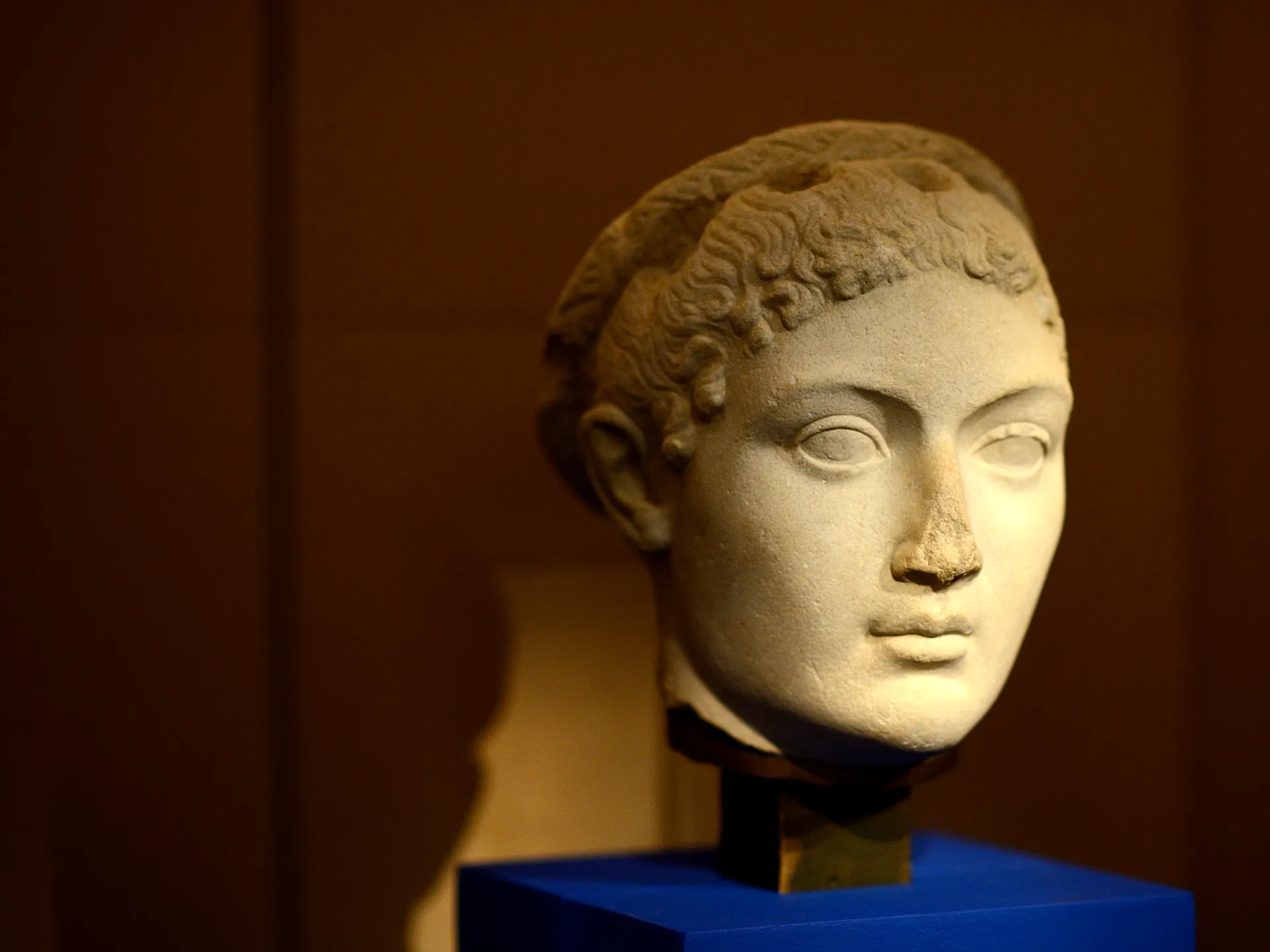
Cleopatra VII, one of the most recognizable figures in ancient history, lives in the popular imagination as the quintessential Egyptian queen—mysterious, seductive, powerful, and tragically doomed. Her name conjures images of gold-lined palaces along the Nile, lavish banquets, and dramatic encounters with Julius Caesar and Mark Antony. Yet behind the familiar myth lies a remarkable historical truth: Cleopatra was not ethnically Egyptian at all. Instead, she came from a long line of Greek rulers who had governed Egypt since the conquests of Alexander the Great. A descendant of Ptolemy I Soter, the Macedonian general who became Egypt’s ruler after Alexander’s death, Cleopatra belonged to the Ptolemaic dynasty, a foreign royal house that blended Greek political ideals with Egyptian traditions to maintain control over the land of the pharaohs. Understanding Cleopatra’s true heritage not only challenges popular assumptions but also illuminates the complex cultural world she inhabited—a world marked by political fragmentation, intellectual flourishing, and a deep interplay between Greek and Egyptian identities.
The Macedonian Roots of Egypt’s Most Famous Queen
To grasp why Cleopatra was Greek rather than Egyptian, we must travel back to the fourth century BCE, when Alexander the Great swept across the Mediterranean and Near East, transforming the political landscape in a matter of years. After conquering Egypt in 332 BCE, Alexander established the city of Alexandria—destined to become a global center of learning—before continuing his campaigns into Asia. When he died in 323 BCE with no clear successor, his generals divided his empire among themselves. One of these generals, Ptolemy, seized control of Egypt and founded the Ptolemaic dynasty, which would govern the region for nearly three centuries.
The Ptolemies were thoroughly Macedonian-Greek in culture, language, and governance. They spoke Greek, practiced Greek customs, and maintained strong ties with Greek institutions. Although they adopted select elements of Egyptian religion—most notably presenting themselves as pharaohs for ceremonial purposes—the ruling family remained distinctly Greek. Marriages within the dynasty were typically endogamous, often between siblings or close relatives, to preserve both political stability and ethnic identity. This tradition of royal inbreeding reinforced the dynasty’s Hellenistic character and limited genetic and cultural integration with the broader Egyptian population.
Against this backdrop, Cleopatra’s Greek ancestry becomes clear. Born around 69 BCE, she grew up in Alexandria, one of the most cosmopolitan cities in the ancient world—a place where Greek philosophers, Egyptian priests, Jewish scholars, and traders from across the Mediterranean mingled. Her education reflected elite Greek traditions, emphasizing rhetoric, philosophy, mathematics, and linguistics. Yet what made Cleopatra stand out from her predecessors was her willingness to embrace Egyptian traditions more fully. While the Ptolemies before her governed Egypt at a cultural distance, Cleopatra uniquely positioned herself as a hybrid figure, adopting Egyptian dress, participating in Egyptian religious ceremonies, and presenting herself as a reincarnation of the goddess Isis. Still, her lineage—politically and genetically—remained unequivocally Macedonian Greek, a fact that fundamentally shaped her role in the ancient Mediterranean world.
Cleopatra’s Cultural Identity: Greek by Blood, Egyptian by Choice
Although Cleopatra was Greek by ancestry, she consciously cultivated an Egyptian identity to bolster her political legitimacy. This duality—Greek blood paired with Egyptian cultural symbolism—crafted an image that appealed to both her elite Greek supporters and her Egyptian subjects. Unlike previous Ptolemaic rulers, who often felt detached from local traditions, Cleopatra made an effort to speak the Egyptian language, making her the first of her dynasty known to do so. This gesture was not merely symbolic; it reflected her understanding of the power of cultural connection in maintaining a fragile kingdom beset by internal rivalries and external threats.
Greek remained the administrative language of the royal court, and Cleopatra’s education placed her firmly within the Hellenistic intellectual tradition. She studied works of Homer, learned complex rhetoric, and corresponded with scholars in Alexandria’s famed library. According to ancient writers, she mastered several languages, including Hebrew, Aramaic, Latin, Median, and possibly Parthian dialects. This multilingual ability was unusual for ancient monarchs and demonstrated Cleopatra’s adaptability and intelligence—a stark contrast to the one-dimensional seductress portrayed in later Roman propaganda.
Her persona was a strategic blend of cultural identities. In Egypt, she adopted imagery associated with Isis, aligning herself with a powerful goddess tied to fertility, magic, and kingship. To her Egyptian subjects, this presented her as a protector of the land and a rightful inheritor of the pharaonic throne. To the Greeks of Alexandria and the broader Hellenistic world, Cleopatra remained a Macedonian queen who upheld the traditions of her ancestors. This dual identity was essential in maintaining political stability during a period marked by social unrest, economic challenges, and Roman expansion.
Even her famous relationships with Julius Caesar and Mark Antony reflect a nuanced political strategy rooted in her unique cultural position. The Romans viewed Egypt through a mixture of fascination and suspicion; Cleopatra’s alignment with Rome’s most powerful men was driven not by romance alone but by the necessity of protecting her kingdom’s autonomy. Her ability to navigate both Greek-Egyptian identity and Roman political landscapes underscores her sophistication. While later Roman writers sought to diminish her by focusing on beauty and seduction, modern scholarship recognizes Cleopatra as a skillful, multilingual diplomat whose actions were shaped as much by cultural strategy as by personal relationships. Her Greek heritage did not hinder her, but rather gave her the tools to bridge worlds in a period defined by cultural exchange and imperial ambition.
The Ptolemaic Dynasty: A Greek Kingdom in Egyptian Lands
Cleopatra’s identity cannot be separated from the broader history of the Ptolemaic dynasty. The Ptolemies ruled Egypt not as native pharaohs but as foreign kings who gradually blended Greek political traditions with Egyptian religious symbolism. Their rule marked the last flourishing of the ancient Egyptian state before its absorption into the Roman Empire. The Ptolemaic dynasty was characterized by both extraordinary cultural achievements and persistent political strife.
One of the dynasty’s greatest accomplishments was transforming Alexandria into a global intellectual powerhouse. The Library of Alexandria, the Mouseion, and the city’s renowned scholars helped advance mathematics, astronomy, engineering, medicine, and literary studies. Figures like Euclid, Eratosthenes, and Archimedes were connected to Alexandria’s scholarly community. The city became a beacon of Hellenistic learning, attracting thinkers from across the Mediterranean. In this environment, Greek thought and culture thrived, shaping everything from philosophy to urban planning.
At the same time, the Ptolemies adopted aspects of Egyptian religious and ceremonial customs to legitimize their rule. Pharaohs had long been seen as divine intermediaries between the gods and the people, and the Ptolemies capitalized on this tradition. They appeared in Egyptian temples wearing traditional regalia and commissioned monumental works in the style of earlier pharaohs. However, this cultural assimilation was largely superficial; the heart of their governance remained Greek, and they maintained a clear distinction between Greek elites and the Egyptian majority.
The dynasty was also marked by internal instability. Succession disputes, sibling rivalries, and palace intrigue were common. Marriages between siblings were encouraged to preserve dynastic purity, a practice borrowed not from Greek tradition but from the native Egyptian pharaonic model. This mixture of Greek and Egyptian customs created a unique hybrid monarchy, one that Cleopatra would inherit at a time of significant decline.
By the time Cleopatra ascended the throne in 51 BCE, the Ptolemaic kingdom was weakened by economic troubles, social unrest, and increasing Roman influence. The dynasty that once commanded one of the wealthiest kingdoms in the Mediterranean was now dependent on Roman support to maintain stability. Cleopatra’s intelligence and charisma helped her navigate this turbulent environment, but the legacy of her Greek ancestors shaped every aspect of her reign. Though politically fragile, the dynasty produced one of the most enduring figures in world history—an Egyptian queen whose lineage traced not to the Nile Valley but to the mountains of Macedonia.
Cleopatra’s Legacy: Rewriting Identity, Power, and Memory
Cleopatra’s Greek heritage is not merely a historical footnote; it fundamentally changes how we interpret her life and legacy. For centuries, she was framed primarily through Roman lenses, especially those of Octavian (later Augustus), who used propaganda to portray her as a dangerous foreign temptress whose influence corrupted Roman leaders. This narrative served political purposes but obscured Cleopatra’s true identity and achievements. Only in modern scholarship has her image been reevaluated, revealing a ruler of remarkable intelligence, ambition, and cultural fluency.
Understanding Cleopatra as Greek highlights her role as the last ruler of the Hellenistic world—a world that emerged from Alexander’s conquests and blended Greek traditions with local cultures across the Middle East. She was the final sovereign of a dynasty that represented the last independent Greek kingdom in the Mediterranean. Her defeat by Rome in 30 BCE marked not only the end of pharaonic Egypt but also the conclusion of the Hellenistic Age.
Her ability to navigate multiple cultural identities allowed her to wield influence more powerful than armies alone could achieve. Cleopatra’s reign embodied a syncretic vision of power that combined Egyptian religious legitimacy, Greek intellectual heritage, and Roman political alliances. Few rulers in history have operated so effectively across such diverse cultural spheres.
Today, Cleopatra remains a figure of fascination precisely because of her complexity. She has been depicted as a goddess, a seductress, a scholar, a patriot, and a tragic heroine. Each portrayal reflects the values and anxieties of the era in which it was created. Yet beneath these shifting interpretations lies a consistent truth: Cleopatra’s real power came not from beauty but from intellect, diplomacy, and her ability to reshape identity to fit the demands of politics. Her Greek heritage did not diminish her status as an Egyptian queen; rather, it enriched her capacity to command diverse loyalties and craft a legacy that endures long after her dynasty’s fall.
The Greek Queen Who Ruled Egypt with Extraordinary Skill
Cleopatra was not Egyptian by ancestry, but her reign represents one of the most captivating intersections of cultures in ancient history. She was a Greek queen ruling an Egyptian kingdom, a multilingual diplomat navigating Roman politics, and a charismatic leader who embraced the traditions of two civilizations to legitimize her power. Understanding her true origins offers a deeper appreciation of her complexity and challenges simplistic portrayals that have persisted for centuries. More than just a femme fatale, Cleopatra was a product of the Hellenistic world, a savvy political strategist, and the last great monarch of ancient Egypt—one whose story continues to fascinate precisely because it transcends cultural boundaries and defies easy categorization.
Leave a Reply