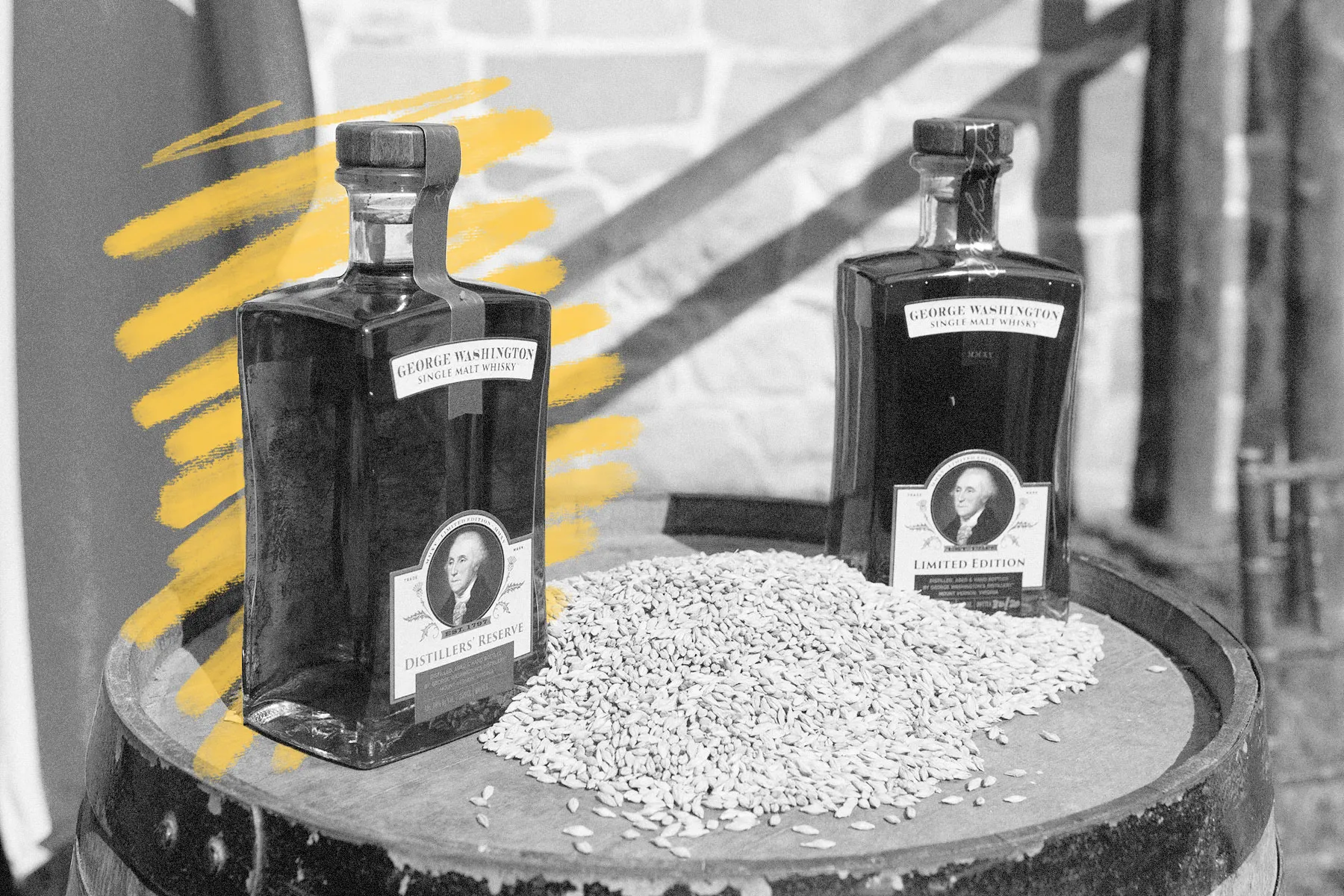
George Washington is remembered as the steadfast general who led the American colonies to independence and the first president who helped shape a fragile new nation into a functioning republic. His legacy is closely tied to honor, discipline, and public service. Yet few people realize that after stepping away from political life, Washington entered an unexpected and surprisingly lucrative business: whiskey distilling. At his Mount Vernon estate in Virginia, Washington built and operated a commercial distillery that, by 1799, had become the largest producer of un-aged whiskey in the United States. In its peak year, the distillery produced an astonishing 11,000 gallons of rye-based whiskey, generating significant income and proving that Washington was not only a military and political leader but also a highly capable entrepreneur. This lesser-known chapter of his life offers a fascinating glimpse into early American industry, agriculture, and commerce, revealing a side of Washington that blends practicality, innovation, and economic foresight.
Washington’s Transition from President to Gentleman Farmer and Businessman
When George Washington stepped down after two terms as president in 1797, he did something almost unthinkable by the standards of his time: he voluntarily relinquished power. Many expected him to remain in office indefinitely, yet he chose to return to Mount Vernon and resume the life of a private citizen. But this return was not a retreat into quiet retirement. Washington had long envisioned Mount Vernon not merely as a home but as a productive agricultural and commercial enterprise. Even during his presidency, he closely monitored his estate’s operations through detailed correspondence with his managers. After leaving office, he threw himself fully into the work of modernizing and expanding his economic ventures.
By the late 1790s, traditional tobacco farming—once the backbone of Virginia’s economy—had become less profitable due to soil depletion and fluctuating markets. Washington had already begun transitioning away from tobacco toward diversified agriculture years earlier. His estate produced wheat, corn, rye, oats, and other grains, along with fish, livestock, and various manufactured goods. Washington viewed farming through a scientific lens, constantly experimenting with crop rotation, soil improvement, and efficient labor systems. This attitude naturally extended into processing raw materials into value-added goods that could be sold for profit.
It was during this period that the idea of a whiskey distillery gained traction. Distilling was not unusual in early America. Whiskey was widely consumed, easier to transport than grain, and served not only as a beverage but also as a form of currency in some rural areas. Many farmers distilled surplus grain into liquor to prevent spoilage and increase its market value. Washington recognized that his abundant rye crop provided the perfect foundation for a distilling operation. Importantly, he didn’t act on a whim. As with all his ventures, the distillery was carefully planned, studied, and executed with attention to both quality and profitability. Retirement, for Washington, was not an end to productivity—it was simply a new arena in which to apply his leadership and discipline.
Why Whiskey Made Economic Sense in Early America
To understand why Washington’s distillery became so successful so quickly, it is essential to understand the economic landscape of post-Revolutionary America. The late 18th century was a time of rapid transformation. The nation was expanding westward, infrastructure was limited, and cash was often scarce in rural areas. Grain crops like rye, wheat, and corn were abundant, but transporting bulky, perishable crops over bad roads to distant markets was expensive and inefficient. Distilling grain into whiskey dramatically reduced both volume and spoilage risk while increasing value, making it one of the smartest ways for farmers to maximize profits.
Whiskey also enjoyed enormous demand. It was consumed daily by people of all social classes, used medicinally, and even served as a medium of exchange in some frontier economies. Taverns relied on it, laborers expected it as part of their wages, and merchants traded it extensively. In this context, Washington’s decision to enter the whiskey business was not just practical—it was visionary. He recognized that Mount Vernon’s location near major waterways, including the Potomac River, gave him access to regional transportation routes that could move his product efficiently to market.
Another factor that favored distilling was the surge in rye production at Mount Vernon. Rye thrived in Virginia’s climate and soil, and Washington cultivated it extensively. Rather than selling raw grain at fluctuating prices, converting it into whiskey stabilized income and allowed for greater control over profit margins. This shift reflected Washington’s broader approach to estate management: vertical integration. By handling production, processing, and distribution on his own property, he reduced dependency on outside middlemen.
Washington’s distillery also benefited from broader postwar economic optimism. Despite political tensions and periodic recessions, the United States was growing rapidly. Cities were expanding, immigrants were arriving, and trade networks were developing. Whiskey flowed through all of these systems. By entering the market at precisely this moment of rising demand, Washington positioned his operation for extraordinary success. Far from being a simple hobby for a retired president, the distillery was a calculated investment that aligned perfectly with the realities of early American commerce.
The Creation of Washington’s Distillery at Mount Vernon
The physical construction of Washington’s distillery began in 1797 under the guidance of his estate manager, James Anderson, a skilled agriculturalist and experienced distiller from Scotland. Anderson played a crucial role in transforming Washington’s vision into a functioning industrial operation. The distillery was built near Dogue Run, a tributary that provided a reliable water source essential for the distilling process. The structure was impressive for its time—a large stone building designed for efficiency, housing five copper stills and multiple furnaces.
The choice of materials and layout reflected Washington’s commitment to durability and productivity. Stone walls helped regulate internal temperature, which aided in fermentation, while the multiple stills allowed for continuous production rather than small, intermittent batches. The distillery could operate on a near-industrial scale, far surpassing the typical farm-based stills found throughout rural America.
Production began almost immediately after construction. Using a mash primarily composed of rye, corn, and malted barley, Washington’s distillers produced un-aged whiskey, sometimes referred to as “white whiskey” or “new whiskey.” Aging in oak barrels, which would later become standard for American whiskey, was not yet common practice. Instead, the product was sold quickly after distillation, maximizing cash flow and turnover.
Washington took a hands-on interest in the operation even though he relied on trusted managers to oversee daily production. His surviving records reveal careful attention to output levels, ingredient quantities, labor costs, and profits. By 1799, just two years after it began operating, the distillery reached its peak output of approximately 11,000 gallons of whiskey in a single year—an astonishing figure for the period. The operation employed enslaved workers alongside hired specialists, reflecting both the realities of early American industry and the moral contradictions at the heart of Washington’s legacy.
The distillery was not a side operation tucked away out of view; it was one of the most dynamic and profitable features of the Mount Vernon estate. It demonstrated Washington’s ability to adapt from military leadership and political governance into large-scale commercial enterprise with remarkable success.
The Financial Impact and National Significance of Washington’s Whiskey Operation
By the end of 1799, Washington’s distillery was not only the largest in the country—it was also one of the most profitable agricultural ventures in America. The whiskey produced at Mount Vernon generated thousands of dollars in revenue annually, a substantial sum in the late 18th century. This income helped support the massive estate, which included hundreds of enslaved individuals, multiple farms, livestock operations, fisheries, mills, and manufacturing facilities. Whiskey quickly became one of Mount Vernon’s most important commodities.
The national significance of Washington’s distillery extended beyond its financial success. Symbolically, it represented the entrepreneurial spirit of the new republic. Here was the man who had once commanded the Continental Army and presided over the Constitutional Convention now functioning as a private businessman in a competitive marketplace. His success sent a powerful message about the possibilities available in a free economy built on land ownership, entrepreneurship, and agricultural innovation.
Ironically, Washington’s whiskey enterprise also intersected with one of the most explosive political controversies of the 1790s: the Whiskey Rebellion. Earlier in his presidency, Washington had ordered federal troops to suppress violent resistance to a federal excise tax on distilled spirits in western Pennsylvania. Many farmers saw the tax as oppressive and unfair. Yet only a few years later, the same man was operating the largest distillery in the country. This apparent contradiction highlights the complexity of early American economic policy. Washington opposed lawless resistance to federal authority, not whiskey production itself. In fact, his compliance with taxation regulations at Mount Vernon demonstrated his belief in the rule of law, even when it affected his own business interests.
Washington’s distillery also helped normalize commercial distilling as a respectable enterprise. While whiskey had long been associated with frontier life, taverns, and informal trade, large-scale distilling represented a shift toward industrial food and beverage production. In this way, Washington’s operation foreshadowed the rise of America’s later whiskey industry, including the famous distilleries of Kentucky and Tennessee that would emerge in the 19th century. His success helped lay cultural and economic groundwork for whiskey’s future as one of America’s defining spirits.
Washington’s Death and the Short Life of His Distillery
Tragically, George Washington did not live long enough to enjoy many years of profits from his whiskey operation. In December 1799, he fell severely ill and died at age 67 after a sudden throat infection. His death shocked the nation and brought an abrupt end to his active management of Mount Vernon. Although the estate continued to operate the distillery for several years under subsequent ownership, the business never matched the scale or efficiency it achieved under Washington’s direct oversight.
Without Washington’s leadership, the estate gradually declined. Financial mismanagement, changing market conditions, and the complexities of inheritance took their toll. By the early 19th century, the distillery ceased operation. Over time, the building fell into ruin and eventually disappeared from the landscape altogether. For generations, the story of Washington’s distillery faded into obscurity, overshadowed by his military and political achievements.
It wasn’t until the late 20th and early 21st centuries that historians and archaeologists revived serious interest in Washington’s whiskey business. Excavations at Mount Vernon uncovered the original distillery’s foundations, tools, and layout. Using Washington’s meticulous records and archaeological evidence, historians were able to reconstruct the distillery with remarkable accuracy. Today, a fully operational replica of Washington’s distillery exists at Mount Vernon, producing small batches of rye whiskey using 18th-century methods.
This modern revival serves both educational and cultural purposes. Visitors can see firsthand how early American distilling was conducted and gain deeper insight into Washington’s business acumen. The whiskey produced today is sold in limited quantities and has become a popular historical novelty, connecting modern consumers directly to the agricultural and industrial practices of the nation’s founding era. In a sense, Washington’s distillery lives on—not as a mass producer, but as a living piece of American history.
The Founding Father Who Helped Build America’s Whiskey Industry
George Washington’s post-presidential venture into whiskey distilling reveals a side of him that is rarely emphasized in textbooks. Beyond the battlefield and the presidency stood a shrewd businessman who understood markets, agriculture, logistics, and industrial production with remarkable clarity. By 1799, his Mount Vernon distillery had become the largest in the United States, producing roughly 11,000 gallons of un-aged whiskey in a single year—a staggering figure that speaks to both the scale of his operation and the growing demand for distilled spirits in the young nation.
This forgotten chapter of Washington’s life deepens our understanding of the man behind the legend. It shows that his leadership did not end with politics and war but continued into economic innovation and enterprise. His distillery helped shape early American industry, demonstrated the potential of value-added agriculture, and contributed to the cultural legacy of whiskey as a distinctly American product. Washington may be remembered primarily as the Father of His Country, but he also deserves recognition as one of the earliest giants of American whiskey—a founder not only of a nation, but of an industry that continues to thrive more than two centuries later.
Leave a Reply