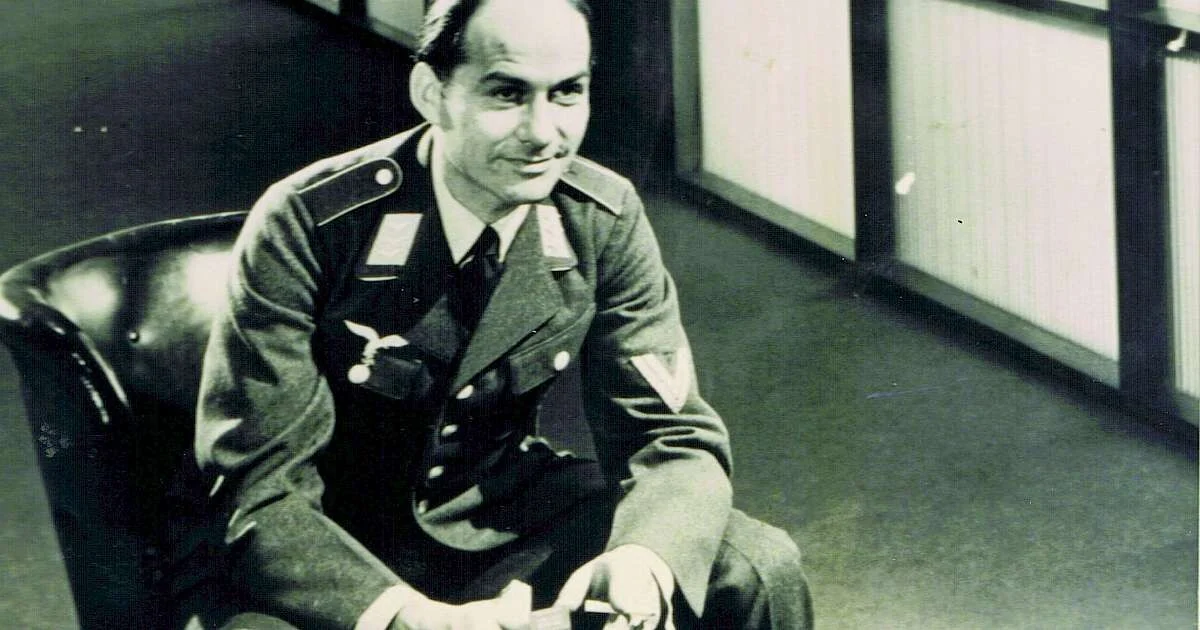
During the Second World War, interrogation rooms were usually imagined as dark, hostile places filled with intimidation, fear, and psychological pressure. In popular culture and historical memory, interrogators are often portrayed as ruthless figures who extract information through threats, coercion, or violence. Yet hidden within the Luftwaffe’s intelligence apparatus was a man who defied almost every expectation of what an interrogator should be. His name was Hanns Scharff, and his methods were so unconventional, humane, and effective that they later reshaped how modern militaries think about intelligence gathering.
Rather than relying on fear, Scharff believed that information flowed most freely when prisoners felt safe, respected, and even appreciated as human beings. His approach centered on kindness, patience, and carefully constructed social situations that encouraged enemy pilots to talk voluntarily. He took prisoners on peaceful walks, baked them homemade cakes, joked with them, shared drinks, and invited them to relaxed gatherings with famous German fighter aces. To many Allied prisoners, it barely felt like an interrogation at all. And yet, by the end of their captivity, Scharff often knew far more than they ever realized they had revealed.
What makes Scharff’s story especially remarkable is not just his success during the war, but the lasting influence of his methods. After the conflict ended, American intelligence officers studied his techniques closely. His philosophy of rapport-based interrogation ultimately became foundational in U.S. military training programs, standing in stark contrast to harsher approaches that often proved unreliable. Scharff’s legacy challenges long-held assumptions about power, persuasion, and the psychology of human trust in times of war.
Hanns Scharff and His Unlikely Path to Interrogation
Hanns Scharff did not begin his wartime career with any intention of becoming one of the most effective interrogators of the Second World War. Born in Germany in 1907, he was trained as a businessman and had a strong interest in aviation, languages, and culture. These seemingly ordinary skills would later become the foundation of his extraordinary success. When war broke out, Scharff joined the Luftwaffe, Germany’s air force, not as a pilot or intelligence officer, but initially in administrative roles.
Scharff’s transformation into an interrogator occurred almost by accident. Because he spoke fluent English and had lived in the United States earlier in his life, he was assigned to assist with questioning captured Allied airmen. At the time, German intelligence largely relied on traditional interrogation methods that emphasized authority and intimidation. Scharff quickly realized that these approaches often produced unreliable information, as prisoners either resisted completely or provided misleading details to protect themselves.
Drawing from his personal experiences and intuition, Scharff began experimenting with a radically different style. He treated prisoners as guests rather than enemies, engaging them in casual conversation instead of formal questioning. He avoided direct questions about military operations, knowing that trained pilots were conditioned to resist such tactics. Instead, he focused on building trust, allowing conversations to wander naturally toward topics of shared interest such as flying, technology, music, and life back home.
What distinguished Scharff was his deep understanding of human psychology. He recognized that people are far more likely to speak freely when they feel understood and respected. By removing the atmosphere of confrontation, he lowered the prisoners’ mental defenses. Many Allied airmen later admitted that they had spoken far more openly with Scharff than with any other interrogator, often without realizing that they were revealing valuable intelligence. This intuitive, human-centered approach marked the beginning of a quiet revolution in interrogation philosophy.
The Power of Kindness as a Strategic Weapon
At the core of Hanns Scharff’s success was a belief that kindness could be a powerful strategic tool rather than a sign of weakness. In a wartime environment defined by brutality and suspicion, his behavior stood out as almost surreal. Prisoners expected hostility, but instead they encountered warmth, humor, and civility. This contrast created a psychological dissonance that worked strongly in Scharff’s favor.
One of Scharff’s most effective techniques was his refusal to apply pressure. He rarely asked direct questions about military objectives, aircraft specifications, or future missions. Instead, he allowed prisoners to talk at their own pace, often steering conversations toward seemingly harmless subjects. He understood that trained pilots were constantly on guard against interrogation traps. By avoiding obvious probing, he disarmed their defensive instincts.
Scharff also used silence masterfully. When a prisoner made a statement, Scharff would often respond with a knowing smile or a casual remark that suggested he already knew more than he was letting on. This subtle implication led many prisoners to believe that withholding information was pointless. Rather than challenging them, he created an illusion of omniscience, encouraging them to fill in gaps voluntarily.
Importantly, Scharff never threatened or punished prisoners for remaining silent. This reinforced the perception that cooperation was a personal choice rather than an obligation. Over time, many prisoners began to view him not as an enemy interrogator, but as a trustworthy confidant. This emotional shift was crucial. When people feel respected, they are more likely to speak honestly, especially in informal social settings. Scharff’s kindness was not naïve; it was calculated, disciplined, and deeply effective.
Nature Walks, Tea, and the Art of Disarming Prisoners
Among the most famous aspects of Hanns Scharff’s interrogation style were his unconventional social settings. Rather than confining prisoners to interrogation rooms, he frequently took them on long nature walks through the German countryside. These walks were conducted without guards, an astonishing decision during wartime. The absence of visible security sent a powerful message of trust, subtly obligating prisoners to reciprocate with openness.
The walks served multiple purposes. Physically, they relaxed prisoners who had endured intense combat stress and captivity. Psychologically, they blurred the line between interrogator and companion. Conversations flowed more naturally when surrounded by forests and open skies, far removed from barbed wire and concrete walls. Scharff used these moments to observe body language, tone, and emotional responses, gathering insights that formal questioning could never reveal.
Food played an equally important role. Scharff was known for baking homemade cakes and sharing meals with prisoners. In an era of rationing and hardship, these gestures carried enormous emotional weight. Sharing food is one of the most ancient human bonding rituals, and Scharff understood its power intuitively. Afternoon tea sessions, complete with polite conversation and laughter, further reinforced the illusion of normalcy.
Perhaps most striking were Scharff’s gatherings that included celebrated German fighter aces. These meetings were designed to appeal to Allied pilots’ professional pride. Surrounded by fellow aviators, discussions naturally drifted toward aircraft performance, tactics, and personal experiences in combat. Scharff rarely needed to ask questions. Pilots spoke freely, often forgetting that they were revealing sensitive information. By transforming interrogation into social interaction, Scharff dismantled resistance without force or fear.
Psychological Insight and the Illusion of Control
Hanns Scharff’s genius lay in his ability to make prisoners feel in control while subtly guiding conversations toward useful intelligence. This psychological balancing act required patience, discipline, and a profound understanding of human behavior. Scharff recognized that people resist most strongly when they feel manipulated or dominated. By removing overt control, he allowed prisoners to believe that they were choosing what to share.
One of his most effective techniques was selective confirmation. Scharff would occasionally mention small details that suggested he already possessed extensive knowledge about Allied operations. These details were often gathered from other sources or inferred from patterns. Prisoners, assuming that secrecy was already compromised, became more willing to elaborate. This technique exploited a natural human tendency: people are more likely to speak when they believe the outcome is inevitable.
Scharff also avoided taking notes or recording conversations in front of prisoners. This created the impression that discussions were informal and inconsequential. In reality, Scharff possessed an exceptional memory and reconstructed conversations in detail afterward. Prisoners later expressed shock upon learning how much information he had retained and accurately recalled.
Crucially, Scharff never lied blatantly or fabricated threats. His credibility remained intact throughout interactions, reinforcing trust. When prisoners later realized that they had been skillfully guided into revealing information, many expressed admiration rather than resentment. Scharff’s methods demonstrated that psychological insight, when applied ethically and intelligently, could outperform brute force in extracting reliable intelligence.
Postwar Reflections and Allied Recognition
After the war ended, Hanns Scharff’s reputation among former prisoners became unexpectedly positive. Many Allied airmen who had been interrogated by him spoke openly about their experiences, often describing him as courteous, intelligent, and humane. This postwar testimony played a significant role in shaping Allied understanding of his methods. Rather than being remembered as an enemy villain, Scharff emerged as a complex figure who challenged simplistic notions of wartime morality.
American intelligence officers were particularly interested in why Scharff’s interrogations had been so effective. During debriefings and historical analyses, it became clear that his success was not accidental but rooted in a consistent philosophy. Unlike coercive interrogations, which often produced false or exaggerated information, Scharff’s approach yielded accurate, verifiable intelligence. This reliability made his techniques especially valuable for long-term strategic planning.
Scharff himself cooperated openly with postwar investigations. He shared his insights into interrogation psychology and emphasized the importance of respect, patience, and ethical boundaries. His willingness to explain his methods helped demystify interrogation and reframed it as a skill rooted in communication rather than domination.
These reflections came at a time when Allied militaries were reassessing their own interrogation practices. The brutal realities of war had exposed the limitations of fear-based methods. Scharff’s example provided a compelling alternative, grounded in real-world success rather than theory. His postwar legacy began to extend far beyond Germany, influencing the next generation of intelligence professionals.
From Luftwaffe Cells to U.S. Interrogation Schools
Perhaps the most enduring aspect of Hanns Scharff’s legacy is the direct influence his methods had on American military doctrine. In the decades following World War II, the United States military studied his techniques as part of a broader effort to professionalize and humanize interrogation practices. Scharff’s approach became a foundational case study in rapport-based interrogation.
U.S. interrogation schools began emphasizing principles that mirrored Scharff’s philosophy. Building trust, avoiding confrontation, and understanding cultural and psychological factors were prioritized over intimidation. Trainees were taught that reliable intelligence comes from cooperation, not fear. Scharff’s techniques were especially influential in shaping training during the Cold War, when intelligence accuracy was critical and misinformation could have catastrophic consequences.
What made Scharff’s methods particularly appealing was their ethical dimension. By avoiding physical or psychological abuse, his approach aligned with international law and human rights standards. This not only protected prisoners but also enhanced the credibility of intelligence operations. Information obtained through humane methods was more likely to withstand scrutiny and cross-verification.
Today, Scharff is often cited as a pioneer of modern interrogation science. His legacy lives on in manuals, training programs, and academic studies that emphasize empathy as a strategic asset. The irony is striking: a Luftwaffe interrogator from Nazi Germany helped shape some of the most ethical interrogation standards in modern Western militaries. It is a testament to the power of ideas to transcend ideology and historical boundaries.
Redefining Power, Trust, and Intelligence
Hanns Scharff’s story forces us to reconsider what power truly looks like in situations of extreme conflict. At a time when violence and fear dominated the global landscape, he demonstrated that patience, kindness, and psychological insight could be far more effective than brutality. His success was not rooted in manipulation alone, but in a genuine understanding of human nature and communication.
By treating prisoners as people rather than enemies, Scharff achieved results that many harsher interrogators could not. His legacy challenges the assumption that ethical behavior is incompatible with strategic success. On the contrary, his methods suggest that empathy can be a powerful tool when applied with discipline and integrity.
The fact that his techniques were later adopted by the United States military underscores their lasting value. Scharff’s influence continues to shape how intelligence professionals think about interrogation, trust, and truth. In an age where ethical standards in warfare remain under constant scrutiny, his example remains profoundly relevant.