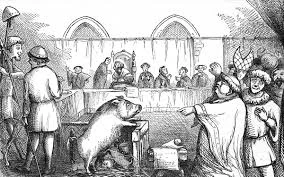
In the year 1386, in a quiet medieval town in France, one of the most unsettling and surreal legal events in European history took place. A pig—an ordinary farm animal—was formally arrested, imprisoned, tried in a court of law, convicted of murder, and publicly executed by hanging. Its crime, according to surviving legal records, was the fatal attack of a child who later died from severe wounds. To the modern mind, this episode seems grotesque, absurd, or even darkly comedic. Yet in the Middle Ages, it was viewed as a perfectly legitimate act of justice. The animal was treated not as livestock but as a legal person, subject to the same judicial process as a human criminal. The pig was dressed in human clothing for its execution, hauled to the gallows, and killed before a watching crowd. This macabre spectacle was not an isolated oddity but part of a broader medieval legal tradition in which animals were held morally and criminally accountable for their actions. To truly understand how a pig could be tried and executed for murder, we must step completely outside modern assumptions about law, responsibility, and the boundary between humans and animals.
The 1386 Case: What Actually Happened to the Executed Pig
The most famous animal execution of the Middle Ages occurred in the town of Falaise in 1386. The preserved court documents describe how a sow attacked a small child, inflicting severe injuries to the face, arms, and legs. The child later died as a result of these wounds. This alone would have been a tragic but not entirely uncommon occurrence in medieval life, where children often lived in close proximity to large, unpredictable farm animals. What transformed this incident into a historical landmark was what followed.
Instead of simply killing the pig as dangerous livestock, local authorities treated the case as a homicide. The animal was formally arrested and placed in custody, reportedly held in the same prison where human criminals were detained. Witnesses were called to testify against the pig. The wounds were examined. Evidence was presented. A court convened to hear the case exactly as it would have if a human had been accused. After deliberation, the pig was found guilty of murder.
The sentence was death by hanging—one of the standard execution methods used for human criminals. To emphasize the moral symbolism of the punishment, the pig was dressed in human clothing before being led to the gallows. According to accounts, its face and forelegs were mutilated prior to execution in a ritual imitation of the injuries it had inflicted on the child. Then, before a gathered crowd, the pig was hanged.
This was not done in secret. It was a public act of justice meant to be seen, understood, and remembered. The people who witnessed it did not consider it farcical. They considered it necessary. The execution served multiple functions: it punished wrongdoing, restored moral balance, deterred future danger, and reaffirmed the authority of the law. In medieval thinking, justice was not only about individual guilt—it was about maintaining cosmic and social order.
The legal system that condemned the pig did not view animals as morally neutral forces of nature. Instead, animals existed within a moral framework governed by God and enforced by human law. If an animal committed a crime, it disrupted that framework. Trial and execution were methods of repairing spiritual and societal damage. Without such action, people feared divine punishment, social disorder, and moral decay.
Why Medieval Courts Put Animals on Trial at All
To modern readers, the idea of trying an animal in court feels like pure absurdity. Animals lack moral agency in contemporary legal systems. They cannot form criminal intent and are therefore not held legally responsible. In the Middle Ages, however, the worldview was fundamentally different. Law, religion, and morality were not separate domains. They were intertwined into a single system of meaning that governed everything from kingship to livestock behavior.
Medieval Europeans believed that the entire universe operated according to divine law. God established order, and both humans and animals existed within that order. When any creature violated that order—whether through sin, violence, or unnatural behavior—justice had to be carried out to restore harmony. This applied not only to people but to animals as well. An animal that killed a human was thought to have committed a crime against God, community, and cosmic balance.
Animals were also viewed as capable of being influenced by evil forces. Just as humans could be tempted by demons, animals were believed to be susceptible to possession or corruption. A murderous pig was not simply acting on instinct—it might be seen as an instrument of Satan. Allowing such a creature to live after committing a violent act could invite further disaster upon the town.
Legal theory at the time supported this logic. Courts existed not primarily to analyze psychology or intent but to publicly affirm right and wrong. Crime was not just a personal failing—it was a public wound that required ritual cleansing. Trials of animals served as acts of collective purification. By condemning a criminal animal, the community demonstrated that no act of violence would go unanswered, regardless of the perpetrator’s species.
Importantly, these trials were not jokes. They followed formal legal procedures. Animals were granted legal representation in some cases. Court records show that lawyers argued on behalf of pigs, cows, horses, rats, locusts, and even insects. In ecclesiastical courts, entire populations of pests were sometimes excommunicated or ordered to leave an area under threat of divine punishment.
The pig of 1386 was not just being killed for safety. It was being judged for a moral offense. Medieval people believed that every violent act carried spiritual consequences. If justice was not properly enacted, God might punish the entire community. The execution of the pig was therefore both punishment and protection—a legal and religious safeguard against further calamity.
Violence, Livestock, and Daily Danger in the Middle Ages
To grasp why animal executions felt necessary rather than ridiculous, one must understand how dangerous everyday life was in the Middle Ages. People lived in extremely close contact with animals. Pigs roamed freely through villages, feeding on scraps, garbage, and refuse. They were powerful, aggressive, and unpredictable. Children played in the same muddy streets where livestock wandered. There were no fences, no modern safety regulations, and no clear separation between human and animal spaces.
Attacks by animals were not rare. Pigs in particular were responsible for numerous fatal and disfiguring injuries. They were strong, territorial, and capable of killing adults, let alone children. Wolves, bears, bulls, horses, and dogs also caused frequent deaths. Without modern medicine, even non-fatal wounds could quickly become lethal through infection.
In this environment, when an animal killed a child, the event reverberated through the entire community as both a tragedy and a warning. People did not interpret such deaths purely as accidents. They saw them as signs of disorder, divine punishment, or moral contamination. Justice had to be public, severe, and unmistakable.
The execution of the pig was not simply about vengeance for the child’s death. It was about reasserting control over a frightening world. Medieval communities were deeply aware of how thin the line was between safety and catastrophe. Disease, famine, war, and natural disaster were constant threats. Law and ritual were among the few tools people had to impose meaning and order on chaos.
Public executions, whether of humans or animals, reinforced this sense of control. They demonstrated that violence would be met with counter-violence sanctioned by divine and royal authority. The spectacle was meant to frighten not only other animals, but also humans into obedience and caution. In this context, hanging a pig was not insanity—it was symbolic governance.
The choice to dress the pig in human clothing only intensified this symbolism. It visually declared that the animal was being punished as a moral agent. This theatrical element reinforced the idea that the pig had crossed a boundary from beast to criminal. By treating it as a human offender, the court sent a powerful message that no act of violence could hide behind instinct alone.
Animal Trials Were Widespread, Not a One-Time Aberration
The execution of the pig in 1386 is the most famous case, but it was far from unique. Across medieval Europe, hundreds of recorded animal trials took place between the 13th and 18th centuries. Pigs, cows, horses, dogs, goats, rats, insects, and even beetles were brought before courts and formally charged with crimes. Some were accused of murder. Others were charged with destroying crops, spreading disease, or disrupting public order.
In many cases, animals were sentenced to death by hanging, burning, or beheading. In other cases, particularly involving pests like rats or locusts, animals were excommunicated by church courts. They were symbolically cast out of the Christian community and commanded to leave the area under penalty of divine curse.
Remarkably, some animals were even acquitted. Court records show that defense attorneys argued that certain animals had not acted maliciously, were provoked, or were physically incapable of the alleged crimes. In several instances, animals were spared execution due to lack of evidence or legal technicalities. These outcomes further demonstrate that courts took these proceedings seriously.
There were also cases in which the owners of animals were punished alongside or instead of the animals themselves. Owners could be fined, imprisoned, or publicly shamed for failing to control dangerous livestock. This reinforces the idea that animal trials were not merely symbolic—they were part of a broader system of social regulation.
What gradually caused these trials to disappear was the slow transformation of legal philosophy. As scientific thinking expanded and Enlightenment ideas spread, animals began to be viewed less as moral agents and more as biological organisms governed by instinct. Responsibility shifted toward owners, handlers, and environmental conditions. Criminal intent became a human category rather than a universal one.
By the time modern legal systems emerged, the idea of prosecuting an animal had become unthinkable. What once seemed like righteous justice transformed into historical curiosity. But for several centuries, communities across Europe participated in these rituals with complete sincerity, convinced that moral law applied to all living beings.
The Psychological and Social Function of Executing the Pig
Beyond law and theology, the execution of the pig in 1386 served deep psychological and social purposes. The violent death of a child was a trauma that shattered families and communities. In a world without grief counseling, forensic science, or modern explanations of animal behavior, people sought meaning through ritualized justice. The trial and execution provided a narrative closure that simple slaughter could not.
By arresting the pig and subjecting it to a trial, the community transformed a chaotic tragedy into an understandable moral story. There was a crime, a criminal, a legal process, and a final resolution. This structure gave people a sense of control over a horrifying event that otherwise felt random and unjust.
The public nature of the execution further reinforced communal healing through shared experience. Everyone saw justice being done. Everyone participated, at least as witness, in restoring order. The pig’s death was not private revenge—it was collective purification.
There was also a crucial deterrent function. Even if people did not literally believe that other pigs would learn from the execution, they believed that symbolic punishment affected the behavior of all creatures under divine law. Failing to punish the pig properly might invite further attacks as a sign that evil went unchallenged.
For parents, the execution offered something even deeper: meaning in loss. It transformed the child’s death from meaningless accident into cosmic struggle between order and chaos. The community did not merely lose a child—it defeated an embodiment of destruction. This reframing was psychologically necessary in a society where death was common yet emotionally devastating.
In this light, the execution of the pig was not driven by cruelty alone. It was an attempt to make sense of unbearable grief within the only conceptual framework people had. Justice was not just legal—it was emotional, spiritual, and communal.
When Justice Extended Beyond Humanity
The execution of a pig for murder in 1386 stands as one of the most haunting reminders of how radically different medieval thinking was from our own. To modern eyes, the idea of arresting, imprisoning, trying, and hanging an animal feels absurd. But in the moral universe of the Middle Ages, it made devastating sense. Animals were not seen merely as instinct-driven creatures. They existed within a divine order where violence demanded judgment and where justice served to repair not just society, but the cosmos itself.
The pig that killed a child was not simply destroyed—it was formally condemned as a criminal. Its execution was a public ritual of purification, deterrence, and spiritual restoration. In that moment, law, religion, grief, and fear converged on a scaffold built for a beast dressed like a human.
Today, the story unsettles us because it blurs boundaries we consider absolute: between human and animal, between accident and intent, between instinct and guilt. Yet for the people of 1386, those boundaries were far more fluid. Justice was not limited by species. It was defined by moral violation.
The hanging of the pig remains a chilling testament to a time when law reached into every corner of existence—where even a farm animal could stand before a court, hear a sentence, and die as a condemned criminal.
Leave a Reply