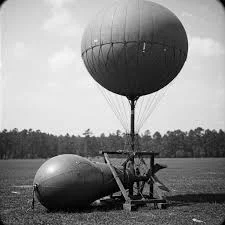
On a quiet spring day in 1945, far from the battlefields of Europe and the Pacific, World War II reached the American homeland in a way few could have imagined. In the forests near Bly, Oregon, a Japanese balloon bomb—carried thousands of miles across the Pacific Ocean by high-altitude jet streams—detonated unexpectedly. The explosion killed a pregnant woman and five children who had stumbled upon it during a church outing. These six individuals became the only confirmed civilian casualties of World War II caused by enemy action on U.S. soil. The tragedy is often overshadowed by the war’s immense global scale, yet it remains one of the most haunting episodes in American wartime history. It reveals not only the reach of the conflict, but also the quiet vulnerabilities that existed even in places far removed from combat zones.
The Japanese Balloon Bomb Program: A Weapon Carried by the Wind
The balloon bomb that exploded in Oregon was part of a secret Japanese military program known as Fu-Go. Developed late in World War II, this unconventional weapon aimed to strike the United States using nature itself as a delivery system. Japanese scientists had discovered the existence of powerful high-altitude air currents—now known as the jet stream—that flowed eastward from Japan across the Pacific Ocean to North America. By releasing large hydrogen-filled balloons into these currents, Japan hoped they could drift silently toward the continental United States.
Each balloon measured roughly 33 feet in diameter and was constructed from paper made of mulberry fibers, glued together by hand. Suspended beneath the balloon was a complex bomb mechanism carrying incendiary and anti-personnel explosives. An ingenious ballast system dropped sandbags at timed intervals to maintain altitude during the journey, which could last several days. Once the ballast was depleted, the bomb payload was designed to fall toward the ground.
The Japanese military launched more than 9,000 of these balloons between November 1944 and April 1945. Their primary objective was psychological rather than strategic. Japan hoped the balloons would ignite massive forest fires in the Pacific Northwest, divert American resources, spread fear among civilians, and demonstrate that the U.S. mainland was not immune to attack.
In practice, the campaign was largely ineffective. Weather conditions were unpredictable, many balloons malfunctioned or fell into the ocean, and winter rains in the Pacific Northwest prevented widespread fires. Nonetheless, hundreds of balloons did reach North America, landing in Alaska, Canada, California, Arizona, and Oregon. Most were discovered before causing harm. One, however, found its way into a tragic moment of human curiosity.
America’s Response: Silence, Censorship, and Hidden Danger
When the first balloon bombs began appearing on American soil, U.S. military officials quickly recognized the potential danger—not only from the explosives themselves, but from public reaction. The federal government imposed a strict media blackout, asking newspapers and radio stations to refrain from reporting balloon bomb incidents. The strategy was simple: if Japan believed the weapons were ineffective, they might abandon the program.
The press largely complied. As a result, most Americans had no idea that enemy weapons were landing across the western United States. Even communities near discovered balloon sites were often left uninformed. Local authorities quietly removed devices, and bomb disposal units were dispatched without public explanation.
This secrecy, while strategically effective, had unintended consequences. Civilians were not warned to avoid suspicious objects. Children, hikers, and rural residents—accustomed to unexploded ordnance being a distant wartime concern—had no reason to suspect danger in their own forests.
By early 1945, military leaders believed the balloon campaign was waning. The lack of public reaction reinforced Japanese assumptions that the balloons were failing. Ironically, this very silence would set the stage for the only fatal incident.
On May 5, 1945, a small group from Bly, Oregon—members of a local church—went on a picnic outing into the nearby woods. Among them were Reverend Archie Mitchell, his pregnant wife Elsie, and five children. While Reverend Mitchell parked the car, Elsie and the children wandered ahead. Moments later, an explosion shattered the forest.
The balloon bomb had been disturbed.
The Bly, Oregon Tragedy: America’s Only WWII Civilian Losses at Home
The victims of the explosion were Elsie Mitchell, who was five months pregnant, and five children: Jay Gifford (13), Joan Patzke (14), Dick Patzke (13), Sherman Shoemaker (11), and Edward Engen (13). They had discovered the balloon bomb lying in the woods, likely partially hidden and unrecognizable as a weapon. When someone touched or moved it, the device detonated instantly.
Reverend Mitchell, who had stayed behind to park the car, heard the blast and rushed toward the site. He arrived to a scene of devastation. All six victims were killed instantly. The shock rippled through the small community, which struggled to understand how a weapon from a war half a world away had ended the lives of local children on a peaceful Sunday afternoon.
Military authorities quickly secured the area and began an investigation. Only then did the federal government lift its media blackout. Officials believed that with the war nearing its end and the Japanese balloon program likely concluded, public safety now outweighed strategic secrecy. News of the tragedy spread across the nation, startling Americans who had been unaware of the balloon threat.
President Franklin D. Roosevelt personally approved the release of information, and military leaders issued warnings urging civilians to report any suspicious objects and avoid touching unknown debris. Unfortunately, for the victims in Oregon, the warning came too late.
The tragedy at Bly remains unique in U.S. history. While other balloon bombs caused minor injuries and property damage, this was the only incident to result in loss of life. It stands as a somber reminder that war does not always announce itself with sirens or uniforms—it can arrive quietly, carried by the wind.
Why the Balloon Bombs Failed as a Strategic Weapon
Despite the tragedy in Oregon, Japan’s balloon bomb campaign was largely a failure from a military standpoint. Several factors contributed to its ineffectiveness. First, the reliance on natural wind patterns made the balloons unpredictable. Many never reached North America. Others landed harmlessly in remote wilderness or fell into the ocean.
Second, the intended goal of causing widespread forest fires proved unrealistic. The Pacific Northwest’s climate during the winter and early spring months was too wet for fires to spread effectively. Even when balloons landed intact, their incendiary charges often fizzled out without igniting significant blazes.
Third, the U.S. government’s media blackout was highly successful. Japanese intelligence relied on open-source information, including American newspapers and radio broadcasts, to assess the effectiveness of their weapons. The lack of coverage convinced Japanese planners that the balloons were missing their targets or causing no disruption. As a result, the program was quietly scaled back.
Ironically, the Japanese never learned of the Oregon deaths until after the war ended. Had they known the balloons caused civilian casualties, the program might have continued longer. Instead, it faded into obscurity, overshadowed by the rapid collapse of Japan’s military position in 1945.
From a technological standpoint, the balloon bombs were innovative. They represented one of the earliest attempts at intercontinental weapons delivery and foreshadowed later developments in missile and drone warfare. Yet innovation alone could not overcome environmental unpredictability and effective countermeasures.
The balloons’ failure highlights a recurring theme in military history: weapons designed to terrorize civilians often fail to achieve strategic goals, even when they succeed in causing isolated tragedies.
The Legacy of the Bly Incident in American Memory
For decades after the war, the Bly tragedy remained relatively obscure. Unlike Pearl Harbor or D-Day, it did not fit neatly into popular narratives of World War II. The victims were civilians, the weapon was unconventional, and the attack lacked dramatic intent or visibility. Yet within Oregon—and among historians—it has never been forgotten.
A memorial now stands near the site of the explosion, honoring Elsie Mitchell and the five children. Each year, local residents and visitors gather to remember the lives lost and reflect on the strange path history took to that quiet forest clearing. The site serves both as a tribute and as a warning.
The incident also prompted long-term changes in how unexploded ordnance is treated and reported. Public awareness campaigns, emergency response protocols, and civilian education about wartime debris were strengthened in the years that followed—not just in the U.S., but globally.
In a broader sense, the tragedy challenges the notion that America was untouched by the war at home. While the continental United States did not experience bombings on the scale seen elsewhere, it was not entirely insulated from danger. The balloon bomb demonstrated that distance alone could not guarantee safety.
The story has gained renewed attention in recent years as historians and educators seek to highlight lesser-known aspects of World War II. It offers a poignant counterpoint to narratives of victory and heroism, reminding us that war’s consequences often fall on the innocent and unprepared.
How Nature Became a Weapon—and Why That Still Matters
The Japanese balloon bomb campaign represents one of the earliest examples of weaponizing environmental systems. By harnessing the jet stream, Japan attempted to turn the planet’s natural forces into tools of war. This concept—using nature as both carrier and camouflage—has only grown more relevant in the modern era.
Today, military planners consider weather, terrain, and environmental systems as integral parts of warfare. Cyberattacks, satellite disruption, and autonomous systems echo the same principle behind the balloon bombs: reach the enemy indirectly, invisibly, and unexpectedly.
The Bly tragedy illustrates the moral risks of such approaches. When weapons rely on chance and natural forces, control is lost. Civilian populations become more vulnerable, and accountability becomes blurred. The balloon that landed in Oregon did not discriminate between military and civilian targets—it simply followed the wind.
This lesson resonates in contemporary debates about long-range weapons, autonomous drones, and cyber warfare. The further removed a weapon becomes from human oversight, the greater the risk of unintended harm. The balloon bombs were crude by modern standards, yet they embody dilemmas that remain unresolved.
In this sense, the Oregon incident is not just a historical curiosity. It is an early warning about the dangers of technological innovation divorced from ethical restraint.
A Quiet Forest, a Global War, and a Lasting Lesson
The deaths of a woman and five children in rural Oregon in 1945 stand as one of the most tragic and least-known moments of World War II. Carried across an ocean by invisible winds, a weapon designed thousands of miles away found its way into the lives of people who had no reason to expect danger.
They became the only confirmed World War II casualties on U.S. soil caused by enemy action—not because America was uniquely safe, but because the circumstances that led to their deaths were extraordinarily rare.
Their story reminds us that war’s reach extends far beyond front lines and battle maps. It arrives quietly, unpredictably, and often without warning. It also reminds us of the human cost behind strategic experiments and technological innovation.
The balloon bomb that landed in Oregon failed as a weapon of war, but it succeeded in leaving a permanent mark on history. Not through destruction on a grand scale, but through a single, devastating moment that continues to echo as a warning about the unintended consequences of conflict.
Leave a Reply