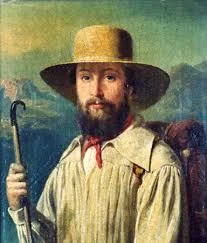
Johnny Appleseed is often remembered as a half-mythical folk hero—a barefoot wanderer scattering apple seeds across the American frontier, guided by kindness, faith, and an almost magical connection to nature. For generations, his story has been told in children’s books, songs, and school lessons, gradually blurring the line between fact and folklore. Yet behind the legend was a real, complex human being. Johnny Appleseed’s true name was John Chapman, and he was born in Leominster, Massachusetts, in 1774. Far from being a simple fairy-tale character, Chapman was a savvy nurseryman, a deeply religious missionary, and a man whose life intersected with some of the most formative moments in early American history. Even today, his hometown honors him with a street named not after the man he legally was, but after the legend he became—Johnny Appleseed Lane—a quiet reminder of how deeply myth and reality have fused around his life.
John Chapman’s Early Life in Leominster, Massachusetts
John Chapman was born on September 26, 1774, in the small town of Leominster, Massachusetts, during a turbulent period in American history. The American Revolutionary War was unfolding, and Chapman’s childhood was shaped by uncertainty, loss, and movement. His mother died shortly after his birth, a trauma that likely influenced his later embrace of asceticism and spiritual devotion. His father, Nathaniel Chapman, served as a Minuteman in the Continental Army, exposing young John early to the ideals of sacrifice, independence, and endurance.
Leominster in the late 18th century was a modest New England town, surrounded by forests, farms, and rivers. It was here that Chapman developed his early connection to nature. The region’s agricultural rhythms—planting, harvesting, and tending orchards—would later define his life’s work. Apples were already an important crop in colonial America, used not just for eating but for making cider, vinegar, and preserves. Clean drinking water was often scarce or unsafe, and hard cider was a daily staple for many families, including children.
Chapman received some formal education, enough to read and write fluently, but his true education came from the land. As a young man, he apprenticed with a nurseryman, learning how to plant apple seeds, graft trees, and maintain orchards over long periods. This training gave him practical knowledge that most frontier settlers lacked. While many pioneers planted crops for immediate survival, Chapman understood the long-term value of orchards—assets that would grow more valuable with time.
It was also in Massachusetts that Chapman encountered the religious ideas that would guide his life. He became a follower of Emanuel Swedenborg, a Christian mystic whose teachings emphasized simplicity, charity, and a deep spiritual connection with nature. This belief system encouraged Chapman’s rejection of material wealth and shaped his unconventional lifestyle.
Although Chapman would spend most of his adult life traveling far from Leominster, the town remained foundational to his identity. The fact that modern Leominster honors him with Johnny Appleseed Lane—using his legendary name rather than his birth name—reflects how completely the myth has eclipsed the man, even in the place where his story began.
Why Johnny Appleseed Wasn’t Just Scattering Seeds Randomly
Popular imagery portrays Johnny Appleseed as a whimsical wanderer tossing apple seeds wherever he went, but this version of the story misses the strategic intelligence behind his actions. John Chapman was not planting seeds randomly—he was deliberately establishing apple nurseries along the advancing edge of American settlement.
Chapman traveled westward ahead of settlers, particularly into what are now Ohio, Indiana, and Illinois. He would identify fertile land near rivers or emerging communities and plant apple seeds in carefully tended plots. He often fenced these nurseries to protect them from livestock and returned periodically to maintain them. These were not casual plantings; they were long-term investments.
When settlers arrived, Chapman sold or traded young apple trees from his nurseries. Sometimes he accepted money, but often he accepted food, clothing, or simply the promise that settlers would care for the trees. In some cases, he even gave trees away to families who could not afford them. Contrary to the image of a penniless drifter, Chapman understood property rights and land claims. In several instances, he legally owned the land where his nurseries stood.
This approach made him an important figure in frontier expansion. Orchards were valuable because they signaled permanence. Under U.S. land laws at the time, planting apple trees could help settlers establish legal claims to land. Apples also provided food, drink, and trade goods. Chapman’s work made frontier life more sustainable and less precarious.
It is also important to note that apples grown from seeds do not produce sweet eating apples. Most of Chapman’s trees yielded small, bitter fruit suitable for cider rather than fresh consumption. This aligns with historical reality: cider, not apples, was the primary goal. Chapman was helping settlers produce alcohol—a safer alternative to contaminated water—and an essential part of frontier diets.
Thus, Johnny Appleseed was not a naïve dreamer scattering hope in the wind. He was a knowledgeable horticulturist, a land speculator, and a man who understood the economic and legal systems shaping early America. The myth simplifies him; the reality reveals a far more impressive figure.
The Religious Beliefs That Shaped Chapman’s Life
John Chapman’s lifestyle cannot be fully understood without examining his deep religious convictions. He was a devoted follower of Swedenborgian Christianity, a movement based on the teachings of Emanuel Swedenborg. This faith emphasized personal spirituality, charity, pacifism, and harmony with nature—principles that Chapman embodied fully.
Chapman believed that caring for the land was a form of worship. Planting trees, in his view, was a sacred act that benefited future generations. He saw himself as both a missionary and a steward of God’s creation. As he traveled, he often preached, distributing religious pamphlets and sharing Swedenborg’s writings with frontier families. Many settlers remembered him not just as an orchard planter, but as a gentle preacher who spoke of kindness, restraint, and spiritual reflection.
His faith also influenced his extreme simplicity. Chapman rejected material possessions, often wearing old clothes and walking barefoot—even in harsh weather. While later stories exaggerated this behavior, there is strong evidence that he lived with remarkable austerity. He avoided harming animals, reportedly nursing injured wildlife back to health and refusing to kill even insects unnecessarily.
This pacifism extended to human conflict as well. Chapman was known for mediating disputes between settlers and Native American communities. His reputation for honesty and nonviolence earned him trust among Indigenous tribes, allowing him to travel safely through regions that were dangerous for most settlers. In some cases, Native Americans warned him of approaching threats, recognizing him as a man who meant no harm.
Chapman’s religious devotion made him an outsider in many ways. He did not marry, did not settle permanently, and did not accumulate wealth. Yet it also gave him a moral authority that transcended social boundaries. To frontier communities, he was both eccentric and deeply respected—a living symbol of conscience in a rapidly expanding nation.
The Relationship Between Johnny Appleseed and Native Americans
One of the most remarkable aspects of John Chapman’s life was his relationship with Native American tribes. During a time marked by violence, displacement, and mistrust, Chapman managed to move freely among Indigenous communities with minimal conflict. This was not accidental; it was the result of his behavior, beliefs, and reputation.
Chapman treated Native Americans with respect and dignity at a time when many settlers did not. He did not see them as obstacles to expansion but as fellow inhabitants of the land. His pacifism and refusal to carry weapons distinguished him from most frontiersmen. This, combined with his religious convictions, made him a unique presence on the frontier.
Several historical accounts suggest that Native American tribes viewed Chapman as a harmless and even beneficial figure. His apple nurseries provided food resources, and his peaceful demeanor signaled that he posed no threat. In return, Chapman received protection and warnings of danger. This mutual respect allowed him to traverse contested territories safely.
The myth of Johnny Appleseed often omits this aspect of his life, yet it may be one of his most important legacies. At a time when cultural collision defined American expansion, Chapman represented an alternative approach—one rooted in coexistence rather than conquest.
How the Myth of Johnny Appleseed Took Shape
The transformation of John Chapman into Johnny Appleseed began during his own lifetime and accelerated after his death in 1845. As frontier communities modernized, nostalgia for earlier times grew. Chapman’s unusual lifestyle, religious devotion, and constant travel made him a perfect subject for storytelling.
Early newspaper articles and local histories began embellishing his deeds. Stories portrayed him as a saintly figure who gave away apple trees out of pure kindness, walked barefoot through snow without suffering, and lived in perfect harmony with nature. Children’s literature further softened his image, removing references to cider production, land ownership, and religious preaching.
By the late 19th and early 20th centuries, Johnny Appleseed had become a symbol of American innocence and generosity. He represented the idea that the nation was built not only by soldiers and politicians, but by gentle individuals planting seeds for the future. This myth aligned perfectly with America’s desire to see its expansion as benevolent rather than exploitative.
Yet the myth also erased complexity. It stripped Chapman of his strategic intelligence, his religious intensity, and his role within broader systems of land settlement. While the legend is charming, it flattens a life that was far richer and more challenging than folklore suggests.
Johnny Appleseed Lane: Memory, Myth, and Place
Today, Leominster, Massachusetts, honors its most famous son with Johnny Appleseed Lane. The choice to use his mythical name rather than “John Chapman” is telling. It reflects how collective memory often prefers legend to reality.
Street names are acts of storytelling. By naming the street after Johnny Appleseed, Leominster acknowledges not just a historical figure, but a cultural icon. The name evokes generosity, simplicity, and connection to the land—values the town wishes to celebrate.
At the same time, the street serves as a reminder that myths are rooted in real lives. Johnny Appleseed Lane leads back to a man who walked long distances, planted orchards with intention, and lived according to beliefs that set him apart from his era.
The coexistence of myth and history in this single street name encapsulates Chapman’s legacy. He was both John Chapman and Johnny Appleseed—both a practical nurseryman and a symbol of American idealism.
Why Johnny Appleseed Still Matters Today
In an age of environmental concern and renewed interest in sustainable living, John Chapman’s life feels strikingly relevant. He practiced long-term thinking, planted for future generations, and lived with minimal consumption. His belief that humans should act as caretakers rather than conquerors of nature resonates strongly in the modern world.
At the same time, revisiting the real John Chapman encourages us to think critically about myths. Legends can inspire, but they can also obscure truth. Understanding the man behind Johnny Appleseed allows us to appreciate both the poetry and the pragmatism of his life.
He was not a fairy-tale figure, but a human being navigating a complex world—balancing faith, commerce, survival, and idealism. That balance is perhaps his greatest lesson.
Beyond the Legend, a Life Well Planted
Johnny Appleseed was real. His name was John Chapman, and he came from Leominster, Massachusetts—a town that still remembers him through a street named after the legend he became. Yet his true story is richer than folklore.
He was a skilled nurseryman, a religious missionary, a pacifist, and a quiet architect of American settlement. He planted orchards not as random acts of kindness, but as deliberate investments in the future. He lived simply not because he was naïve, but because he believed deeply in restraint and charity.
The legend of Johnny Appleseed continues to inspire, but the reality of John Chapman is even more compelling. In understanding both, we see how history and myth intertwine—and how one man’s life can grow far beyond its roots, bearing fruit for generations.
Leave a Reply