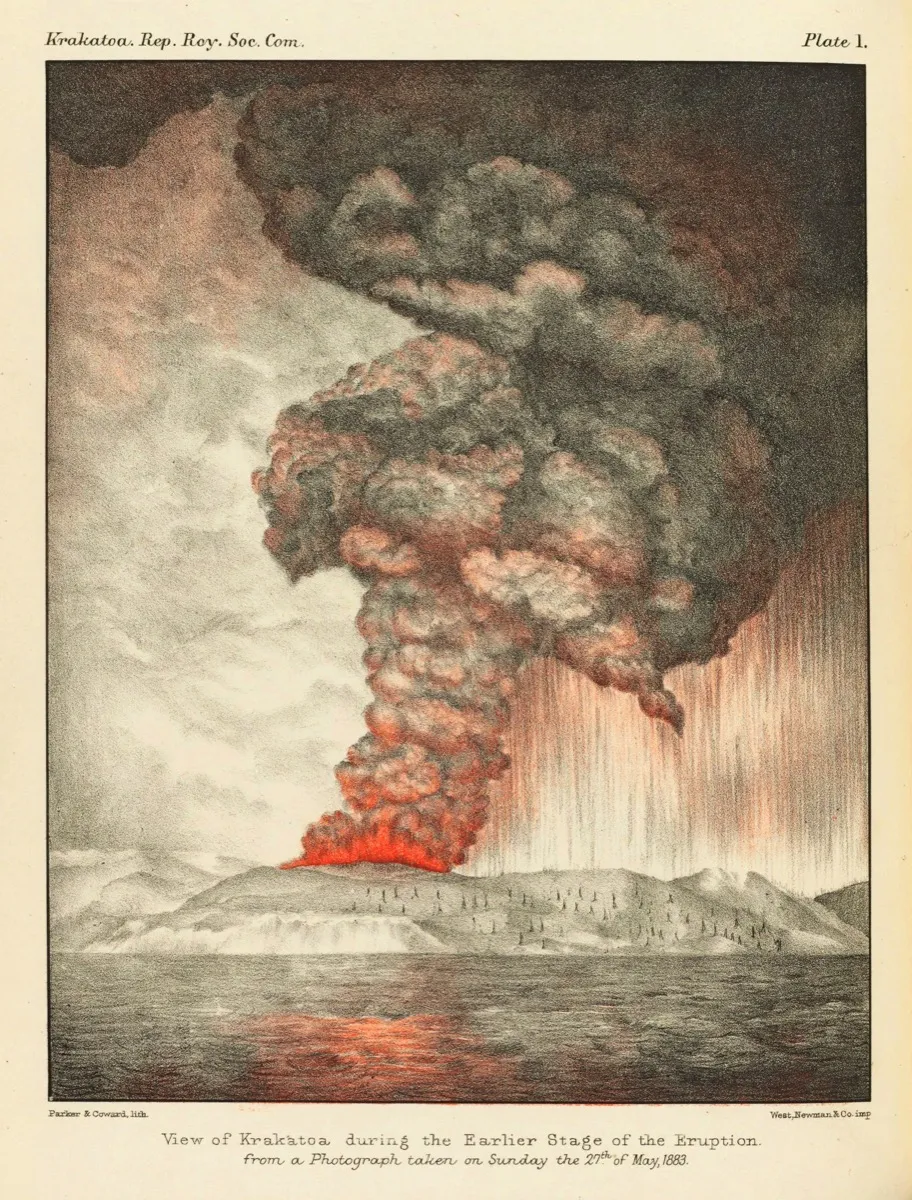
The eruption of Krakatoa was not just destructive—it was profoundly audible. On the morning of August 27, 1883, the Earth itself seemed to tear apart. What began as a distant rumble in the Sunda Strait between Java and Sumatra escalated into one of the most violent natural events ever recorded by humanity. The sound it produced shattered eardrums, echoed across oceans, and circled the globe multiple times. Long before modern seismographs and satellite monitoring, people around the world experienced this eruption not through sight, but through sound. It was heard as far away as Australia, Sri Lanka, and even the island of Rodrigues near Africa. To grasp the scale of this phenomenon, one must imagine standing in New York City and clearly hearing a sound that originated in San Francisco. That comparison, astonishing as it sounds, still does not fully capture the raw power unleashed that day.
The Krakatoa eruption stands as a reminder that sound, when driven by unimaginable energy, can transcend distance in ways that challenge intuition. It also reveals how deeply interconnected the planet is, with atmospheric waves carrying evidence of catastrophe across hemispheres. More than a geological event, Krakatoa became a global sensory experience—one that humanity has never forgotten.
Krakatoa Before the Explosion: A Volcanic Giant Awakens
Before its catastrophic eruption, Krakatoa was a volcanic island complex located in the Sunda Strait, a narrow body of water separating the Indonesian islands of Java and Sumatra. The region sits along the Pacific Ring of Fire, an area known for intense seismic and volcanic activity due to tectonic plate boundaries. Krakatoa itself was not a single cone but a group of volcanic islands, shaped over thousands of years by repeated eruptions and collapses. For centuries, it had been relatively quiet, its slopes covered with vegetation and its presence largely ignored by the surrounding population.
That calm began to change in May 1883, when ships passing through the strait reported ash clouds rising from the island. Sailors described explosions, pumice floating in the water, and a persistent haze dimming the sun. These early warnings, however, did not trigger evacuations or widespread alarm. Volcanology was still a young science, and the mechanisms behind such eruptions were poorly understood. Many assumed Krakatoa was simply releasing pressure in a routine way.
Throughout the summer, activity intensified. Ash fell on nearby towns, and loud detonations were heard intermittently along the coast. Yet daily life continued. Coastal communities had lived alongside volcanoes for generations and were accustomed to their moods. What no one realized was that magma chambers beneath Krakatoa were filling with enormous pressure, primed for a release unlike anything in recorded history.
By late August, the volcano had reached a critical state. The sea around it churned, the air vibrated with low-frequency booms, and ships reported difficulty navigating through thick layers of ash and pumice. Still, the true scale of what was coming remained unimaginable. Krakatoa was not preparing for a typical eruption—it was preparing to explode with such force that it would permanently alter global understanding of sound, energy, and atmospheric waves.
The Moment of Detonation: Sound Beyond Human Experience
At approximately 10:02 a.m. local time on August 27, 1883, Krakatoa produced the loudest sound ever reliably documented. The final explosion was so violent that it destroyed most of the island, sending vast quantities of rock, ash, and gas into the atmosphere. But it was the sound—an immense pressure wave—that stunned the world. People within 40 miles of the eruption suffered ruptured eardrums. Some were knocked unconscious by the sheer force of the blast. Windows shattered hundreds of miles away.
The explosion generated a shockwave that raced through the atmosphere at the speed of sound. Barometers around the world recorded sudden spikes as the pressure wave passed by, not once, but repeatedly. Incredibly, this atmospheric wave traveled around the Earth four times before dissipating. Instruments in Europe, North America, and beyond registered the disturbance, providing scientific proof of the eruption’s global reach.
Human ears, too, bore witness. The sound was clearly heard in Perth, Australia, nearly 2,000 miles away, where it was mistaken for distant cannon fire. Even more astonishing, reports came from the island of Rodrigues in the Indian Ocean—about 3,000 miles from Krakatoa—where residents described a loud bang followed by confusion and alarm. This distance is roughly equivalent to hearing a sound travel from New York to San Francisco, a comparison that helps modern readers appreciate the scale but still fails to convey the terror of the moment.
The nature of the sound itself remains difficult to describe. Survivors closer to the eruption spoke of a deafening roar followed by an oppressive silence, as if the air had been momentarily sucked away. Scientists later estimated that the sound reached approximately 310 decibels near the source—far beyond the threshold of pain and well into a range that defies direct human experience. Krakatoa did not merely make noise; it redefined what sound could be.
Waves Through Air and Sea: The Planet Responds
The sound of Krakatoa was only one manifestation of the immense energy released. That same force displaced enormous volumes of air and water, creating tsunamis that devastated coastal regions. Waves as high as 120 feet slammed into nearby shores, obliterating towns and killing more than 36,000 people, most of them drowned. Entire communities along the coasts of Java and Sumatra were erased in minutes.
The atmospheric pressure wave generated by the eruption behaved like a ripple across the sky. As it traveled, it compressed and expanded the air, causing barometers worldwide to oscillate rhythmically. Scientists later confirmed that these oscillations corresponded precisely to the times the pressure wave passed each location, offering rare global data from a single event. This phenomenon demonstrated, in a dramatic and measurable way, that Earth’s atmosphere functions as a connected system.
Sound, in this case, became a planetary messenger. Long before news of the eruption reached distant countries by ship or telegraph, the air itself carried the message. People heard explosions without knowing their source, a deeply unsettling experience in an era when unexplained sounds often inspired fear of war or divine punishment. Newspapers across the world struggled to explain the reports, initially attributing them to naval battles or industrial accidents.
The eruption also injected massive amounts of ash and sulfur dioxide into the upper atmosphere, leading to vivid sunsets and temporary global cooling. While these effects were visual and climatic rather than auditory, they underscored the same truth revealed by the sound: Krakatoa had reached beyond its immediate surroundings and touched the entire planet. Few events in history have so clearly demonstrated Earth’s capacity to transmit energy across vast distances through air, sea, and sky.
Science Learns to Listen: Krakatoa’s Lasting Impact
The eruption of Krakatoa marked a turning point in the scientific study of natural disasters. For the first time, researchers were able to analyze a global atmospheric event using synchronized data from around the world. The barometric records provided concrete evidence of how pressure waves propagate through the atmosphere, advancing the understanding of sound on a planetary scale.
At the time, seismology and volcanology were still emerging disciplines. Krakatoa offered a tragic but invaluable dataset. Scientists could correlate eyewitness accounts with instrument readings, linking human experience to measurable physical phenomena. The realization that sound waves could travel such immense distances reshaped assumptions about energy transfer and atmospheric behavior.
The eruption also influenced the development of global scientific cooperation. Data from ships, colonial outposts, and European observatories had to be collected and compared, encouraging more standardized measurement practices. In many ways, Krakatoa helped lay the groundwork for modern Earth sciences, demonstrating the necessity of international collaboration to understand global events.
Beyond academia, Krakatoa entered public consciousness as a symbol of nature’s overwhelming power. The sound became its most haunting legacy. Even today, it holds the record for the loudest noise ever recorded. Later volcanic eruptions, nuclear explosions, and industrial accidents have been compared to Krakatoa, yet none have matched its combination of raw acoustic power and global reach.
The volcano itself did not disappear entirely. In 1927, a new volcanic cone, Anak Krakatau—meaning “Child of Krakatoa”—emerged from the sea, continuing the cycle of creation and destruction. But the 1883 eruption remains singular, a benchmark against which all other natural sounds are measured.
Remembering the Loudest Sound on Earth
Today, the story of Krakatoa’s sound continues to astonish scientists and laypeople alike. In an age of constant noise—engines, explosions, amplified music—it is difficult to imagine a sound so powerful that it circles the globe multiple times. Yet Krakatoa did exactly that, reminding humanity that the natural world operates on scales far beyond ordinary experience.
The comparison to hearing a sound from New York while standing in San Francisco helps modern audiences conceptualize the distance involved, but it also highlights the rarity of such an event. Sound normally fades quickly, absorbed by terrain and atmosphere. Krakatoa overwhelmed those limits, forcing the planet itself to act as a resonating chamber.
This episode belongs firmly to the modern period of history, characterized by global communication, scientific measurement, and written records that allow us to reconstruct events with remarkable precision. Yet it also carries a timeless lesson. Human technology, for all its sophistication, remains small when measured against the forces locked within the Earth.
Krakatoa’s sound was not just loud—it was revelatory. It showed that a single moment can leave echoes in instruments, memories, and scientific understanding for generations. Long after the ash settled and the seas calmed, the world continued to “hear” Krakatoa through data, stories, and awe. It remains a powerful reminder that the Earth is not silent, and when it speaks, it can be heard across the entire globe.