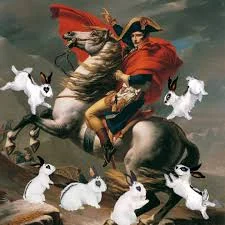
Most historical accounts of Napoleon Bonaparte focus on his meteoric rise to power, his sweeping military campaigns across Europe, and his lasting influence on law, governance, and national identity. Yet amid the grand narratives of strategy and empire lies a bizarre and charmingly unexpected episode—one in which the legendary conqueror found himself under siege not by soldiers or rivals, but by an onrushing swarm of rabbits. Yes, real rabbits. The story of Napoleon’s ill-fated rabbit hunt has survived through letters, memoirs, and anecdotal accounts, offering a humorous contrast to the seriousness that defines much of Napoleonic history. It reveals a lighter, more human side to a figure often portrayed as uncompromising and severe. And though the tale has been retold with varying embellishments, the core of it remains one of the most delightful footnotes in European history: Napoleon Bonaparte was once forced into retreat by a determined army of bunnies.
The Strange Origins of Napoleon’s Rabbit Hunt
The rabbit incident took place sometime after the signing of the Treaties of Tilsit in 1807, at a moment when Napoleon was enjoying a rare pause in warfare. Having secured major victories and reshaped the geopolitical landscape of Europe, he found himself surrounded by ministers, officers, and dignitaries eager to celebrate his success. Leisure activities were common rewards following military triumphs, and hunting—long a favorite pastime of European elites—was a particularly popular diversion. Eager to provide entertainment for the emperor and his entourage, Napoleon’s chief of staff, Alexandre Berthier, arranged what was supposed to be an elegant and well-organized rabbit hunt.
Organizing a hunt for one of the most powerful men in Europe was no small task. The grounds needed to be selected, the equipment prepared, and—most importantly—the rabbits acquired. Berthier ordered several hundred rabbits for the event, though some accounts claim the number reached into the thousands. The idea was simple: cage the rabbits, release them when the hunt began, and allow Napoleon and his men to enjoy a controlled, predictable outing. It was meant to be a flattering demonstration of abundance and coordination, showcasing Berthier’s ability to cater to the emperor’s wishes. Unfortunately for all involved, the plan hinged on a single assumption: that the rabbits would behave like wild animals and scatter in fear once released. This assumption proved spectacularly incorrect.
Unbeknownst to Napoleon and his party, the rabbits Berthier acquired were not wild but domesticated. While wild rabbits flee from predators, domesticated rabbits—especially those raised for food or breeding—often associate humans with feeding time. This detail, overlooked in the rush to organize an impressive event, became the key factor that transformed a leisurely hunt into one of the most comical retreats in Napoleonic lore. When the cages were opened and the rabbits spilled into the field, instead of bolting for freedom, they hopped in unison toward their expected source of food. But to Napoleon and his officers, the sight of hundreds of rabbits advancing in a fluffy formation looked less like innocence and more like an adorable invasion. What was intended as a serene celebration suddenly teetered on the brink of farce.
The Bunny Onslaught: When Rabbits Charged the Emperor of France
Once the rabbits were released, the situation escalated with unexpected speed. Instead of scattering, the animals turned toward Napoleon, their whiskers twitching and their paws thumping eagerly. At first, the emperor seemed amused, perhaps even charmed by the sight. But amusement quickly gave way to bewilderment as the rabbits continued to hop forward—steadily, confidently, and in astonishing numbers. Witnesses later described the scene as a furry tide rolling across the field, spilling over boots and barreling toward the imperial hunting party with unstoppable enthusiasm.
The rabbits swarmed not just Napoleon but his entire entourage. Officers who had faced fierce opposition on battlefields now found themselves awkwardly trying to fend off enthusiastic bunnies tugging at their coats and climbing their boots. Napoleon, for all his strategic brilliance, was momentarily at a loss. Rabbits were not trained infantry, and they refused to recognize any battlefield formation. Efforts to shoo them away were futile; the more they were pushed back, the more determined they seemed to advance. Some began to climb up the emperor’s uniform, while others hopped into the coaches and wagons lining the field. Napoleon, famously unshaken by artillery fire, was now faced with a challenge unlike any he had prepared for.
Eyewitness descriptions of the event vary in tone—from humorous recollections to lightly embarrassed attempts at justification—but all agree that the rabbits were relentless. Their behavior was likely driven by simple food-seeking instinct rather than aggression, but the effect was undeniably chaotic. The emperor ordered his men to form a line, but the rabbits slipped through gaps with ease. Servants attempted to scoop them up, only to be overwhelmed by the sheer number of hopping bodies. Napoleon, realizing the situation was hopeless—and perhaps unwilling to risk further ridicule—ultimately retreated to his carriage. Accounts suggest that even there, the rabbits continued their cheerful assault, some leaping into the vehicle or clinging to the steps. In the end, Napoleon was forced to flee the battlefield with his staff in tow, his imperial dignity momentarily upended by a cuddly cavalry.
The image of a towering historical figure routed by rabbits feels almost too whimsical to be true, yet the sources supporting it are compelling. Newspapers, letters, and memoirs written by Napoleon’s contemporaries recorded the incident, sometimes with a mischievous tone but never with outright denial. Some historians believe the event became a favorite anecdote among officers eager to humanize—or gently mock—their commander. Others suggest that the story endured precisely because it contrasted so sharply with Napoleon’s public persona as an unstoppable conqueror. Regardless of the reason, the bunny onslaught represents a rare moment of levity in the otherwise intense chronicle of Napoleonic Europe.
Historical Reactions: Humor, Embarrassment, and the Human Side of Napoleon
The rabbit incident spread quickly among those present and soon became a piece of whispered humor in military and political circles. For soldiers accustomed to discipline and hierarchy, the story offered a rare opportunity to laugh at a leader who otherwise inspired awe and fear. While there is no record of Napoleon publicly addressing the event, the fact that the tale survived in multiple sources indicates that the emperor did not—or could not—completely suppress its retelling. Rather than a scandal, it became a form of lighthearted gossip, a reminder that even the most formidable leaders could be caught off-guard by nature’s unpredictability.
For historians, the event provides fascinating insight into Napoleon’s personality. Although renowned for his intense focus and strategic mind, Napoleon was not humorless. Accounts from his generals describe him as sometimes playful, occasionally sarcastic, and capable of self-deprecating amusement. It is possible that he laughed at the absurdity of the situation once the chaos subsided. After all, even one of the greatest military tacticians in history could appreciate the irony of being outmaneuvered by rabbits. Still, the incident likely stung his pride. Napoleon was acutely aware of symbolism and public image; being seen as vulnerable—even in a humorous context—ran counter to the persona he cultivated as the embodiment of French resolve.
The event also highlights broader cultural differences in how historical narratives develop. While French sources often retell the story with gentle amusement, British and other European writers sometimes used it as fuel for satire, weaving it into caricatures that poked fun at Napoleon’s ambitions and perceived hubris. In the nineteenth century, political cartoons frequently depicted him in exaggerated forms, emphasizing his relatively short stature or portraying him as comically overmatched by trivial obstacles. The rabbit incident provided the perfect metaphor for these satirical portrayals: a mighty conqueror undone not by foreign alliances or military missteps but by nature’s harmless creatures.
In the grand sweep of history, this episode may seem minor, but it adds dimension to our understanding of Napoleon. Great leaders are often portrayed as mythic figures, their stories polished and edited to emphasize triumph while glossing over embarrassment. Yet it is precisely these moments of vulnerability that make historical figures relatable. Napoleon’s encounter with the rabbits reminds us that the past was populated not by symbols but by real people—individuals capable of being surprised, amused, and occasionally humbled by events outside their control. In a sense, the exaggerated legacy of the rabbit hunt reflects a universal truth: even the greatest figures in history sometimes have very bad days.
How Legends Grow: The Afterlife of Napoleon’s Bunny Attack
Over time, the rabbit incident grew from a quirky anecdote into a piece of historical folklore. The basic facts remained intact—a hunt, domesticated rabbits, an unexpected swarm—but storytellers embellished the details for dramatic effect. Some later accounts inflated the number of rabbits to comically high estimates, ranging from several thousand to tens of thousands. Others added humorous exaggerations, suggesting the rabbits “showed military discipline,” “charged in organized waves,” or “executed a flanking maneuver.” These additions, while not historically accurate, underline how the story evolved into a kind of mythical counterpoint to Napoleon’s otherwise fearsome reputation.
Humor has long served as a coping mechanism in societies dealing with conflict, power, and authority. By retelling the bunny incident, Europeans could poke fun at a man who had dominated their politics for more than a decade. The story became a soft weapon, a way of claiming psychological victory over a figure whose military prowess had reshaped the continent. Even today, historians note how rare it is to find moments when powerful leaders appear genuinely overwhelmed by something so harmless. The juxtaposition of Napoleon—the embodiment of strategic brilliance—against a horde of rabbits remains one of history’s most comedic contrasts.
In modern culture, the story has found new life in books, trivia collections, and online discussions. Its charm lies in its absurdity combined with its authenticity. Unlike many legends, this one has a strong documentary foundation. It illustrates how a real historical event can take on a life of its own, sliding between fact and myth while remaining fundamentally rooted in truth. It also shows how memory works: the things we remember are not always the most important events but often the ones that surprise us, amuse us, or make us reconsider a person we thought we understood.
Historians increasingly recognize the value of such stories. While they may not change our interpretation of major battles or political doctrines, they offer insight into daily life, social dynamics, and the human elements that shape historical figures. The rabbit attack does not diminish Napoleon’s accomplishments, nor does it redefine his legacy, but it enriches his biography by adding texture and humanity. It reminds us that even the most towering figures of history sometimes face moments that leave them bewildered, amused, or humbled. And sometimes, those moments involve rabbits.
A Lighthearted Moment in the Life of a Legendary Conqueror
Napoleon’s encounter with a horde of enthusiastic rabbits stands out as a delightful exception in the often serious narrative of his life. It brings humor to a biography dominated by war, diplomacy, and political upheaval, offering a glimpse of a rare moment when the emperor was not commanding armies but instead fleeing from a fluffy onslaught. While this episode has been embellished over time, its core truth remains both historically grounded and irresistibly charming. It reflects the unpredictable nature of history and the many ways in which human beings, no matter how powerful, can find themselves surprised by the world around them.
More importantly, the story reminds us that history is not only shaped by monumental events but also by the small, unexpected moments that reveal character, vulnerability, and humor. Napoleon Bonaparte was a formidable strategist, a groundbreaking legislator, and a polarizing leader—but he was also a man who once found himself scrambling away from a determined crowd of rabbits. And that simple image does more to humanize him than many volumes of military analysis ever could.
Leave a Reply