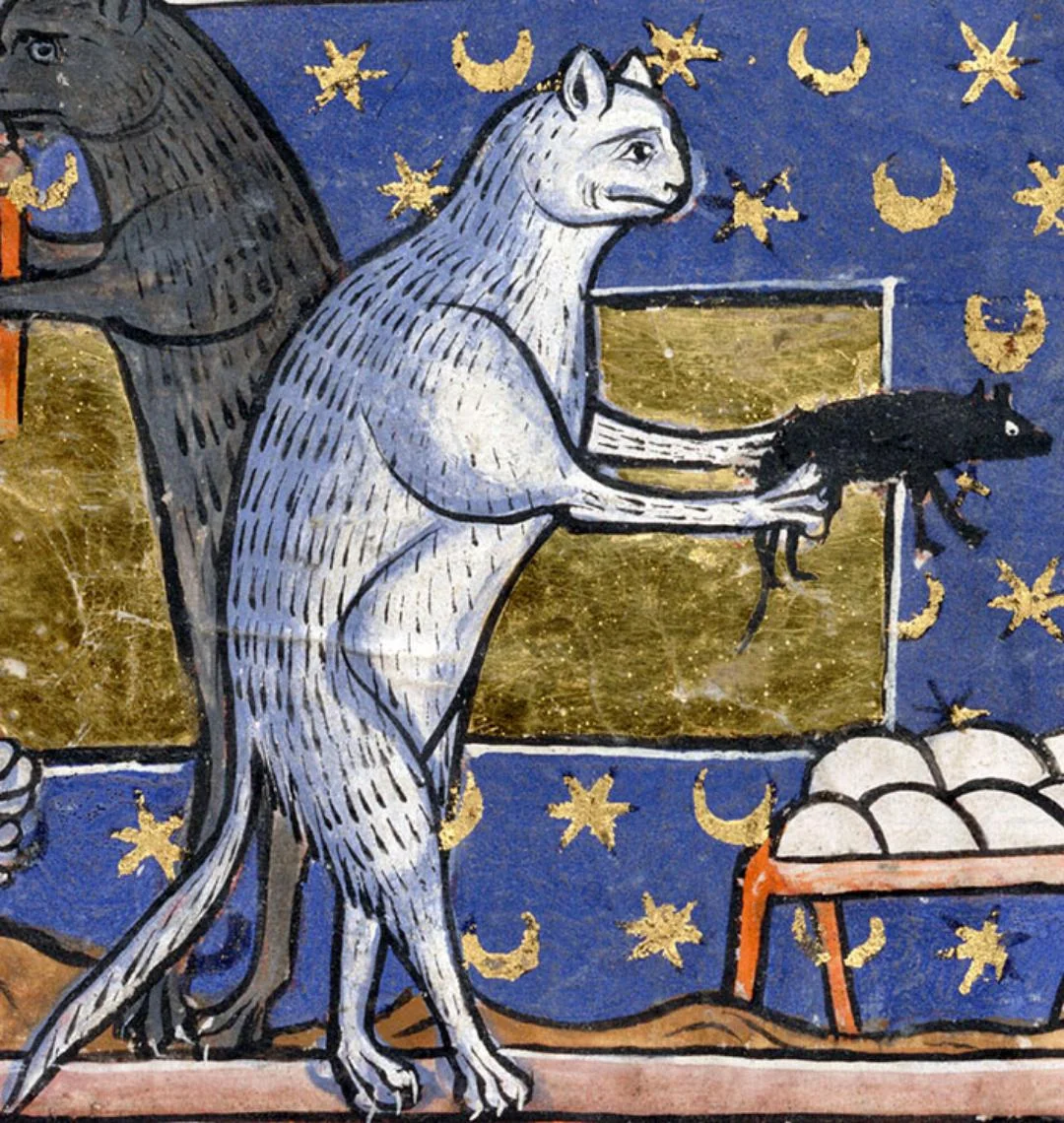
Few historical claims circulate as widely—or as confidently—as the idea that medieval Europe’s deadliest pandemic was partly caused by a war on cats. According to the popular story, a pope declared cats to be agents of the devil, mass exterminations followed, rat populations exploded, and the Black Death swept across Europe unchecked. It is a compelling narrative: dramatic, ironic, and morally satisfying in its suggestion that superstition directly caused catastrophe. Yet, like many viral historical anecdotes, the truth is more complex, more nuanced, and ultimately more revealing about medieval society than the simplified version suggests.
The roots of this story lie in real events, real fears, and real religious beliefs, but also in centuries of reinterpretation and exaggeration. Cats were indeed viewed with suspicion in parts of medieval Europe, and Church authorities did sometimes associate certain animals with heresy or demonic symbolism. At the same time, the Black Death was a multifaceted disaster driven by ecology, trade, climate, and disease vectors that no single policy could fully explain. Exploring the connection between papal authority, cats, rats, and plague requires careful separation of documented fact from modern mythmaking.
Pope Gregory IX and the association of cats with heresy
The claim most often cited in this narrative centers on Pope Gregory IX, who reigned from 1227 to 1241. During his papacy, Gregory IX was deeply concerned with combating heresy, particularly in regions of Germany and southern France. In 1233, he issued a papal bull known as Vox in Rama, which described alleged heretical rituals practiced by a sect believed to be associated with Luciferian worship. Within this text appeared a striking image: a black cat presented as part of a blasphemous ceremony.
This document is often interpreted as proof that Gregory IX declared cats to be evil and ordered their destruction. In reality, the bull did not call for the extermination of cats as a species. Rather, it used the image of a black cat symbolically, reflecting existing folklore that linked nocturnal animals with darkness, secrecy, and diabolical forces. Medieval Europeans frequently used animals as moral metaphors, and black cats in particular were already associated with mystery and misfortune long before Gregory’s papacy.
However, papal authority carried immense weight, and the language of Vox in Rama reinforced popular fears. While there is no direct evidence of a coordinated, Europe-wide campaign to kill cats initiated by the pope, it is plausible that local clergy and laypeople interpreted the message in literal terms. In an age where religious instruction shaped everyday behavior, symbolic condemnation could easily translate into real-world action. Cats, especially black ones, may have been targeted in certain regions as embodiments of heresy or witchcraft.
Importantly, this association must be understood within the broader medieval worldview. Animals were not morally neutral; they were believed to reflect spiritual realities. A creature’s habits, appearance, and symbolism all contributed to its perceived place in God’s creation. Cats, independent and nocturnal, did not fit neatly into ideals of obedience and utility, making them vulnerable to suspicion in times of heightened religious anxiety.
Medieval attitudes toward cats and animals
Long before papal decrees or inquisitorial texts, cats occupied an ambiguous position in European culture. In ancient times, cats had been revered in some civilizations, most famously in Egypt, but that reverence did not fully carry over into medieval Europe. Instead, cats were valued primarily for their practical role in controlling pests, especially mice in homes, barns, and monasteries. At the same time, their behavior set them apart from more familiar domesticated animals like dogs or livestock.
Medieval society tended to favor animals that clearly served human needs and displayed visible loyalty. Dogs guarded property and assisted in hunting; horses enabled travel and warfare; cattle and sheep provided food and materials. Cats, by contrast, were useful but aloof. They hunted independently, came and went as they pleased, and showed little interest in obedience. This independence was often interpreted negatively, especially in a culture that prized hierarchy and submission.
Folklore further complicated the cat’s reputation. Stories circulated linking cats to witches, shapeshifters, and nighttime spirits. Their glowing eyes, silent movements, and preference for darkness made them easy symbols for fear of the unknown. These beliefs were not universally accepted, but they were widespread enough to influence attitudes, particularly during periods of social stress or religious fervor.
That said, cats were not universally despised. Many households, including monasteries, kept cats and relied on them for pest control. Manuscripts from the period even include affectionate references to cats, suggesting a more balanced reality than the myth implies. The medieval world was not monolithic; beliefs varied by region, class, and circumstance. While suspicion existed, it coexisted with everyday practicality.
The Black Death and its real causes
The Black Death, which devastated Europe between roughly 1347 and 1351, was one of the deadliest pandemics in human history. It is estimated to have killed between 30 and 60 percent of Europe’s population. Modern science has identified the primary cause as Yersinia pestis, a bacterium transmitted primarily through fleas that lived on rodents, especially rats. However, the pathways by which the disease spread were far more complex than a simple rat-to-human chain.
The plague reached Europe through trade routes connecting Asia, the Middle East, and the Mediterranean. Ships carried infected rodents and fleas into port cities, where dense populations, poor sanitation, and limited medical knowledge created ideal conditions for rapid transmission. Climate factors, including a cooling period known as the Little Ice Age, may have altered rodent populations and human vulnerability to disease. Urban overcrowding and malnutrition further weakened immune defenses.
While rats played a role, recent research suggests that human fleas and lice may also have been significant vectors. This challenges the long-held assumption that rat populations alone determined the scale of the outbreak. In other words, even in regions where rats were less prevalent, the plague could still spread efficiently among humans.
Placing too much emphasis on cats oversimplifies a catastrophe driven by global trade, ecological disruption, and systemic vulnerability. The absence or presence of cats in medieval Europe would not have been sufficient to prevent or unleash a pandemic of this magnitude. The Black Death was not the result of a single mistake or superstition but a convergence of multiple factors unfolding over decades.
Did cat extermination really increase rat populations?
The idea that killing cats directly led to an explosion in rat populations is intuitively appealing but historically difficult to substantiate. While cats do hunt rats, their effectiveness varies widely depending on environment, prey availability, and human behavior. In medieval cities, rats thrived not because cats were absent, but because food waste, grain storage, and overcrowded living conditions provided abundant resources.
Moreover, there is little concrete evidence that cats were exterminated on a scale large enough to meaningfully alter rodent populations across Europe. Isolated persecutions or localized fears may have reduced cat numbers in certain areas, but a continent-wide collapse of feline populations is not supported by historical records. Cats continued to appear in art, literature, and household accounts throughout the medieval period, including during and after the Black Death.
It is also important to recognize that rats are highly adaptable. Even in environments with predators, they reproduce rapidly and exploit human infrastructure to survive. Eliminating cats would not automatically result in unchecked rat proliferation, especially when other limiting factors, such as disease among rodents themselves, were at play.
The persistence of this narrative owes much to its moral clarity. It offers a cautionary tale about the dangers of superstition and the unintended consequences of fear-driven policies. While such lessons are valuable, they risk distorting history when not grounded in evidence. The relationship between cats, rats, and plague was real, but it was neither simple nor deterministic.
How the myth developed in later centuries
The story linking Pope Gregory IX, cat extermination, and the Black Death gained popularity long after the medieval period ended. Enlightenment-era thinkers and later historians often portrayed the Middle Ages as a time of ignorance and irrationality, contrasting it with their own emphasis on reason and science. In this context, stories that highlighted medieval superstition served rhetorical purposes, reinforcing narratives of progress.
Victorian writers, in particular, were fond of dramatic historical anecdotes. They often simplified complex events into moral lessons, and the cat-plague story fit neatly into this framework. Over time, repetition transformed speculation into apparent fact. By the twentieth century, the claim appeared in popular histories, documentaries, and classrooms, frequently without critical examination.
Modern media has further amplified the myth. Short-form content favors striking, easily digestible stories, and the idea that killing cats caused the Black Death is both memorable and emotionally resonant. Unfortunately, nuance is often lost in the process. The real history, while less tidy, is far more informative about how societies respond to fear, authority, and uncertainty.
Understanding how this myth evolved is itself a valuable historical exercise. It shows how later generations reinterpret the past to reflect their own values and concerns. In doing so, it reminds us that history is not just about what happened, but about how stories are told and retold.
Conclusion
The belief that Pope Gregory IX’s association of cats with devil worship directly contributed to the Black Death is rooted in fragments of truth layered with centuries of exaggeration. Cats were sometimes viewed with suspicion in medieval Europe, and religious symbolism did influence attitudes toward animals. Yet there is no solid evidence of a systematic extermination of cats powerful enough to reshape the ecological balance of an entire continent. The Black Death was the result of global trade networks, environmental change, and biological forces far beyond the control of any single institution or belief.
Rather than dismissing medieval people as foolish, a more accurate reading reveals a society grappling with limited knowledge, deep faith, and real dangers. The enduring myth about cats and plague tells us as much about modern storytelling as it does about medieval history. By examining the evidence carefully, we gain a clearer understanding not only of the past, but of how easily compelling narratives can overshadow complex realities.
Leave a Reply