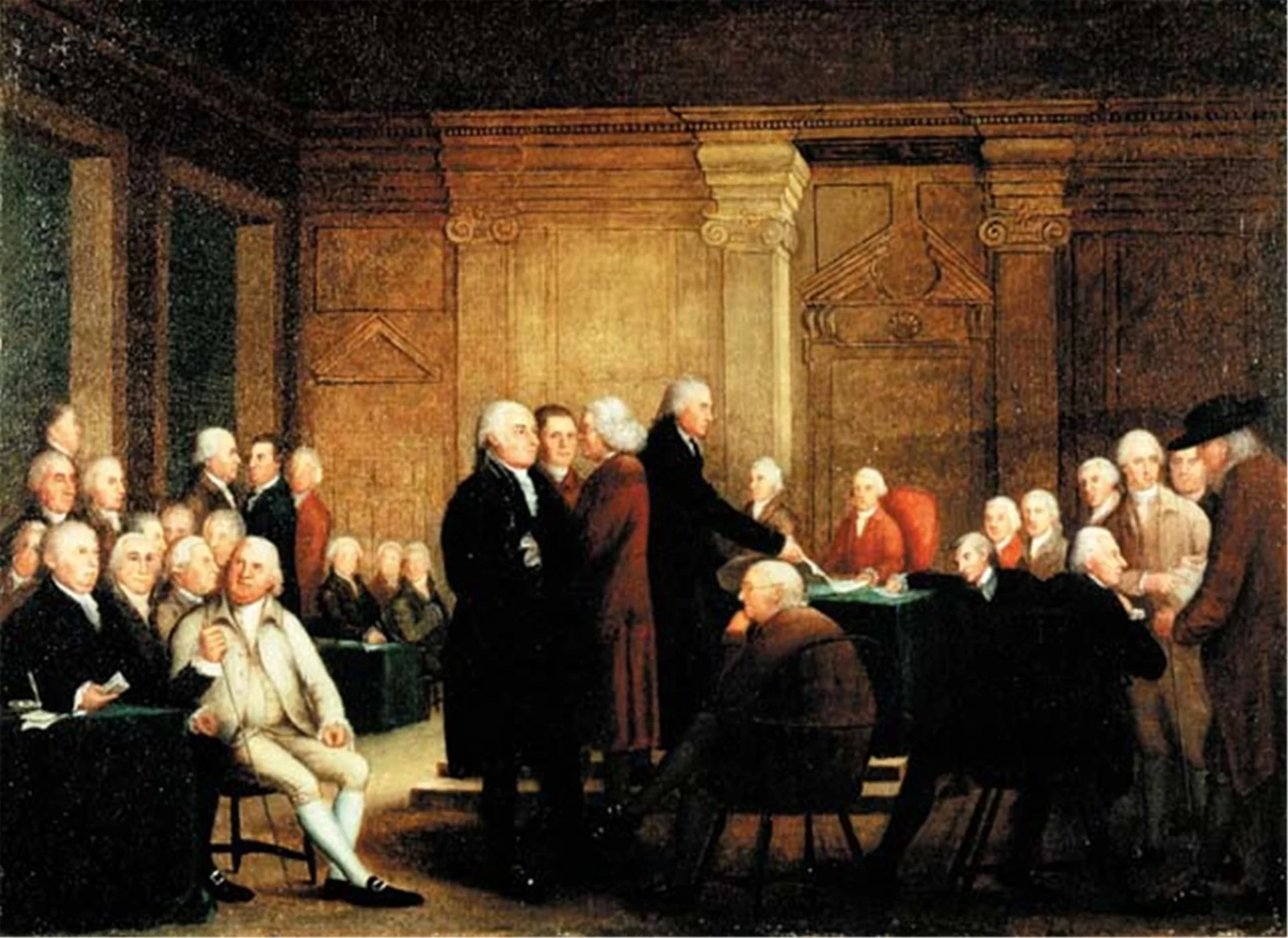
In the long and often dramatic story of the United States, few moments feel as symbolically perfect as the deaths of John Adams and Thomas Jefferson. Two men who helped give birth to a nation, who argued fiercely and reconciled deeply, who embodied opposing political philosophies yet shared an unbreakable bond, both died on the same day. Even more remarkably, they died on July 4, 1826, exactly fifty years after the adoption of the Declaration of Independence. History rarely aligns events with such poetic precision, and when it does, it invites reflection far beyond coincidence. This moment feels less like a random twist of fate and more like a closing chapter written with deliberate care.
Their simultaneous passing has fascinated historians, writers, and ordinary citizens for generations. It is not simply the fact that they died on the same day, but who they were, what they represented, and how their lives intertwined with the nation they helped create. From revolutionary allies to bitter political rivals and finally to aging correspondents reflecting on the meaning of liberty, Adams and Jefferson mirrored the struggles and aspirations of the early republic. Their deaths on the nation’s jubilee seemed to mark the end of the founding era itself, as if history paused to acknowledge that a generation’s work was complete.
Two Revolutionary Minds and the Birth of American Independence
When the American colonies moved toward independence in the 1770s, John Adams and Thomas Jefferson emerged as central figures in a cause that demanded both intellectual clarity and political courage. Adams, a lawyer from Massachusetts, was known for his sharp mind, tireless energy, and uncompromising commitment to independence. Jefferson, the Virginia planter and philosopher, brought eloquence and a deep belief in natural rights that would shape the ideological foundation of the new nation. Though very different in temperament, the two men recognized in each other a shared devotion to liberty and self-government.
Their collaboration reached its most famous expression during the Second Continental Congress in 1776. Adams was a driving force behind the push for independence, persuading hesitant delegates that reconciliation with Britain was no longer possible. Jefferson, meanwhile, was chosen to draft the Declaration of Independence, a task that would immortalize his words. Adams supported Jefferson’s selection, believing his colleague possessed a “peculiar felicity of expression” that could capture the spirit of the moment. The document Jefferson produced articulated universal principles of equality and natural rights that transcended the immediate conflict with Britain.
Although Adams did not write the Declaration, his influence was profound. He defended it vigorously on the floor of Congress and worked to secure its adoption. Together, Adams and Jefferson stood at the heart of a revolutionary transformation, helping to turn colonial resistance into a clear assertion of nationhood. Their roles during this period cemented their status as Founding Fathers and bound their personal legacies to the birth of the United States.
This shared achievement created a bond that would endure through decades of political conflict and personal estrangement. Even when they later found themselves on opposite sides of the nation’s emerging party system, the memory of 1776 remained a point of mutual pride. The Declaration of Independence was not merely a political statement; it was the defining expression of their generation’s ideals, and its anniversary would later frame the final chapter of their lives in a way no one could have anticipated.
From Allies to Rivals: Politics, Power, and Personal Estrangement
Following independence, the young republic faced the immense challenge of governing itself, and it was here that Adams and Jefferson’s paths began to diverge sharply. Adams believed in a strong central government capable of maintaining order and stability, while Jefferson favored states’ rights and a more limited federal authority. These differences were not merely theoretical; they shaped the formation of America’s first political parties and defined the political battles of the late eighteenth century.
As the nation’s first vice president and later its second president, John Adams often found himself defending policies that Jefferson and his allies viewed as dangerously authoritarian. Jefferson, who served as the first secretary of state, clashed with Adams and Alexander Hamilton over foreign policy, economic structure, and the scope of federal power. These disagreements grew increasingly personal, fueled by partisan newspapers and political maneuvering. By the time Jefferson defeated Adams in the presidential election of 1800, their friendship had collapsed into silence.
The bitterness of this period cannot be overstated. Adams felt betrayed, convinced that Jefferson had allowed supporters to attack his character and undermine his presidency. Jefferson, for his part, believed Adams had abandoned revolutionary principles in favor of monarchical tendencies. For more than a decade, the two men did not communicate at all. Their estrangement reflected the broader divisions within the nation, as Americans struggled to define what their hard-won independence truly meant in practice.
Yet even during these years of rivalry, their shared history lingered beneath the surface. Both men understood that their disagreements, however intense, were rooted in a common commitment to the republic. They had fought the same enemy, signed the same Declaration, and risked the same consequences. Time, distance, and the passage of political power would eventually soften their resentments, setting the stage for one of the most remarkable reconciliations in American history.
Reconciliation in Old Age: Letters, Reflection, and Mutual Respect
The reconciliation of John Adams and Thomas Jefferson began quietly in 1812, long after both men had retired from public office. It was Adams who made the first move, writing a letter that reopened communication after years of silence. Jefferson responded warmly, and what followed was an extraordinary correspondence that would last until their deaths. Through these letters, the former rivals rediscovered their friendship and reflected deeply on the meaning of the Revolution they had helped lead.
Their exchanges were thoughtful, candid, and often philosophical. They discussed politics, religion, history, and the future of the republic, drawing on decades of experience. Freed from the pressures of office, they could speak openly, acknowledging past mistakes and disagreements without rancor. The letters reveal two aging statesmen grappling with the legacy of their lives and the uncertain future of the nation they had created.
What makes this correspondence so significant is its tone of mutual respect. Adams and Jefferson did not erase their differences, nor did they pretend they had always been in agreement. Instead, they came to see those differences as essential to the healthy functioning of a republic. Their debates, once so divisive, were now understood as part of a broader struggle to balance liberty and order. In this sense, their reconciliation mirrored the maturation of the United States itself.
As the years passed, both men became increasingly aware that they were among the last surviving leaders of the revolutionary generation. This awareness lent a reflective, almost elegiac quality to their letters. They wrote not only to each other, but to history, offering insights into the ideals that had driven them in youth and sustained them in old age. By the 1820s, Adams and Jefferson had become living symbols of the nation’s origins, revered even as they quietly prepared for their final days.
July 4, 1826: A Nation’s Jubilee and a Remarkable Coincidence
The fiftieth anniversary of the Declaration of Independence was a moment of national celebration and reflection. Across the United States, communities marked July 4, 1826, with speeches, parades, and expressions of gratitude for the revolutionary generation. It was widely understood that this anniversary represented more than a milestone; it was a tribute to the men and ideas that had made the nation possible. Few could have imagined how profoundly that day would be marked by loss.
Thomas Jefferson died at his home in Monticello in the early hours of July 4, weakened by illness and age. He was eighty-three years old. Reports indicate that he remained conscious until near the end, aware of the significance of the day and the legacy he would leave behind. Just hours later, in Quincy, Massachusetts, John Adams also passed away at the age of ninety. The news spread slowly, but when it did, it stunned the nation.
The coincidence was almost overwhelming. Two principal authors of independence, two former presidents, two old friends and rivals, dying on the same day that symbolized their greatest achievement. It felt to many Americans as though history itself had chosen the moment. The sense of providence was difficult to ignore, particularly in a culture that often interpreted events through a moral or religious lens.
The deaths of Adams and Jefferson on July 4, 1826, were widely mourned and deeply symbolic. They seemed to mark the end of an era, the passing of a generation whose sacrifices and vision had shaped the republic. In the midst of celebration, Americans were reminded of the fragility of life and the enduring power of ideas. Independence Day would never again be observed without recalling the extraordinary coincidence that had forever linked it to the final moments of two of its greatest architects.
“Jefferson Lives”: Adams’ Final Words and Their Lasting Meaning
Among the many details that have contributed to the legend surrounding July 4, 1826, none is more poignant than John Adams’ reported last words. As he lay dying, Adams is said to have whispered, “Jefferson lives,” unaware that his old friend had already passed away earlier that day. Whether spoken exactly as recorded or slightly altered by memory, the sentiment has resonated deeply with generations of Americans.
On a literal level, Adams was mistaken. Jefferson did not live. Yet symbolically, his words could not have been more accurate. Jefferson lived on through his ideas, his writings, and the nation he helped create. In that sense, Adams’ final utterance captured a profound truth about legacy and memory. Individuals pass away, but the principles they champion can endure far beyond their lifetimes.
The emotional weight of these words is amplified by the long and complex relationship between the two men. From youthful collaboration to bitter rivalry and eventual reconciliation, Adams and Jefferson’s lives were deeply intertwined. That Adams’ thoughts turned to Jefferson in his final moments speaks volumes about the bond they shared. It suggests that, despite decades of conflict, their friendship and shared purpose remained central to their identities.
For the American public, the story of Adams’ last words became a powerful symbol of unity and continuity. It reinforced the idea that the nation’s founders, though human and flawed, were ultimately bound together by a common vision. The phrase “Jefferson lives” has since been interpreted as a reminder that the ideals of liberty, equality, and self-government remain alive as long as they are remembered and upheld.
Legacy, Memory, and the End of the Founding Generation
The deaths of John Adams and Thomas Jefferson on July 4, 1826, marked more than the loss of two prominent individuals. They represented the closing of a chapter in American history, the fading of the revolutionary generation that had fought for independence and laid the foundations of the republic. In the years that followed, the United States would continue to grow and change, but it would do so without the direct guidance of its original architects.
Their shared passing invited Americans to reflect on the meaning of independence and the responsibilities it entailed. It underscored the idea that nations, like individuals, are shaped by both conflict and reconciliation. Adams and Jefferson disagreed passionately, yet their willingness to reconnect in old age offered a model of civic respect and intellectual humility. Their lives demonstrated that debate and dissent need not destroy a shared commitment to the common good.
Over time, the story of their deaths has become woven into the fabric of American civic mythology. It is retold not simply as an interesting coincidence, but as a moment that captures the spirit of the early republic. The image of two Founding Fathers departing the world on the nation’s birthday serves as a reminder that the United States was born of ideas that transcend any single lifetime.
This episode belongs firmly to the modern period of history, shaped by revolutions, nation-building, and the emergence of democratic ideals. Yet its emotional power feels timeless. The deaths of Adams and Jefferson continue to resonate because they speak to enduring questions about legacy, friendship, and the relationship between history and meaning. In their final hours, as the nation celebrated its independence, two of its greatest champions quietly took their leave, forever linked to the day that defined their lives.