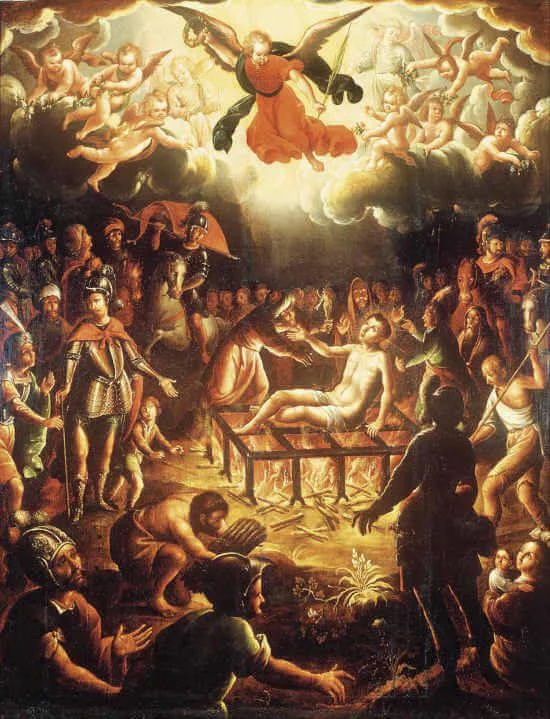
The story of Saint Lawrence is one of the most enduring, dramatic, and unexpectedly humorous legends in Christian history. A 3rd-century deacon of the Church in Rome, Lawrence lived during a time when Christians were increasingly targeted by imperial authorities. Yet despite the danger surrounding him, he became known for his unwavering courage, deep compassion for the poor, and a surprising wit that would immortalize him in Christian lore. According to tradition, when Lawrence was sentenced to death by being roasted alive on a gridiron, he faced unbearable pain with a calm, even cheerful defiance. At one point, he is said to have joked: “Turn me over—I’m well done on this side!” This extraordinary moment, blending martyrdom with humor, ensured that Lawrence would forever be remembered not only as a hero of the faith but also as the patron saint of cooks, chefs, and comedians. His story, both gruesome and uplifting, offers unique insight into early Christian courage and the power of humor even in the face of death.
The Historical and Political Context Behind Saint Lawrence’s Martyrdom
To understand why Lawrence’s death became so legendary, we must begin with Rome in the mid-3rd century. During this period, the Roman Empire was under tremendous strain. It faced military threats from outside forces, plagues that destabilized cities, and internal political turmoil. Emperors rose and fell with alarming frequency. Amid this instability, religious minorities—especially Christians—often became convenient scapegoats for imperial anxieties. Under Emperor Valerian, these tensions erupted into one of the more severe persecutions of the early Church.
Valerian’s decrees specifically targeted Christian clergy and wealthy believers whose possessions could be confiscated by the state. The Church in Rome at this time was growing steadily, both in influence and resources. As a deacon, Lawrence was entrusted with managing the Church’s treasury and distributing alms to the poor. His role placed him squarely in the imperial crosshairs. When Pope Sixtus II, his mentor, was executed in 258 AD, Lawrence knew his own arrest was imminent. But instead of fleeing or hiding, he boldly continued his work, supporting Rome’s needy and preserving what he could of the Church’s charitable network.
The prefect of Rome soon approached Lawrence with a demand: surrender the Church’s riches. The authorities believed Christians had accumulated substantial wealth and hoped to seize it for the empire. Lawrence, however, had already dispersed much of the Church’s resources to the poor, fulfilling his duty as deacon and protector of the vulnerable. When ordered to present the treasure, he famously gathered the blind, the sick, the widowed, and the orphaned, declaring, “These are the treasures of the Church.” This gesture, at once defiant and compassionate, infuriated the prefect. It also solidified Lawrence’s reputation as a champion of the marginalized. His bold act of moral conviction set the stage for the dramatic martyrdom that followed.
The Gridiron Execution: How a Horrific Death Became a Symbol of Courage
Lawrence’s execution on a gridiron is one of the most graphic martyrdom accounts in early Christian tradition. Although historical accuracy is debated—some scholars believe he may have been beheaded like many other martyrs of the time—the gridiron story became the most widely embraced version due to its vivid symbolism. According to legend, the prefect ordered an unusually cruel punishment: Lawrence was to be slowly roasted alive over an open flame, ensuring a prolonged and torturous death.
Such executions were not unheard of in ancient Rome, though they were rare and typically reserved for those who greatly angered authorities. The gridiron became a metaphor for the prefect’s desire to make an example of Lawrence, to show what happened to those who mocked Roman power. Yet even in the face of such cruelty, Lawrence’s courage never faltered. Witnesses described him as calm, steadfast, and shockingly composed. His faith, rather than weakening in the face of agony, seemed to intensify.
What makes Lawrence’s martyrdom especially striking is the reported moment of humor in its midst. As the flames licked his flesh and the heat seared his body, Lawrence did not scream or beg for mercy. Instead, he turned to his executioners and said, “I’m well done on this side. Turn me over.” The line, remarkable in its wit and resilience, became legendary. It transformed a horrific death into a display of spiritual triumph.
This act of defiant humor served multiple purposes. First, it denied the prefect the satisfaction of witnessing fear or despair. Second, it offered a final message of hope to Christians present: faith can withstand even the worst cruelty. Third, it humanized Lawrence, presenting him not only as a martyr but as someone whose spirit refused to be crushed. Humor, in this moment, became a weapon—one that turned suffering into victory.
Over time, this scene became one of the most reproduced and celebrated stories in hagiography. Artists depicted Lawrence calmly lying on the iron grid, flames rising beneath him, his eyes lifted toward heaven. The gridiron itself became his enduring symbol, appearing in countless churches, paintings, and stained-glass windows. His death, rather than silencing the Christian community, inspired generations with its blend of courage, charity, and unexpected wit.
Why Saint Lawrence Became Patron Saint of Cooks, Chefs, and Comedians
Saint Lawrence’s famous gridiron remark is the main reason he became associated with cooks and chefs, but his patronage extends far deeper than a single joke. The image of Lawrence roasting over a fire created an immediate symbolic connection to the culinary world. Medieval Christians, who delighted in layered symbolism, found humor and reverence in this connection. The gridiron, originally an instrument of torture, became a sacred symbol—one that cooks and kitchen workers felt a special bond with. Many culinary guilds in medieval Europe adopted Lawrence as their patron, believing he understood the tools, heat, and labor of their craft better than any other saint.
Beyond the kitchen, Lawrence’s cheerful bravery made him a natural patron for comedians, humorists, and entertainers. His ability to turn unimaginable suffering into a moment of levity demonstrated the profound power of humor. For comedians, his remark became a reminder that laughter can uplift even the darkest circumstances. More importantly, Lawrence’s humor was not dismissive or shallow—it was deeply rooted in faith, courage, and integrity. Comedy, in this context, became a form of resistance and hope.
Lawrence’s patronage also expanded to firefighters, librarians, and the poor. Firefighters saw in him someone who endured flames with extraordinary fortitude. Librarians honored him because he protected the Church’s resources, including sacred texts. The poor claimed him as their advocate because his final acts on earth were dedicated to them. Yet it is his unusual connection to cooks and comedians that remains most widely recognized.
Throughout Europe, festivals honoring Saint Lawrence often included feasts, roasted foods, and comedic performances. His feast day, August 10, became an occasion for communities to celebrate joy in the face of hardship—a fitting tribute to a man who brought divine humor into a moment of mortal terror. Even today, culinary schools, restaurants, kitchen guilds, and comedy troupes invoke his name with affection, seeing in him a protector who understands both heat and humor better than anyone else.
The Spread of Lawrence’s Legend Across Medieval Europe
After his death, Lawrence’s reputation grew rapidly. Early Christian writers such as Ambrose and Augustine praised him as a model of charity and courage. Rome, still grappling with internal instability, found in Lawrence a powerful symbol of Christian resilience. His tomb at the site of his execution became a place of pilgrimage. Over time, a great basilica—San Lorenzo fuori le Mura—was erected over his burial site, becoming one of the seven principal churches of Rome.
As Christianity spread across Europe, so did Lawrence’s legend. Medieval hagiographers embellished his story, adding miracles, dramatic dialogues, and symbolic details. Artists depicted him with a gentle face, often carrying a gridiron or a book of alms. His story resonated particularly strongly during times of crisis—plagues, famines, wars—moments when people needed heroes who endured suffering with courage and humor.
In northern Europe, cooking guilds adopted him widely. Blacksmiths, grill-makers, and metalworkers also felt kinship with Lawrence, whose death involved iron and fire. Monasteries celebrating his feast often prepared roasted meals, connecting culinary tradition with spiritual memory. The motif of fire—both destructive and transformative—became central to Lawrence’s imagery.
His story also appealed to storytellers and playwrights. Medieval mystery plays sometimes reenacted his martyrdom, emphasizing both the horror of the execution and Lawrence’s defiant joke. In these performances, the line “Turn me over!” became a dramatic turning point, eliciting laughter even in solemn settings. It reminded audiences that faith could transform tragedy into triumph.
By the Renaissance, Saint Lawrence had become one of the most beloved saints in Europe. His name was invoked by travelers, cooks, comedians, and the poor. Cities, parishes, and religious orders honored him through shrines and festivals. Even explorers carried the name across the world, giving rise to geographical landmarks such as the Gulf of St. Lawrence in Canada.
Through all these cultural expressions, the essence of Lawrence’s story remained constant: he was the martyr who laughed in the face of pain, the deacon who cherished the poor, and the saint who turned torture into a testament of unshakable faith.
The Meaning of Humor in the Face of Persecution
Perhaps the most compelling aspect of Saint Lawrence’s story is the use of humor in a moment when laughter seems impossible. Humor is not often associated with martyrdom. Yet Lawrence’s legendary remark has inspired centuries of reflection on the power of wit in moments of suffering.
Humor served multiple spiritual and psychological functions. First, it demonstrated inner freedom. Even when the prefect sought to break him, Lawrence retained control of his mind and spirit. His joke reminded his executioners that physical suffering could not crush his faith. Second, humor disarmed cruelty. The prefect wanted Lawrence’s death to instill fear in Christians; instead, the martyr’s composure transformed the execution into a victory of the spirit.
Third, humor strengthened the Christian community. For early believers facing persecution, Lawrence’s story offered reassurance that God granted fortitude even in unimaginable trials. His humor acted as a beacon of hope—proof that fear could be met with courage, hatred with compassion, and death with joy.
Modern psychology offers further insight. Humor is a coping mechanism that helps people face pain, trauma, and adversity. It creates distance from suffering without denying it. In Lawrence’s case, humor became a final act of defiance, transforming victimhood into triumph.
Theologians have long argued that Lawrence’s humor reflects a deep understanding of Christian resurrection hope. Death was not an end but a beginning. Fear was unnecessary because he believed himself already in God’s care. His joke was therefore not simply comedic—it was theological. It proclaimed that suffering had no power over the soul.
For this reason, Lawrence remains an icon for comedians and performers. He represents the boldness to laugh, the courage to speak truth, and the ability to lift others’ spirits even in hardship. He is a reminder that humor, far from being trivial, can carry profound spiritual weight.
A Martyr with Fire, Faith, and Unforgettable Humor
The legend of Saint Lawrence has endured for centuries because it captures something deeply human and profoundly spiritual. His story blends charity, courage, defiance, suffering, and humor in a way that few other saints’ stories do. From his devotion to the poor to his bold confrontation with Roman authority, from his horrific execution to his legendary joke, Lawrence stands out as one of Christianity’s most memorable figures.
His role as patron saint of cooks and comedians stems from a moment of extraordinary wit—a reminder that the human spirit can shine even in the midst of flames. His gridiron became not only a symbol of his martyrdom but a symbol of transformation: pain turned into victory, suffering into sanctity, fire into faith.
In a world often marked by seriousness, fear, and conflict, Saint Lawrence’s story encourages us to meet hardship with courage, to care for the vulnerable, and to recognize the surprising power of humor to uplift and strengthen the soul. More than 1,700 years after his death, his legacy continues to inspire cooks in their kitchens, comedians on their stages, and believers seeking strength in moments of trial.
Saint Lawrence reminds us that even when life turns up the heat, the human spirit can still find a way to laugh—and in that laughter, discover remarkable strength.
Leave a Reply