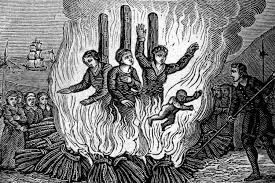
Few historical events are as deeply embedded in the popular imagination as the Salem witch trials. Images of innocent people being burned at the stake have become almost inseparable from the story, reinforced by movies, novels, and classroom tales that favor drama over precision. Yet this widely believed detail is entirely false. During the Salem witch trials of 1692–1693, not a single accused person was burned alive. Instead, the majority of the accused were jailed, nineteen were hanged, one man was crushed under heavy stones, and several died in prison under harsh conditions. While these realities are no less tragic, the myth of burning has persisted for centuries, obscuring the actual legal, religious, and social forces that drove one of the darkest episodes in colonial American history. Understanding what truly happened—and why the burning myth took hold—offers a clearer, more unsettling view of how fear, superstition, and power combined to destroy lives without a single flame being lit.
How the Salem Witch Trials Truly Began: Fear, Religion, and Social Tensions
The Salem witch trials did not erupt out of nowhere. They emerged from a volatile mix of religious extremism, political instability, economic stress, and deep-seated social conflict in late 17th-century New England. The Puritan settlers who founded the Massachusetts Bay Colony believed that they were living in a constant spiritual war between God and the Devil. They saw the world as a battlefield where Satan actively worked to corrupt souls, sabotage communities, and undermine their sacred mission. This worldview made the idea of witchcraft not only plausible, but terrifyingly real.
By the early 1690s, Salem Village—which was separate from Salem Town—was already plagued by internal divisions. Families feuded over land boundaries, inheritance, church leadership, and political power. Economic inequality was growing, and many villagers felt trapped between loyalty to traditional rural life and the rising influence of mercantile elites in nearby Salem Town. Into this powder keg of resentment and anxiety came a series of strange events in the household of Reverend Samuel Parris.
In early 1692, Parris’s daughter Betty and niece Abigail Williams began exhibiting bizarre behavior—screaming, convulsing, speaking incoherently, and claiming they were being attacked by invisible forces. Local doctors, unable to find a medical explanation, concluded that the girls were under witchcraft. Under pressure from adults, the girls began naming supposed attackers, quickly setting off a chain reaction of accusations.
Once accusations started, they spread with terrifying speed. Neighbors accused neighbors. Servants accused masters. Long-standing grudges suddenly found supernatural justification. In a society where spectral evidence—testimony that a person’s spirit had appeared in visions—was considered admissible in court, accusations alone carried immense power. Fear replaced reason, and soon dozens of people found themselves imprisoned based on nothing more than rumor, dreams, and hysteria.
Contrary to later depictions, the accused were not immediately tortured or burned. They were arrested, interrogated, and held in overcrowded, unsanitary jails while awaiting trial. Many were chained to walls for months. Some were children. Others were elderly. Some were respected church members. Guilt or innocence mattered less than perception. Once accused, a person faced overwhelming odds, and the machinery of fear moved forward without mercy.
What Actually Happened to the Accused: Jails, Hangings, and Deaths in Custody
Despite the enduring image of burning at the stake, the real punishments during the Salem witch trials followed English legal tradition. Witchcraft was considered a capital offense under colonial law, but it was punished by hanging—not burning. From June to September of 1692, nineteen people were executed by hanging on Gallows Hill. Fourteen of them were women, and five were men. All maintained their innocence to the end.
One additional victim, Giles Corey, met a different and especially horrific fate. Refusing to enter a plea of guilty or not guilty, Corey was subjected to peine forte et dure, a brutal legal punishment in which heavy stones were placed on his chest to force a confession. Over two days, he was slowly crushed to death. His decision to remain silent was likely motivated by a desire to prevent the seizure of his property, which could have been confiscated if he were formally convicted.
Beyond the executions, conditions in the jails claimed several more lives. At least five people died while awaiting trial, including infants who were imprisoned alongside their mothers. The jails were cold, filthy, overcrowded, and infested with disease. Prisoners were often kept in heavy irons for months. Food was scarce, medical care was nonexistent, and many grew dangerously ill. The psychological toll was equally devastating, as prisoners lived each day under the looming threat of execution.
In total, more than 200 people were formally accused, and about 2,000 were named or suspected in some capacity throughout New England during the broader witch panic. Yet none of them were burned alive—not in Salem, not anywhere in colonial America during this episode. Burning was a punishment more commonly associated with witch trials in parts of Europe during earlier centuries, particularly under certain Catholic jurisdictions. English law, which governed the colonies, explicitly mandated hanging rather than burning for witchcraft.
The distinction matters because the truth is no less horrifying. Nineteen people swinging from ropes, one crushed under stones, and others dying in filthy cells is not a softer story—it is simply a more accurate one. The absence of flames does not make the injustice any less brutal. Instead, it reveals how myth has reshaped memory, transforming historical reality into something more symbolic than factual.
Why the Burning-at-the-Stake Myth Became So Widespread
If no one was burned during the Salem witch trials, why does the image persist so powerfully in popular culture? The answer lies in a combination of European history, artistic symbolism, and the way societies remember trauma. Long before Salem, burning at the stake had indeed been used in witch trials across parts of Europe, particularly during the late medieval and early early modern periods. Thousands of people—especially in Germany, Switzerland, and parts of France—were executed this way. When later writers and artists depicted “witch hunts” as a universal phenomenon, they often merged European and American events into a single imagined narrative.
Fire, as an image, also carries immense symbolic power. Burning represents purification, destruction, and spectacle. It is far more visually dramatic than hanging, which tends to be quieter, quicker, and less cinematic. When authors, playwrights, and filmmakers sought to convey the horror of witch hunts, flames provided a shortcut to emotional intensity. Over time, this symbolism hardened into assumed fact.
The 19th century played a major role in spreading the burning myth. During this period, American writers romanticized colonial history and often embellished its darker episodes for moral or dramatic effect. Witch trials became cautionary tales about mass hysteria and religious extremism, and burning at the stake reinforced the brutality of those lessons. By the time books, school texts, and later movies embraced the image, it had become inseparable from the narrative.
Another factor is the blending of global witch-hunt history into a single story in popular memory. Few people differentiate between the German trials of the 1500s and the Salem trials of the 1690s. They become one continuous “age of witch burning” in the public imagination. As a result, the methods of execution from one region are projected onto another.
Even today, textbooks sometimes mention “witch burnings” in a general sense without clarifying that Salem followed a different legal practice. Halloween decorations, tourist attractions, and themed events often reinforce the imagery with flaming stakes, further cementing the myth. Once a visual idea becomes embedded in culture, it can take generations of careful education to undo it.
The irony is that the real story of Salem—dominated by hangings, prison deaths, and crushing—does not need embellishment to be horrifying. The truth is already a stark example of how fear and belief can override reason, law, and compassion. Yet the myth of burning persists because it satisfies our desire for dramatic storytelling more than for historical precision.
The Legal Collapse and the End of the Witch Trials
The Salem witch trials did not end because the hysteria burned itself out naturally. They ended because doubt, resistance, and political pressure finally forced the legal system to confront its own failures. By the autumn of 1692, accusations were spiraling beyond control. Even prominent and respected citizens—including ministers’ family members—were being named as witches. This raised an alarming question: if anyone could be accused, was anyone truly safe?
A turning point came when Governor William Phips’s own wife was accused of witchcraft. Almost immediately, his support for the trials evaporated. Phips dissolved the special Court of Oyer and Terminer that had been created to handle witchcraft cases and forbade the use of spectral evidence. Without dream visions and invisible attacks as legal proof, most remaining cases collapsed.
By early 1693, Phips pardoned many of those still imprisoned. Others were released after paying jail fees, which meant that even those found innocent emerged financially ruined. Public opinion began to shift. What once felt like righteous purification now looked like mass murder driven by fear and superstition.
In the years that followed, Salem struggled to reckon with what had been done. Some judges admitted regret. One of the most prominent accusers, Ann Putnam Jr., later issued a public apology, stating that she had been used by Satan. In 1711, the Massachusetts government formally reversed many of the convictions and provided financial compensation to victims’ families. However, that money could never restore lost lives, reputations, or years spent in chains.
The end of the trials did not erase their psychological impact. The community lived for generations with the shame and trauma of what had occurred. Families remained divided. Trust was fractured. And the memory of innocent people executed by their neighbors became a permanent scar on American history.
It is important to recognize that the end of the trials did not come from a sudden surge in compassion but from political self-preservation and growing legal doubt. The system collapsed only when it threatened people with real power. This reality adds another layer of darkness to the story and reminds us that injustice often persists until it reaches the doorsteps of the influential.
What the Salem Witch Trials Teach Us About Fear, Power, and Historical Memory
The Salem witch trials remain one of the most powerful lessons in American history about how fear can distort truth and mobilize entire communities toward destruction. Ordinary people—parents, farmers, ministers, and officials—became participants in a system that imprisoned and executed the innocent. The mechanisms that drove the trials are distressingly familiar: moral panic, us-versus-them thinking, rumor elevated to evidence, and authority figures validating the worst fears of the public.
The burning myth itself is part of how societies process trauma. Over time, the human mind reshapes events into symbols that match emotional truths rather than factual ones. Burning at the stake feels like the ultimate image of cruelty, so the mind fills in flames where ropes actually stood. But preserving accurate memory matters precisely because the real methods were carried out through lawful courts, official jails, and government-sanctioned executions. The horror was not chaotic—it was bureaucratic.
This distinction is important in a broader sense. The Salem victims were not killed by mobs alone. They were killed through legal proceedings, warrants, judges, and ministers. The executions were orderly, formal, and publicly justified. That makes the lesson far more unsettling: injustice does not always wear the face of chaos. Sometimes it wears the face of law.
The trials also reveal how quickly fear can override evidence. Once the belief in witchcraft took hold, no amount of logic could easily dismantle it. Confessions—often coerced—fed the system. Each new accusation reinforced the perceived reality of the threat. Even those who doubted the trials were afraid to speak out, knowing that skepticism itself could become grounds for suspicion.
Salem’s legacy continues to resonate because the underlying dynamics repeat themselves in different forms across history. Labeling enemies as subhuman, imagining invisible threats, and justifying punishment through belief rather than proof are patterns that reappear in political repression, religious extremism, and social hysteria. The myth of burning at the stake simplifies this complex lesson into a single dramatic image. The truth—that people were legally hanged and crushed by their own government—is far more sobering.
No Flames, Only Fear and the Machinery of Injustice
The Salem witch trials remain one of the darkest chapters in American history, not because of burning at the stake—but because of what truly happened in the absence of flames. Nineteen innocent people were hanged, one was crushed to death, several died in prison, and hundreds more had their lives permanently shattered by imprisonment, accusation, and shame. The fact that none of the accused were burned does not make the story gentler. It makes it more chilling, because it reveals that the machinery of death operated through ordinary courts, laws, and officials who believed they were doing God’s work.
The myth of burning at the stake persists because it satisfies our need for dramatic symbolism, but the real lesson of Salem lies in quieter horrors: chains in dark cells, ropes on a hill, and neighbors turning on neighbors under the weight of invisible fears. Understanding the truth does not diminish the tragedy—it clarifies it. And in that clarity lies the most important warning of all: when fear becomes evidence and belief replaces reason, injustice does not need fire to consume lives.
Leave a Reply