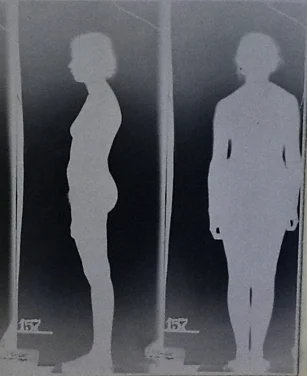
The idea that generations of America’s future leaders once stood naked in front of a camera as part of an Ivy League “health study” sounds like satire, or at least like an urban legend that grew more elaborate with each retelling. Yet this unsettling practice was real, institutionalized, and defended for decades under the banner of medical science. From roughly the 1940s through the 1970s, several elite universities required incoming students to participate in full-body photographic examinations conducted in the name of public health research. These sessions were not optional in any meaningful sense, and refusal could jeopardize a student’s standing at the institution.
What makes the episode especially disturbing in retrospect is not voyeurism or scandal in the modern sense, but how ordinary it was treated at the time. Administrators, doctors, and even many students accepted the procedure as a scientific necessity, a minor indignity outweighed by the prestige of an Ivy League education. Only decades later, when the existence of the archives became public knowledge, did the practice provoke outrage. By then, the photographs represented not only invasive data collection, but a profound failure of consent, ethics, and institutional accountability.
The medical logic behind the nude posture studies
The origin of these photographs lies in early twentieth-century medical concerns about posture, skeletal development, and nutritional diseases. One of the most prominent fears was rickets, a condition caused by vitamin D deficiency that leads to bone deformities, particularly in children and adolescents. Although rickets was more common among the urban poor, medical researchers believed it could also affect affluent populations in subtler ways, especially during periods of rapid growth.
University physicians argued that the late teenage years were an ideal time to study skeletal alignment. Freshmen were young enough for developmental issues to be visible, yet old enough to be considered physically mature. To assess posture accurately, researchers insisted that clothing had to be removed entirely. Even minimal garments, they claimed, could obscure spinal curvature, shoulder asymmetry, or hip alignment. From a clinical standpoint rooted in the norms of the era, nudity was framed as a technical requirement rather than an invasion.
The examinations typically involved standardized poses against a gridded backdrop, designed to allow precise measurement of bodily angles. In some cases, researchers lightly pressed pins or markers against the back to identify vertebrae and reference points. These details were recorded photographically, creating a visual archive intended for longitudinal study. What is striking is how long this rationale went unquestioned. The authority of medicine, combined with deference to elite institutions, insulated the practice from serious ethical scrutiny for decades.
Ivy League institutions and institutionalized compliance
Among the schools that adopted these practices were Yale University, Harvard University, Brown University, and Vassar College. Although procedures varied slightly by campus, the underlying model was consistent: participation was framed as routine, mandatory, and scientifically justified. Incoming students were often told that the examinations were for their own benefit, or that they contributed to important research that would advance public health.
The imbalance of power between institutions and students cannot be overstated. Many freshmen were far from home for the first time, eager to fit in, and acutely aware of the privilege they had been granted by admission. Questioning authority carried social and academic risk. In this environment, consent was more theoretical than real. Students signed forms, but refusal was rare and discouraged, creating a culture of silent compliance.
Administrators later defended the program by pointing to its normalization across elite campuses. Because multiple prestigious schools participated, the practice acquired a veneer of legitimacy. If all the Ivies were doing it, the reasoning went, it must be acceptable. This collective reinforcement delayed ethical reevaluation and allowed the archive to grow for decades, encompassing thousands of students from some of the most influential families in the United States.
The scope of the photographic archives
Over time, the posture studies produced an enormous collection of images. Each photograph was cataloged, labeled, and stored for future reference. Researchers envisioned comparative studies spanning generations, tracking changes in posture, bone structure, and health outcomes across social classes. The ambition of the project reflected mid-century confidence in large-scale data collection, a belief that more information would inevitably yield better understanding.
What gives the archive its lasting notoriety is the fact that it included students who later became household names. Reports emerged that the collection contained images of future political leaders, cultural figures, and professionals who went on to shape public life. Among those frequently mentioned are George W. Bush, Hillary Clinton, and Meryl Streep. Their inclusion was not because they were special cases, but precisely because they were ordinary students at the time.
The presence of such figures underscores how deeply embedded the practice was within elite education. These were not fringe experiments targeting vulnerable outsiders; they were imposed on the children of the political, economic, and cultural establishment. That fact complicates simplistic narratives of exploitation, revealing instead how institutional norms can override personal boundaries even among the most privileged.
Gender, vulnerability, and overlooked harms
Both male and female students were subjected to the examinations, a point sometimes cited to argue that the practice was equitable. In reality, gender neutrality did not eliminate harm. For many participants, especially women, the experience was humiliating and distressing. Being photographed nude by authority figures in a clinical setting did not erase feelings of exposure or loss of control. At a time when discussions of bodily autonomy were limited, students often lacked the language to articulate their discomfort.
The psychological impact was rarely considered. Researchers focused on bones and posture, not on how repeated institutionalized nudity might affect a young person’s sense of self. Confidentiality was promised, but trust depended entirely on the institutions themselves. Students had little assurance about who would access the images or how long they would be kept. The idea that the photographs might persist long after graduation was rarely made explicit.
In hindsight, these omissions reveal a narrow conception of harm. Physical injury was the primary ethical concern; emotional or psychological distress was largely invisible. This reflects broader trends in mid-century research ethics, where consent was often treated as a procedural formality rather than an ongoing moral relationship. The posture studies are now frequently cited as examples of how easily scientific ambition can eclipse human dignity.
Exposure, backlash, and destruction of the photographs
For decades, the posture photo archives remained obscure, known mainly to administrators and researchers. That changed when journalists and historians began uncovering details about the collections. As awareness spread, public reaction was swift and critical. What had once been defended as benign medical research was now widely seen as invasive, coercive, and ethically indefensible.
Former students expressed shock and anger upon learning that their images had been preserved for so long. The idea that deeply personal photographs existed in institutional archives, potentially accessible to unknown parties, provoked outrage. Universities found themselves facing difficult questions about consent, accountability, and the limits of institutional authority. The reputational risk was substantial, particularly given the prominence of many former students.
In response, universities moved to destroy the photographs. This act was framed as a corrective measure, an acknowledgment that the archives should never have existed. Yet destruction also eliminated the possibility of independent review or full historical accounting. What remains is a fragmented record: testimonies, administrative documents, and partial disclosures. The erasure itself has become part of the controversy, raising questions about whether institutions were more concerned with liability than transparency.
Reassessing the legacy of the posture studies
Today, the Ivy League nude photography programs are widely cited in discussions of research ethics and institutional power. They serve as cautionary examples of how good intentions, when combined with unchecked authority, can lead to systemic violations of personal autonomy. The studies were not driven by malice, but by a culture that privileged scientific authority over individual consent.
They also complicate assumptions about elite protection. The students involved were not marginalized in the conventional sense, yet they were still vulnerable to institutional pressure. Prestige did not shield them from coercion; in some ways, it intensified it. The desire to belong, to succeed, and to comply with expectations made resistance unlikely.
Ultimately, the episode forces a broader reflection on how societies balance knowledge-seeking with respect for the individual. The destruction of the photographs closed one chapter, but the ethical questions they raised remain relevant. Modern research standards, with their emphasis on informed consent and participant welfare, were shaped in part by recognizing such failures. Remembering this history is essential to ensuring it is not repeated.
Leave a Reply