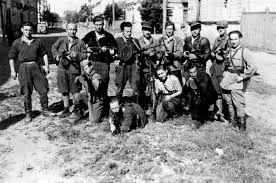
Most people today associate the word “Avengers” with superheroes in colorful suits, epic battles, and blockbuster movies that dominate global pop culture. Yet long before the Marvel franchise became a household name, another group carried the same name—one rooted not in fiction, but in the very real and painful aftermath of World War II. These Avengers were Jewish Holocaust survivors and resistance fighters who banded together with a single, furious purpose: to seek justice against Nazi war criminals who had escaped punishment after the collapse of the Third Reich. Led by figures such as Abba Kovner, they channeled their grief, trauma, and rage into a covert mission known alternately as “The Avengers” or “Nakam,” a Hebrew word meaning “revenge.” While their goals and methods remain subjects of heated debate among historians, there is no denying the boldness of their actions or the historical significance of their story. Among their operations was a successful mass poisoning that targeted 2,283 German prisoners of war, a staggering feat that remains one of the most significant revenge actions undertaken by Holocaust survivors. Exploring their motivations, actions, and legacy offers a deep and often uncomfortable insight into what justice meant in a world still reeling from genocide.
The Origins of the Avengers: Trauma, Survival, and the Quest for Justice
In the immediate aftermath of World War II, Europe was a continent haunted by devastation—cities in ruins, communities uprooted, and millions of lives lost. For Jewish survivors emerging from concentration camps, forests, hiding places, and resistance networks, the end of the war did not bring closure. Instead, it brought a new kind of emotional torment: the realization that many Nazi perpetrators had escaped justice entirely. As Allied occupation zones struggled to identify, arrest, and prosecute war criminals, countless former Nazis blended back into civilian life. Others slipped across borders or forged new identities. To those who had endured the horrors of the Holocaust, this was an unbearable betrayal of justice.
Into this moral vacuum stepped Abba Kovner, a Lithuanian-Jewish poet, partisan commander, and survivor of the Vilna Ghetto. Kovner believed that traditional legal justice alone could never account for the magnitude of the crimes committed. Along with other resistance veterans, many of whom had lost entire families, he founded a clandestine group that called themselves “Nakam,” or “The Avengers.” Their goal was simple and brutal: to ensure that the perpetrators of genocide experienced consequences equivalent to the suffering they caused. While Kovner was the ideological heart of the movement, the Avengers also drew on the skills of fighters from various partisan units, individuals adept at sabotage, covert operations, and survival under extreme conditions.
The formation of the Avengers cannot be separated from the psychological landscape of postwar Europe. Survivors carried trauma beyond anything most human beings can imagine—memories of starvation, forced labor, death marches, and mass executions. They had witnessed not only the murder of loved ones but the systematic destruction of entire Jewish communities across Eastern Europe. Their actions emerged not from wanton violence but from a raw, deeply human response to profound injustice. The Avengers were not supported by governments, nor were they fully aligned with mainstream Jewish organizations. Instead, they operated independently, driven by their own moral calculus. While some envisioned symbolic acts that would serve as warnings to future generations, others sought more direct retribution. It was this internal debate—between symbolic vengeance and mass action—that eventually shaped the group’s operations.
The Plans for Mass Revenge: Between Symbolism and Catastrophe
The Avengers developed two primary plans to carry out their vision of justice. These plans reflected the internal divisions within the group as well as the evolving political realities of postwar Europe. “Plan A,” as they called it, was the most ambitious—and the most controversial. It aimed to kill millions of Germans by poisoning the water supplies of major cities such as Nuremberg, Munich, and Hamburg. The rationale behind this drastic strategy was rooted in the idea that collective punishment mirrored the collective nature of the Holocaust. To the Avengers, the German population as a whole bore responsibility for the genocide, either through active participation or passive complicity.
Abba Kovner championed Plan A, believing it would serve as a devastating message that the destruction of the Jewish people would not pass unanswered. However, other members hesitated, concerned not only about the ethical implications but also about the geopolitical consequences. Allied authorities were actively rebuilding Germany as a bulwark against Soviet influence, and indiscriminate mass killing would have sparked global outrage and potentially endangered Jewish communities elsewhere. Moreover, procuring sufficient quantities of poison and infiltrating secure urban water systems posed immense logistical challenges. Ultimately, Plan A never materialized. Kovner himself was arrested by British authorities while traveling with toxic materials, though the exact circumstances remain somewhat ambiguous. His arrest ended any possibility of executing the plan.
Instead, the Avengers turned their focus to “Plan B,” a more targeted but still dramatic act of retaliation. This plan aimed at killing large numbers of Nazi prisoners of war held in Allied custody. Unlike Plan A, which was societal in scope, Plan B specifically targeted individuals who had fought for or supported the Nazi regime. The group viewed this as a morally justified and proportionate response to the atrocities committed during the Holocaust. Crucially, this plan required fewer resources and was far more feasible to carry out. It also aligned more closely with the strategic and ethical preferences of members who favored retribution against actual perpetrators rather than broad civilian populations. The Avengers’ pivot from Plan A to Plan B represents a pivotal moment in their history, one that highlights the complex interplay between emotion, ethics, and practicality in the pursuit of justice.
The Poisoning of German POWs: Execution of Plan B
Plan B culminated in one of the most significant and carefully orchestrated revenge actions in postwar history: the poisoning of more than 2,000 German prisoners of war at Stalag 13, a POW camp in Nuremberg. The operation was carried out primarily by a subgroup of the Avengers who had the logistical means, nerve, and discipline to execute such a dangerous mission. By early 1946, the group had established connections with local bakeries that supplied bread to the POW camps. It was through these bakeries that the Avengers gained access to the food chain serving German prisoners.
Their chosen method involved brushing arsenic onto thousands of loaves of bread destined for consumption by former SS officers and Wehrmacht soldiers. Unlike Plan A, which required technological expertise and large-scale infrastructure infiltration, Plan B relied on human networks, a precise understanding of supply chains, and an ability to operate quietly under the noses of Allied authorities. The arsenic was smuggled into the bakery in secret and applied during night shifts when oversight was minimal. The Avengers worked swiftly and meticulously, ensuring that the contaminated bread was indistinguishable from the rest.
The poisoning took place on April 13, 1946. When the prisoners consumed the bread, many fell violently ill. Reports from U.S. military investigators documented that 2,283 prisoners displayed symptoms of arsenic poisoning. While early rumors claimed mass fatalities, later evaluations concluded that although the poisoning was widespread, it did not result in mass death. This discrepancy has fueled debate among historians: some argue that the poison concentration was deliberately calibrated to incapacitate rather than kill, while others believe the Avengers intended a deadly outcome that was thwarted by inadequate dosage or medical intervention.
Regardless of the ultimate death toll, the scale of the operation remains staggering. It required coordination, secrecy, and extraordinary psychological resolve. The Avengers were fully aware that discovery would lead not only to their arrest but likely to their execution. Their success in infiltrating a controlled supply network and affecting thousands of individuals underscores the planning sophistication often overlooked in discussions of postwar resistance. Moreover, the act created shockwaves within Allied military command, prompting investigations and heightened security around POW camps. Although the Allied authorities eventually closed their inquiry without charging the perpetrators, the operation stands as one of the most consequential acts of revenge carried out by Holocaust survivors against Nazi forces.
The Legacy of the Jewish Avengers and Their Place in History
The story of the Jewish Avengers occupies a complex and emotionally fraught space within modern memory of the Holocaust and World War II. For decades, their actions were little discussed, overshadowed by broader narratives of reconstruction, reconciliation, and the legal proceedings at Nuremberg. Many survivors involved in Nakam immigrated to Israel, where their experiences in resistance and revenge blended into the broader tapestry of national identity. Only in recent years—through documentaries, interviews, and scholarly research—has the full story of the Avengers begun to receive widespread attention.
Their legacy raises challenging questions about revenge, justice, and the human response to trauma. On one hand, their actions can be seen as a desperate attempt to reclaim agency after experiencing the most profound dehumanization imaginable. On the other hand, the ethical implications of their plans, especially the proposed mass poisoning of civilians, continue to evoke debate. Some scholars argue that the Avengers represent a raw, visceral expression of justice in a world where legal mechanisms were painfully slow and often insufficient. Others caution against romanticizing acts that, if successful, would have resulted in mass civilian casualties.
Yet the Avengers’ story is also a testament to the psychological landscape of survivorhood. These were not figures driven by cruelty but by the memory of parents, siblings, children, and entire communities wiped out with bureaucratic efficiency. Their actions illuminate a dimension of postwar history often overlooked: the ways in which survivors grappled with the inadequacies of conventional justice systems. The Avengers did not shape the political future of Europe, but they embodied a form of moral protest, asserting that genocide cannot simply be followed by normalcy.
Today, the Avengers stand as a stark reminder of a historical moment when justice, revenge, grief, and trauma intersected in extraordinary ways. Their story complicates traditional narratives of victimhood, revealing individuals who refused passivity and instead asserted themselves—however controversially—in the violent and chaotic world left behind by the Holocaust. Whether viewed as heroes, vigilantes, or tragic symbols of unresolved suffering, their actions force us to confront the uncomfortable truth that history is shaped not only by institutions but by individuals responding to trauma in deeply human ways.
Conclusion: Remembering a Difficult and Powerful Chapter of History
The Jewish Avengers were not superheroes, nor were they mythical figures born from imagination. They were real men and women shaped by unimaginable loss, operating in a world where justice felt inadequate and the wounds of genocide remained painfully fresh. Their story challenges the boundaries of historical narrative, inviting us to consider how individuals respond to profound injustice and whether traditional legal systems can ever truly account for crimes as vast as the Holocaust. What they did was controversial, ethically complex, and emotionally charged—but it was also undeniably human. It reflects the desperation of a people confronting a moral universe that had collapsed around them.
Today, as the memory of World War II grows more distant, stories like that of the Avengers remind us that history cannot be sanitized. It is filled with difficult choices, conflicting emotions, and actions that defy simple categorization. The Avengers were shaped by one of the darkest periods in human history, and their quest for justice—however one interprets it—forms a critical part of understanding how survivors coped with the aftermath of genocide. Their story belongs to the broader tapestry of modern history, a chapter that forces us to acknowledge not only the atrocities committed but also the profound emotional and moral struggles that followed.
Leave a Reply