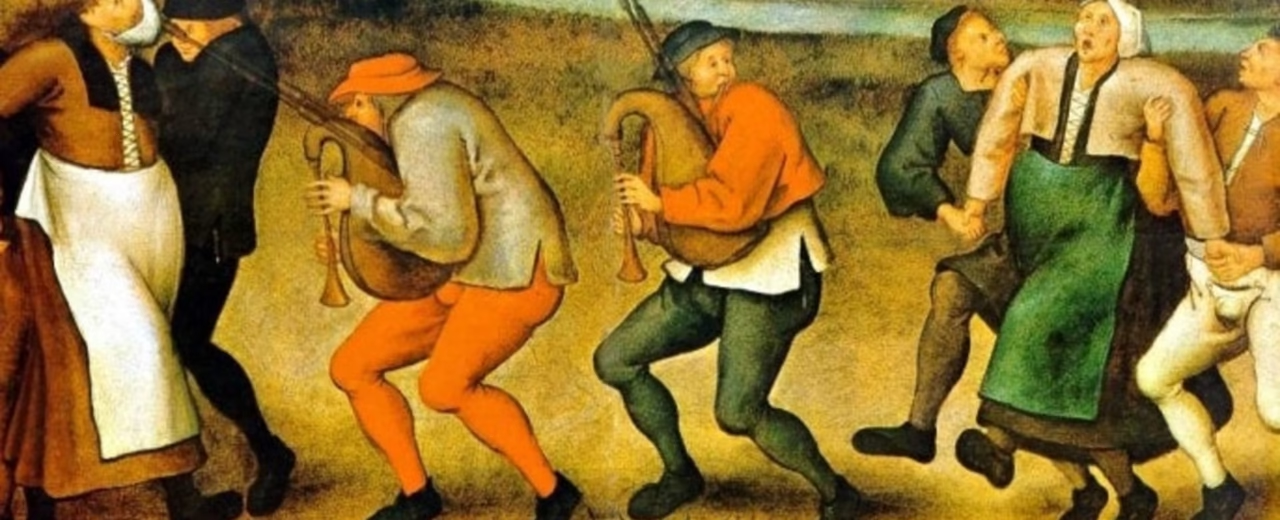
In the summer of 1518, Strasbourg became the stage for one of the strangest and most unsettling episodes in European history. A woman began to dance in the street and, instead of stopping after a few moments of music or celebration, she kept moving. Then another person joined her. Within days, more bodies were caught in the same relentless rhythm. What began as one woman’s inexplicable movement spread into a public crisis, sweeping through an entire neighborhood with a force that baffled physicians, frightened city officials, and left later historians searching for answers that still do not fully satisfy. The event has come down to us as the Dancing Plague of 1518, or choreomania, and it remains one of the most enduring mysteries in the history of illness, fear, and collective behavior.
Unlike many historical oddities that survive only in rumor, the Strasbourg outbreak appears in records that suggest something real and deeply troubling happened. Accounts from the time describe people dancing for days, even weeks, until their bodies gave out. Some modern summaries claim deaths occurred from exhaustion, stroke, or heart failure, though the exact toll is still debated. What is certain is that the episode was not treated as a local curiosity. It disturbed authorities, challenged medical thinking, and revealed how vulnerable a stressed society can be when explanation fails and panic takes hold. To understand the dancing plague, it helps to look not only at the movements themselves but at the world that produced them: a city under pressure, a population vulnerable to hardship, and a culture that interpreted suffering through religious and medical ideas very different from our own.
The first dancer and the moment the mystery began
The outbreak is usually traced to July 1518, when a woman known in the records as Frau Troffea stepped into the streets of Strasbourg and began to dance. The historical record does not preserve a neat, satisfying portrait of her inner life. We do not know what she thought as her body kept moving or whether she had some earlier cause, physical or emotional, that set the episode in motion. But the reports agree on the broad sequence: she danced without pause, and her exertion lasted long enough to alarm neighbors. In the beginning, the scene may have looked like a private crisis. Very quickly, it became a public contagion of a very different kind.
Within a week or so, others joined her. By the end of July, dozens were dancing in the streets and in enclosed spaces, unable to stop even when their feet bled and their limbs swelled. Later accounts vary on the exact number involved, but they consistently portray a frightening escalation. This was not a festive dance at a wedding or a devotional movement in a church procession. It was compulsive, exhausting, and apparently involuntary. The dancers seemed trapped inside an action they could not escape, and the city around them did not know whether to treat the phenomenon as a sickness, a spiritual affliction, or something else entirely.
Part of what makes the dancing plague so compelling is the narrowness of the surviving evidence. We have enough to know that this was not a legend invented out of whole cloth, yet not enough to fully reconstruct the first moments of the outbreak. That gap leaves historians with room for careful interpretation. Some have wondered whether Frau Troffea was suffering from a neurological disorder, seizure-like episodes, or some form of psychological distress that was then amplified by observers. Others emphasize the highly charged environment of early sixteenth-century Strasbourg, where poverty, disease, and fear could turn one person’s visible suffering into a communal event. The first dancer may not have caused the plague in a simple mechanical sense. She may instead have provided the spark for a city already poised to burn.
Why Strasbourg was so vulnerable to a mass dancing mania
To modern readers, the idea of people dancing themselves to collapse can sound absurd, even theatrical. But Strasbourg in 1518 was not a safe, prosperous, and medically sophisticated city. It was a place where ordinary life was shaped by chronic insecurity. Harvests could fail. Food supplies could become unreliable. Disease could move through crowded quarters. Religion framed everyday experience, while medical knowledge still relied heavily on humoral theory, astrology, and inherited classical texts. In such an environment, strange behavior was rarely understood as random. People looked for causes in divine punishment, corrupted blood, overheated humors, or imbalances in the body and soul.
That matters because a mystery like the Dancing Plague of 1518 did not unfold in a vacuum. Strasbourg had recently experienced social and economic stress, and the general population lived with the strain of uncertainty. Modern historians have argued that episodes of mass psychogenic illness often emerge where tension is intense and explanation is limited. The mind and body can respond to pressure in ways that become contagious through attention, imitation, and expectation. In a tightly knit community, one person’s apparent breakdown may trigger another’s. Once the body is seen as acting beyond conscious control, others may begin to experience the same sensations and interpret them through the same framework.
That does not mean the outbreak was “imagined” in any dismissive sense. The dancers were real people in visible distress. Their symptoms had consequences that were physical, social, and possibly fatal. The historical question is not whether they were faking. It is why so many became trapped in the same behavior at the same moment. Some researchers have pointed to stress-related illness, ergot poisoning, or neurological disease. Others, including historian John Waller, have made a persuasive case that severe psychological strain and cultural expectation better explain the spread. In Waller’s interpretation, the people of Strasbourg were primed by hardship and religious belief to experience an episode of mass hysteria, or what we would now call mass psychogenic illness. It is a theory that does not solve every detail, but it does make the outbreak seem less like supernatural nonsense and more like a human response to overwhelming pressure.
If you are interested in other historical cases where communities misunderstood suffering, it can be useful to compare them with events such as Salem “witches” weren’t actually burned, where fear, belief, and institutional response shaped the outcome just as much as the facts on the ground.
What authorities did, and why their response may have made things worse
The response of Strasbourg’s authorities is one of the most revealing parts of the story. Faced with people dancing themselves toward collapse, officials did not simply dismiss the outbreak. Instead, they tried to manage it using the logic available to them. And that logic, tragically, often worsened the situation. According to several accounts, physicians and civic leaders believed the dancers were suffering from a hot blood condition that needed release. Their remedy was to let the afflicted keep dancing. In some versions of the story, they even provided musicians and a stage or designated space so the movements could continue in a controlled manner.
From a modern standpoint, this seems astonishingly misguided. Yet the decision makes more sense when viewed through the medical assumptions of the period. If the problem was caused by excess heat in the body, then motion and music might appear to be part of the cure rather than the cause. Authorities were not being cruel for the sake of cruelty; they were trying to fit a baffling event into the framework they knew. Unfortunately, that framework may have reinforced the very behavior they hoped to end. By staging the dancing as something sanctioned and observable, they may have encouraged more people to participate, or at least made the compulsion feel more legitimate.
As the episode dragged on, the city appears to have reconsidered. Religious explanations gained ground, and officials may have turned to spiritual remedies. The afflicted were reportedly taken to shrines dedicated to saints associated with healing, especially St. Vitus, who was often invoked in connection with dance-related disorders. In a culture where bodily affliction and spiritual crisis were closely linked, pilgrimage and prayer were not irrational choices. They were attempts to restore order in a world where ordinary medicine seemed powerless. Whether those interventions helped is impossible to say with certainty, but the outbreak did eventually subside.
What the official response shows most clearly is the dangerous distance between diagnosis and reality. The city’s leaders were not indifferent, but they were trapped inside the assumptions of their time. Their efforts to contain the phenomenon probably reflected genuine concern, yet concern alone does not guarantee success. When a society misreads a crisis, its solutions can intensify the damage. That lesson still feels uncomfortably modern, which may be one reason the dancing plague continues to fascinate historians and general readers alike.
Theories about cause: poison, faith, psychology, or something else?
The Dancing Plague of 1518 has inspired a long list of explanations, and part of its power lies in the fact that none of them is entirely satisfying. One of the oldest ideas is that the dancers were poisoned, perhaps by ergot, the fungus that can infect rye and produce hallucinations, convulsions, or other strange symptoms. It is an appealing theory because it gives the event a concrete, biological cause. But it also has weaknesses. Ergotism typically produces painful, dramatic physical effects that do not closely resemble prolonged, coordinated dancing. It can cause convulsions and delirium, but a mass outbreak centered on compulsive movement is harder to fit neatly into that diagnosis.
Another line of explanation emphasizes religion and belief. In the early sixteenth century, Europeans were deeply familiar with ideas of divine punishment, demonic influence, and saintly intervention. If the afflicted believed they were cursed or compelled by some supernatural force, their symptoms could have taken on a self-reinforcing character. Cultural scripts matter. People often experience distress in forms that their society already knows how to name. A modern person might report panic, paralysis, or dissociation; an early modern person might dance until collapse, interpreting the experience through the language of sin, possession, or enchantment.
The most widely accepted modern interpretation leans toward mass psychogenic illness, a term that describes real physical symptoms spreading through suggestion and social contagion rather than through a toxic agent. This approach does not claim that the dancers were “making it up.” Quite the opposite: it treats their suffering as genuine and powerful. In stressful conditions, the human body can express trauma in astonishing ways. Once a pattern is visible, others may unconsciously adopt it, especially in a highly communal society. The dancing, in this sense, may have been a shared breakdown of regulation, a kind of social fever.
Still, historians remain cautious. The surviving sources are imperfect, and some details may have been embellished by later writers. There is also the challenge of separating the event itself from the way it was remembered. Did people truly dance for weeks without rest? Were deaths directly caused by the activity, or were the most dramatic claims added afterward? As with many unexplained events in history, certainty is elusive. That is what keeps the case alive. It resists the comfort of a single answer and forces us to admit that the past can be both documented and opaque. Much like other strange episodes preserved in fragmented records, the dancing plague sits on the border between fact, interpretation, and human imagination.
For a different kind of historical mystery shaped by technology and social change, readers may also enjoy The Jacquard Loom: How a Silk-Weaving Machine Helped Invent the Logic of Modern Computing, which shows how a seemingly narrow historical development can have far-reaching consequences in unexpected ways.
Why the Dancing Plague still matters today
The reason the Dancing Plague of 1518 remains so memorable is not simply that it is bizarre. It is memorable because it exposes something enduring about human beings. Under the right conditions, fear can spread as quickly as any disease. Stress can take unusual forms. Communities can reinforce distress without meaning to. And institutions, when faced with the unknown, may reach for explanations that fit their worldview even when those explanations fail to address the real cause. Strasbourg’s dancing outbreak is therefore more than an oddity from the distant past. It is a case study in how bodies, beliefs, and social conditions interact.
Modern readers often approach the episode as a curiosity, something to shake their heads at from the safety of a very different age. But the deeper lesson is less comfortable. We still see mass behavior shaped by anxiety, rumor, imitation, and communal pressure. The forms change, but the mechanisms remain recognizable. What happened in Strasbourg reminds us that people do not react to crises as isolated individuals alone; they react as members of a collective, drawing on shared stories to understand what is happening to them. When those stories are misleading, the results can be startling.
The dancing plague also highlights the limits of historical certainty. The event is well known, but not fully knowable. We can follow the outlines: a woman begins to dance, the behavior spreads, authorities intervene badly, and the crisis eventually fades. Yet the emotional reality inside that outbreak remains partly hidden. What did the dancers feel? Did they believe they were doomed? Were they frightened, relieved, ashamed, or in some altered state that defies easy description? History often offers facts without full access to experience. That is frustrating, but it is also what gives episodes like this their lasting power.
In the end, the Dancing Plague of 1518 is a story about a city caught between explanation and helplessness. It is about a neighborhood transformed into a stage for collective suffering. It is about mistaken remedies, fragile minds, and the strange ways in which social pressure can become visible in the body itself. The mystery has never been solved to everyone’s satisfaction, and perhaps that is appropriate. Some historical events refuse to become neat lessons. They stay unsettled, like a rhythm that will not stop. Strasbourg’s fatal dancing mania is one of those events: haunting, tragic, and impossible to forget once encountered. It endures because it speaks to a very old human fear, the fear that something invisible can seize a community and make it move in ways no one truly understands.