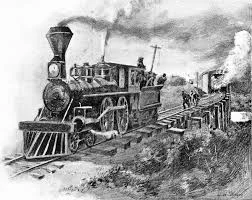
In the pantheon of American military honors, nothing carries more symbolic weight than the Medal of Honor. It is the highest decoration for valor that the United States can bestow, reserved for acts of extraordinary bravery that go far beyond the call of duty. What many people do not realize, however, is that the very first official Medals of Honor were not created in peacetime ceremonies or modern battlefields—they were born in the chaos of the American Civil War. Even more remarkably, the first recipients were not chosen from a traditional battlefield charge or a famous last stand. Instead, they were awarded to Union soldiers and civilian volunteers who took part in one of the most daring and bizarre missions of the war: the Great Locomotive Chase of 1862. This high-risk raid, involving stolen trains, desperate pursuits, and long odds, not only shaped military legend but also gave birth to America’s most sacred military honor.
The Birth of the Medal of Honor in the Crucible of Civil War
Before the American Civil War, the United States had no formal, permanent system for awarding individual military decorations for valor. European armies had long traditions of medals and orders, but American political culture—shaped by suspicion of aristocracy and inherited honors—had resisted such practices. Military recognition existed primarily through promotions, public praise, or congressional resolutions rather than standardized medals.
That changed in 1861. As the Civil War escalated into a conflict of unprecedented scale and brutality, the Union government faced a new challenge: how to recognize acts of exceptional heroism among the rapidly expanding volunteer army. The war was unlike any previous American conflict. It involved massive citizen armies, industrial weaponry, and casualty numbers that stunned the public. Traditional systems of recognition were no longer sufficient to reflect the sacrifices being made.
In December 1861, the U.S. Navy took the first step by authorizing a medal for sailors who distinguished themselves in combat. A few months later, in July 1862, Congress approved a similar honor for the Army. This legislation officially created what would become known as the Medal of Honor. At first, it was not envisioned as the rare and sacred distinction it is today. Early eligibility rules were broad, and the standards for valor were still evolving.
The timing of the medal’s creation is crucial. By mid-1862, the Union war effort was in a precarious position. Major battles had produced horrifying losses. Morale needed reinforcement. The creation of a heroic decoration served not only to honor bravery but also to inspire continued commitment from soldiers and civilians alike.
It was into this historical moment that the Great Locomotive Chase unfolded. When the War Department looked for its first recipients of the new medal, this audacious raid stood out as a perfect symbol of daring, ingenuity, and sacrifice. The men involved had volunteered for a mission that demanded extraordinary courage, with little promise of survival. Their actions would define the Medal of Honor at its very beginning.
The Great Locomotive Chase: A Daring Mission Behind Confederate Lines
The Great Locomotive Chase took place on April 12, 1862, deep within Confederate territory in present-day Georgia. The bold plan was conceived by Union civilian scout and espionage agent James J. Andrews. His goal was to cripple the Confederate rail network that supplied troops to Chattanooga, Tennessee—a vital strategic hub. Railroads were the lifelines of the Civil War, and destroying them could shift the balance of entire campaigns.
Andrews recruited a small group of Union soldiers—mostly volunteers from Ohio regiments—who were willing to disguise themselves as civilians and penetrate enemy territory. Their mission was extraordinarily dangerous. If captured out of uniform behind enemy lines, they would be treated not as prisoners of war but as spies, facing almost certain execution.
The plan was ingenious in its simplicity. The raiders would sneak into northern Georgia, board a northbound train called The General, wait until it stopped for breakfast in the town of Big Shanty (now Kennesaw), and then steal the locomotive. With the engine under their control, they would race north toward Union lines, tearing up track, cutting telegraph wires, and burning bridges along the way to isolate Confederate forces.
At first, everything worked with eerie precision. While Confederate passengers and crew ate breakfast, Andrews and his men uncoupled The General and sped away. But their success triggered one of the most dramatic pursuits in railroad history. The train’s conductor, William Fuller, immediately began chasing the stolen engine—first on foot, then by handcar, and eventually using other locomotives in a relentless relay pursuit.
For hours, the raiders and their pursuers thundered across Georgia at breakneck speed. The Union men sabotaged tracks, cut telegraph wires, and tried desperately to destroy bridges—but rain-soaked wood refused to burn. Their fuel ran low. Confederate trains closed the distance. One by one, the raiders were forced to abandon the locomotive and scatter into the countryside. Within days, all were captured.
The Great Locomotive Chase had failed as a military operation. The bridges stood. The rail line remained functional. Yet its impact on American history would prove far greater than anyone involved could have imagined.
Capture, Execution, and Survival: The Fate of the Raiders
After their capture, the Union raiders were imprisoned under brutal conditions and subjected to intense interrogation. Because they had operated in civilian disguise behind enemy lines, Confederate authorities classified them as spies rather than lawful soldiers. Under the rules of war at the time, this distinction was deadly.
James J. Andrews, the mission’s architect, was among the first to be executed. He was hanged in Atlanta in June 1862. Seven more of the raiders were executed shortly afterward. Their deaths were swift, public, and intended as a warning to any others who might attempt similar acts of sabotage.
Yet not all met the same fate. Some of the captured soldiers managed to escape from Confederate prisons after months of confinement. Others remained imprisoned until they were exchanged as prisoners of war. By the time the surviving raiders returned to Union lines, they were emaciated, traumatized, and permanently marked by what they had endured.
Their failure as a mission did not diminish the courage of their attempt in the eyes of the Union public. In fact, the stark contrast between their daring and their suffering amplified their legend. Newspapers told their story as one of reckless heroism—a group of volunteers who knowingly walked into near-certain death for the sake of the Union cause.
The deaths of Andrews and the executed raiders cast a long shadow over the operation. For the Union government, the story presented a powerful narrative opportunity. These men had volunteered for a mission that required not only physical bravery but also psychological endurance. They had faced execution with full knowledge of the risks. Their sacrifice demanded a form of recognition that went beyond ordinary praise.
It was within this emotional and political atmosphere that the first Medals of Honor would soon be awarded—not to generals or battlefield heroes, but to these raiders whose story combined espionage, endurance, tragedy, and courage in equal measure.
The First Official Medals of Honor Are Awarded
In March 1863, less than a year after the raid, Secretary of War Edwin M. Stanton made history by presenting the first Medals of Honor to six of the surviving raiders from the Great Locomotive Chase. This moment marked the official beginning of the Medal of Honor as a living American institution.
The recipients were Union soldiers who had volunteered for Andrews’ mission and survived Confederate captivity. Their medal citations recognized not only their battlefield bravery but also their willingness to undertake a mission that carried a near-certainty of death if captured. Over time, additional surviving raiders also received the medal as eligibility rules were clarified and expanded.
In total, 19 of the 22 original participants would eventually be awarded the Medal of Honor posthumously or during their lifetimes. This makes the Great Locomotive Chase unique in American history as the single event associated with the highest number of Medals of Honor tied to a single operation.
The early design of the medal itself reflected the transitional identity of the award. It was not yet the solemn, tightly regulated decoration it would become in later generations. Early recipients sometimes received their medals informally, even years after the fact. Some medals were lost, replaced, or reissued as standards evolved.
Yet the symbolism was already clear. From its very first presentation, the Medal of Honor was tied not simply to victory, but to voluntary risk in the face of overwhelming danger. These men had not followed routine orders into battle. They had stepped forward for a mission that defied conventional warfare.
The fact that the earliest Medals of Honor were awarded for a failed mission is deeply significant. It established from the beginning that the medal was not about outcome alone. It was about intent, courage, and self-sacrifice—even when the gamble did not succeed.
How the Great Locomotive Chase Shaped the Meaning of the Medal of Honor
Because the first recipients were tied to such an unconventional mission, the Great Locomotive Chase permanently influenced how Americans understood the Medal of Honor. The raiders’ story framed valor not just as physical bravery under fire, but as the voluntary acceptance of impossible odds.
These men were not celebrated for capturing enemy flags or holding defensive lines. They were celebrated for choosing to go behind enemy lines as civilians, knowing they would be executed as spies if caught. The psychological weight of that decision defined a new type of military heroism.
Later generations of Medal of Honor recipients would embody many forms of courage—last stands, solo assaults, rescues under fire—but all could trace their legacy back to that original definition established in 1863. The standard was not simply excellence in combat. It was action infused with conscious self-sacrifice.
The story also helped shape the Medal of Honor’s association with ordinary soldiers rather than elite commanders. The Great Locomotive Chase involved enlisted men, engineers, and scouts—not famous generals. This reinforced the democratic spirit of the award. In theory, any soldier, regardless of rank, could earn the nation’s highest honor.
Over time, the Medal of Honor would become increasingly regulated. Standards would tighten. Investigations would grow rigorous. Some early medals, awarded under looser criteria, would later be revoked in the 20th century. Yet the Chase medals survived these reviews, reaffirmed as legitimate examples of the highest valor.
The raiders’ story became embedded in military education, folklore, and public memory. It ensured that the origins of the Medal of Honor were forever entwined with espionage, railroads, and one of the most daring pursuits in American history.
Why a Failed Raid Produced the Highest Honor
At first glance, it seems paradoxical that a failed military operation would produce America’s most prestigious military decorations. Yet this paradox reveals something fundamental about how societies define heroism.
The Great Locomotive Chase failed in operational terms. The bridges were not destroyed. The rail lines were restored quickly. Confederate logistics were disrupted only briefly. From a strictly strategic standpoint, the mission changed little.
But heroism, especially in the 19th century, was not measured only by results. It was measured by character under extreme pressure. The raiders had demonstrated initiative, endurance, loyalty, and a willingness to die for a cause they believed in. Their suffering after capture—months of imprisonment, starvation, and the execution of their comrades—only deepened the emotional power of their story.
The Union government needed heroes who represented the moral justification of the war. The Chase offered a narrative of volunteers who embodied devotion rather than conquest. Their heroism did not lie in slaughtering enemies but in risking themselves for strategic advantage.
This distinction mattered greatly in a war that increasingly horrified the public with its industrial killing. The Chase provided a different kind of example: courage expressed through infiltration, ingenuity, and stoic endurance in captivity.
By awarding the first Medals of Honor to these men, the government anchored the medal’s identity in sacrifice rather than spectacle. It set a precedent that the award existed not to glorify destruction, but to honor moral courage under mortal threat.
How the Story Is Remembered in American Memory
More than 160 years later, the Great Locomotive Chase still occupies a peculiar space in American memory. It is taught in military academies, preserved in museums, and retold in books and films. One of the most famous retellings is the 1956 film The General, which dramatized the chase from the Confederate perspective. Other productions have told the Union side, blending fact with cinematic invention.
The raiders themselves became lifelong symbols of valor. Some returned to ordinary civilian life. Others remained connected to military service or public life. Their medals followed them into old age as physical reminders of a moment when they had stood on the edge between survival and execution.
The Medal of Honor itself evolved dramatically after the Civil War. It became more exclusive. Fewer awards were issued in later wars. Its symbolism deepened as generations of Americans associated it with singular acts of heroism at the very edge of human endurance.
Yet at the core of that long tradition stand the men of the Great Locomotive Chase. Their story reminds us that the origins of American military honor lie not only in battlefield triumphs, but also in desperate gambles taken by ordinary soldiers who believed the risk was worth it.
Where America’s Highest Military Honor Truly Began
The first official Medals of Honor were not born from a grand victory parade or a decisive battlefield triumph. They emerged from a failed but fearless mission carried out by a small group of Union volunteers deep inside enemy territory during the darkest days of the American Civil War. The Great Locomotive Chase of 1862 combined audacity, ingenuity, tragedy, and sacrifice in a way that permanently shaped how the United States would define military heroism.
By awarding the nation’s first Medals of Honor to these raiders, the Union government established a powerful moral standard: that true valor is measured not only by success, but by the willingness to face near-certain death for a greater cause. This principle would echo through every later generation of recipients, from the trenches of World War I to the mountains of Afghanistan.
The Great Locomotive Chase may not have crippled the Confederacy’s railroads, but its legacy runs far deeper than any bridge it failed to burn. It forged the symbolic meaning of America’s highest military decoration at the very moment it was created—binding the Medal of Honor forever to extraordinary courage in the face of impossible odds.
Leave a Reply