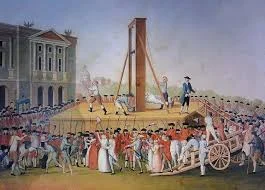
For most of French history before the late eighteenth century, execution was not simply a matter of ending a life. It was a public spectacle, a moral lesson, and a reflection of social hierarchy. Death sentences were designed to hurt, to shame, and to make an example of the condemned. The manner in which someone died at the hands of the state depended heavily on who they were, where they came from, and what crime they had committed. Nobles were often granted relatively swift deaths, while commoners endured punishments of extraordinary cruelty. Against this backdrop of inequality and brutality, the invention of the guillotine emerged not as a symbol of terror, but as a radical proposal for fairness. It was conceived as a tool that would bring equality, humanity, and rationality to a system of punishment that many reformers saw as medieval and unjust.
Execution and Inequality in Pre-Revolutionary France
Before the French Revolution, the justice system in France openly reflected the rigid social divisions of the Ancien Régime. The law did not treat all bodies as equal, even in death. Execution methods varied dramatically depending on class, gender, and the nature of the crime. A noble convicted of a capital offense was typically beheaded with a sword or axe, a method considered relatively quick and honorable. A commoner, by contrast, might be hanged, broken on the wheel, burned alive, or drawn and quartered. These punishments were deliberately prolonged, inflicting maximum pain and humiliation.
Being drawn and quartered, one of the most infamous penalties, involved a sequence of horrors: the condemned was often tortured, dismembered, and finally killed in front of a crowd. The purpose was not efficiency but terror. Authorities believed that fear was the most effective deterrent against crime, and public executions were carefully staged to reinforce state power. Crowds gathered not only to witness justice, but to be reminded of their place in the social order. The body of the criminal became a canvas on which authority wrote its message.
This system increasingly troubled Enlightenment thinkers. Philosophers and legal reformers questioned whether cruelty truly served justice, or whether it merely satisfied a desire for vengeance. The idea that punishment should be proportionate, rational, and applied equally began to gain traction. The old execution methods came to symbolize everything that reformers despised about absolute monarchy: arbitrariness, privilege, and unnecessary suffering. By the late eighteenth century, calls for reform were no longer abstract theories. They were becoming political demands.
Enlightenment Thought and the Question of Humane Punishment
The eighteenth century was an age of intellectual upheaval in Europe, and France stood at its center. Enlightenment philosophers challenged long-held assumptions about authority, tradition, and human nature. Thinkers such as Cesare Beccaria argued that the purpose of punishment was not revenge, but prevention. If punishment was meant to deter crime, then it needed to be certain and swift, not cruel and theatrical. Excessive brutality, Beccaria claimed, hardened society rather than improving it.
These ideas resonated strongly in France, where the legal system was notorious for its inconsistencies and abuses. Torture was still used to extract confessions, and executions often depended on regional customs rather than uniform law. Reformers began to argue that if the state claimed the right to take a life, it also had a moral obligation to minimize suffering. The concept of “humane execution” emerged from this debate, though it was deeply controversial. Many still believed that pain was an essential component of justice.
Crucially, Enlightenment critiques were closely tied to ideas of equality. If all citizens were equal before the law, then their punishments should be equal as well. This challenged the very foundation of aristocratic privilege. The fact that nobles received gentler deaths than commoners was increasingly seen as indefensible. Reforming execution methods thus became part of a broader push to dismantle the legal expressions of social hierarchy. The question was no longer whether executions should be reformed, but how.
The Guillotine as an Idea, Not Just a Machine
The guillotine did not emerge fully formed as a symbol of revolutionary violence. Its origins lie in a surprisingly clinical and reformist mindset. One of its early advocates was Joseph-Ignace Guillotin, a doctor and member of the National Assembly. Contrary to popular belief, Guillotin did not invent the device that bears his name. Instead, he proposed the principle behind it: a single, standardized method of execution that would be quick, reliable, and applied equally to all.
Guillotin’s proposal rested on two key ideas. First, execution should be as painless as possible. As a physician, he was acutely aware of human suffering and believed that decapitation, if performed mechanically, could result in near-instantaneous death. Second, the method should be universal. Whether noble or commoner, every condemned person would die the same way. This was equality made literal.
The device itself was developed by surgeons and engineers, drawing inspiration from earlier beheading machines used in other parts of Europe. What made the guillotine distinctive was not its novelty, but its purpose. It was designed with efficiency and consistency in mind. A heavy, angled blade ensured a clean cut, and the mechanism reduced the risk of botched executions. In theory, it removed human error and emotion from the process.
At this stage, the guillotine was not seen as radical or terrifying. It was presented as a humanitarian reform, aligned with the Enlightenment belief in reason and progress. Few could have predicted how closely it would later be associated with mass death and revolutionary excess.
Equality Before Death and Revolutionary Ideals
When the French Revolution erupted in 1789, the demand for equality became its defining theme. The abolition of feudal privileges and the declaration of equal rights transformed French society at every level. The justice system was no exception. Old laws were rewritten, regional customs abolished, and the principle of equality before the law enshrined as a cornerstone of the new order.
Within this context, the adoption of the guillotine as the primary method of execution made ideological sense. It embodied the revolutionary rejection of privilege. No longer would nobles be spared the humiliations inflicted on commoners. Death would come the same way for everyone. The guillotine thus became a physical manifestation of revolutionary values, translating abstract principles into concrete practice.
The National Assembly formally adopted the guillotine in 1792. From a legal standpoint, this decision was framed as progress. Executions were faster, more predictable, and theoretically less painful. Public spectacles of prolonged suffering were replaced by swift decapitation. Supporters argued that this was a sign of a more civilized society, even in moments of punishment.
Yet there was an inherent tension in this logic. While the method was equal, the act itself remained violent. The revolutionaries had not abolished the death penalty; they had streamlined it. This raised uncomfortable questions about whether equality in execution truly represented justice, or merely a more efficient form of state violence.
From Humane Reform to Instrument of Terror
The guillotine’s transformation from reformist tool to symbol of terror occurred rapidly. During the period known as the Reign of Terror, executions multiplied at an unprecedented rate. What had been intended as a humane and egalitarian device became the centerpiece of mass political repression. Thousands were executed, often after summary trials or on the basis of vague accusations.
This shift was not caused by the machine itself, but by the political climate in which it was used. Revolutionary leaders believed that harsh measures were necessary to defend the revolution from internal and external enemies. The guillotine’s efficiency made it ideal for this purpose. It could process large numbers of executions quickly, reinforcing the perception that the state was both powerful and uncompromising.
Ironically, the very qualities that had made the guillotine appealing to reformers now amplified its horror. Its speed and reliability stripped executions of individual drama, turning them into routine events. Crowds gathered daily, and death became a grim form of public entertainment. Equality in execution meant that anyone could be condemned, regardless of status or past service to the revolution.
The execution of Louis XVI in 1793 crystallized this transformation. The guillotine that had promised fairness now claimed a king, signaling that no one was beyond its reach. Equality before death had been achieved, but at a devastating moral cost.
Legacy and Misunderstanding of the Guillotine
In the centuries since the French Revolution, the guillotine has come to symbolize cruelty, fanaticism, and bloodshed. Popular memory often forgets its original purpose, focusing instead on its role during the Terror. This simplification obscures an important historical truth: the guillotine was born from a desire to reduce suffering and eliminate inequality in punishment.
Understanding this context does not excuse the violence that followed, but it does complicate the narrative. The guillotine reminds us that tools designed for progress can be transformed by political circumstances. It also highlights the limits of legal reform. Changing the method of execution did not address deeper questions about power, fear, and the value of human life.
The idea of “equality in execution” remains unsettling. On one hand, it represents a rejection of aristocratic privilege. On the other, it exposes the stark reality that equality can exist even within systems of violence. The guillotine forced society to confront this contradiction, making it one of the most powerful and disturbing symbols of the revolutionary era.
Conclusion: Equality, Justice, and the Weight of History
The invention of the guillotine was rooted in a genuine attempt to reform a savage and unequal system of punishment. In a society where being drawn and quartered was a legal reality, the promise of a swift and uniform death seemed like moral progress. The guillotine was not created to terrorize, but to humanize, reflecting Enlightenment ideals and revolutionary demands for equality.
Yet history rarely unfolds as intended. The same device that symbolized fairness became an emblem of fear, its blade falling in service of political extremism. The story of the guillotine serves as a cautionary tale about the complexities of reform. Equality in principle does not guarantee justice in practice, especially when power is exercised without restraint.
By examining the guillotine in its full historical context, we gain a deeper understanding of the French Revolution itself: a movement driven by noble ideals, yet capable of profound violence. The guillotine stands at the intersection of these contradictions, a reminder that even the pursuit of equality can carry a heavy human cost.