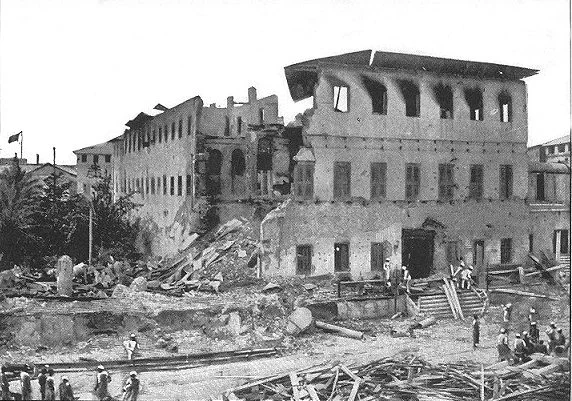
In the long and violent timeline of human conflict, wars are usually measured in years, sometimes decades. Even the briefest military campaigns typically stretch across days or weeks. Yet in 1896, a war erupted and ended in less time than it takes to watch a movie. The Anglo-Zanzibar War, fought between the British Empire and the Sultanate of Zanzibar, lasted just 38 minutes, making it the shortest war in recorded history. It unfolded on the morning of August 27, 1896, and ended in a decisive British victory. What makes this conflict so fascinating is not only its astonishing brevity, but also the tangled web of imperial politics, disputed succession, and raw military imbalance that caused it to ignite so suddenly—and vanish just as quickly. In less than an hour, a palace was reduced to rubble, hundreds were killed or wounded, and Zanzibar’s fate was permanently reshaped under British influence.
The Political Powder Keg: Why Zanzibar’s Leadership Crisis Triggered British Intervention
By the late 19th century, Zanzibar had become a valuable strategic and commercial hub on the East African coast. Once a powerful independent sultanate controlling regional trade routes in spices, ivory, and slaves, Zanzibar had gradually fallen under British influence during the height of European imperial expansion. While it remained officially sovereign, British political advisors, naval officers, and commercial interests wielded enormous behind-the-scenes power. The Sultan of Zanzibar ruled with British approval—and without that approval, his position was dangerously unstable.
When Sultan Hamad bin Thuwaini died suddenly on August 25, 1896, a succession crisis immediately erupted. His death created a power vacuum that both local rivals and British officials moved quickly to fill. According to diplomatic agreements, no new sultan could take the throne without British consent. However, Sultan Hamad’s cousin, Khalid bin Barghash, moved swiftly to seize power anyway. Within hours of the old sultan’s death, Khalid occupied the palace, declared himself ruler, and raised his personal guard in defiance of British authority.
From the British perspective, this was a direct violation of treaties and a dangerous challenge to their control over the region. They had already selected a different candidate as their preferred successor—a man they believed would remain obedient to British interests. Khalid, by contrast, was viewed as unpredictable and potentially hostile. His refusal to step down transformed what might have been a manageable diplomatic dispute into a direct confrontation.
British officials issued urgent demands for Khalid to abdicate. Messages were delivered warning that failure to surrender the palace would be treated as an act of war. Khalid refused. He fortified the palace, armed loyal troops, and positioned artillery facing the harbor. By this point, the situation had become a military standoff with no room left for negotiation. War was no longer a distant possibility. It had become an approaching certainty measured not in days, but in hours.
The Forces Assembled: A Stark Imbalance of Military Power
When hostilities loomed over Zanzibar’s harbor, the military disparity between the two sides could not have been more extreme. On one side stood the world’s most powerful empire at the height of its naval dominance. On the other stood a small palace guard equipped with outdated weapons and desperate resolve. The conflict that followed was less a battle between equal armies than a brutal demonstration of imperial firepower.
The British had positioned several heavily armed warships in the harbor, including the HMS St George, flagship of the Cape and East Africa Station. Alongside it were other cruisers bristling with modern artillery. These ships carried weapons capable of leveling buildings in minutes. Their crews were trained professionals, experienced in colonial warfare and naval bombardment.
In contrast, Khalid bin Barghash commanded roughly 2,800 men, many of them palace guards and local fighters with minimal formal military training. A small number of artillery pieces were stationed around the palace, but they were antiquated and poorly maintained. Khalid also possessed a single armed yacht, the HHS Glasgow, which he positioned in the harbor as a symbolic naval presence. Compared to the British fleet, it was militarily insignificant.
Despite the overwhelming disadvantage, Khalid believed he could force a standoff that might lead to negotiations or foreign intervention. He underestimated both British determination and their willingness to unleash devastating force. The British had issued a final ultimatum: Khalid had until 9:00 a.m. on August 27 to step down peacefully. If he remained in power after that deadline, the British would open fire.
As the morning approached, tension spread through the harbor. British sailors prepared guns. Civilians fled the shoreline. Khalid remained inside the palace, surrounded by men who awaited the inevitable with a mix of fear and fatalism. The question was no longer whether war would begin—but how quickly it would end once the first shot was fired.
Thirty-Eight Minutes of Destruction: How the Shortest War Unfolded
At precisely 9:02 a.m. on August 27, 1896—two minutes after the ultimatum expired—the British warships opened fire on the Sultan’s palace. Massive naval guns roared across the harbor. Shells tore into the heart of the palace complex with devastating accuracy. Walls collapsed. Fires erupted. The wooden structure of the palace offered almost no resistance against naval artillery.
The bombardment was relentless. British ships fired volley after volley into the palace and surrounding defensive positions. The HHS Glasgow attempted to engage but was quickly disabled and sunk by British gunfire within minutes. Zanzibar’s artillery returned fire briefly, but its shells fell far short of the British fleet and caused no significant damage. Within the first ten minutes, the outcome was already sealed.
Inside the palace, chaos unfolded. Defenders were killed instantly by collapsing masonry and exploding shells. Others fled as fires spread uncontrollably through the complex. The palace flag—symbol of Khalid’s authority—was shot down under heavy fire. This act carried enormous psychological weight. The loss of the flag signaled the collapse of effective resistance even before official surrender.
At approximately 9:40 a.m., just 38 minutes after the first shots were fired, the bombardment ceased. Khalid’s forces had been completely neutralized. Hundreds of his defenders lay dead or wounded. The palace was in ruins. The harbor was silent again, its transformation from calm morning to battlefield and back to stillness having occurred in less than an hour.
Khalid himself fled the palace during the bombardment and sought refuge in the German consulate, which granted him asylum. His escape prevented his capture and execution but ended his reign almost as quickly as it had begun. The war was over by 9:40 a.m., making it officially the shortest war in recorded human history.
Casualties and Consequences: The Human and Political Cost of a 38-Minute War
Despite its brevity, the Anglo-Zanzibar War was devastatingly lethal for those on the receiving end of British firepower. Estimates place Zanzibar’s casualties at around 500 killed or wounded, nearly all sustained during the bombardment of the palace. Many victims were palace guards and soldiers stationed near the buildings that were directly targeted. Others were civilians caught in the surrounding area as fires spread through nearby structures.
British casualties, by contrast, were almost nonexistent. Only one sailor was reportedly wounded during the entire engagement. This staggering imbalance underscores the raw destructive capability of late 19th-century naval weaponry when deployed against obsolete fortifications and lightly armed defenders.
The political consequences were immediate and irreversible. Within hours of the bombardment, the British installed their preferred candidate as Sultan—Hamoud bin Mohammed. Unlike Khalid, the new ruler governed entirely under British oversight. Zanzibar’s remaining political independence effectively ended that morning. From that point forward, the sultanate existed largely as a formal figurehead state under British control.
Khalid bin Barghash was eventually allowed to leave German protection and would later reappear in East African political life under German patronage. However, his brief reign and catastrophic defeat ensured that he would never regain control of Zanzibar.
The war also sent a powerful message throughout East Africa. Resistance to British authority, especially open military defiance, would be answered with overwhelming force. The demonstration of naval power during those 38 minutes served as both a warning and a precedent. Zanzibar became a symbol not of resistance, but of the futility of challenging a global empire at its technological peak.
Thus, the shortest war in history produced some of the longest-lasting consequences in the region. Zanzibar’s political destiny was altered forever in less time than it takes to brew a pot of tea.
Why the War Was So Short: Technology, Ultimatums, and Imperial Reality
The astonishing brevity of the Anglo-Zanzibar War was not accidental. It was the direct result of three critical factors: overwhelming technological superiority, strict diplomatic ultimatums, and the strategic psychology of imperial warfare.
First and foremost was technology. By 1896, the British Navy possessed state-of-the-art artillery capable of delivering precise, long-range devastation within minutes. Zanzibar’s defensive capabilities belonged to an earlier military era. Stone walls, wooden structures, and obsolete cannons offered no meaningful resistance against steel warships firing explosive shells. The war’s length was limited not by hesitation but by how quickly British guns could physically destroy the palace.
Second was the use of ultimatums. The British did not stumble into the conflict through misunderstanding or gradual escalation. They issued clear demands with a fixed deadline. This transformed war from a prolonged campaign into a timed event. When Khalid ignored the ultimatum, the British response was automatic and immediate. There was no back-and-forth, no drawn-out mobilization. The moment the deadline passed, war began.
Finally, there was the psychological structure of imperial warfare itself. The purpose of such conflicts was not to engage in prolonged fighting but to impose quick, terrifying demonstrations of power. Speed was part of the strategy. The goal was to break resistance instantly and discourage future defiance. In this sense, the war being only 38 minutes long was not a failure of conflict—it was precisely the result the British intended.
The combination of these factors meant the war could not have lasted longer unless Khalid had surrendered immediately, which would have prevented the war altogether. Once the British guns opened fire, resistance was doomed, and delay had no strategic value.
How the War Is Remembered Today and Why It Still Matters
More than a century later, the Anglo-Zanzibar War remains a historical curiosity—often cited as a bizarre trivia fact, a footnote in imperial history, or a symbol of military absurdity. Its 38-minute length invites humor and disbelief. Yet beneath the novelty lies a sobering reality about power, violence, and the nature of empire.
The war illustrates how extreme asymmetries in power turn diplomacy into illusion. Khalid’s rebellion was not crushed through negotiation or compromise. It was erased through mechanical destruction. The legitimacy of his claim to rule was irrelevant in the face of British naval supremacy. This reflects a broader truth of the imperial age: sovereignty existed only at the pleasure of imperial powers.
For Zanzibar, the war marked the irreversible collapse of meaningful independence. What followed was not a return to balance but a tightening of British control. Decisions about leadership, policy, and external relations were effectively transferred from local rulers to colonial administrators. The war compressed this process into less than an hour—but its effects lasted for generations.
The conflict also reveals the human cost hidden behind abstract facts. When people hear “38-minute war,” they often imagine something bloodless or symbolic. In reality, those 38 minutes involved burning buildings, collapsing walls, screaming defenders, and hundreds of bodies left behind. Brevity does not equal gentleness. The intensity of violence was simply condensed.
Today, historians view the war as one of the starkest examples of late imperial coercion through technology. It stands as a reminder that history’s shortest wars can still be among its most brutal—and among its most decisive.
When a War Is Short, but Its Shadow Is Long
The Anglo-Zanzibar War of August 27, 1896, remains unmatched in its brevity, lasting only 38 minutes from the first British shell to the final silence in the harbor. Yet within those short moments, a palace was destroyed, hundreds of lives were lost or shattered, and the political future of Zanzibar was permanently reshaped. What unfolded was not merely a clash between armies, but a collision between imperial authority and local sovereignty—one in which the outcome had been predetermined by the imbalance of power.
The war’s astonishing speed makes it unforgettable, but its significance lies in what it reveals about the nature of empire, technology, and political dominance at the close of the 19th century. It shows how quickly resistance could be extinguished when diplomacy failed and modern firepower spoke instead. It also reminds us that history is not only shaped by long struggles and heroic campaigns, but sometimes by brief, violent moments that change everything in less than an hour.
The shortest war in history may have lasted only 38 minutes, but its consequences stretched far beyond that morning, leaving a legacy written not in duration, but in destruction and domination.
Leave a Reply