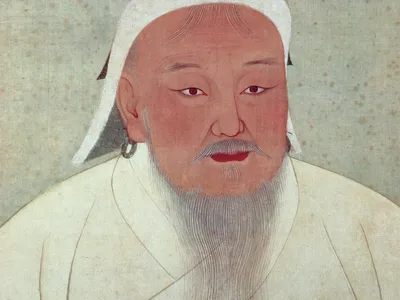
For centuries, Genghis Khan stood as one of history’s most influential figures, a man whose conquests reshaped Eurasia and connected civilizations from East Asia to Eastern Europe. Yet in the late twentieth century, in the land of his birth, his name became something close to forbidden. Under Soviet influence, Mongolia underwent an intense campaign of historical erasure that sought to silence, diminish, or completely remove Genghis Khan from public memory. What made this effort remarkable was not only its severity, but also its ultimate failure. Attempts to suppress his legacy reveal as much about Soviet ideology as they do about the enduring power of historical identity.
Genghis Khan as a Symbol of Mongolian Identity
Before Soviet involvement, Genghis Khan occupied a central place in Mongolian historical consciousness. He was not merely remembered as a conqueror, but as a unifier who brought together fragmented tribes and laid the foundations of a political, legal, and cultural system that allowed the Mongol Empire to function across vast distances. For Mongolians, his legacy extended beyond military victories. He represented order, law, and the emergence of a distinct Mongolian statehood rooted in nomadic traditions.
This symbolic importance made Genghis Khan inseparable from national identity. His life story offered Mongolians a narrative of strength, independence, and global relevance. Even after the collapse of the Mongol Empire, his name survived in oral traditions, folklore, and rituals. Shrines, place names, and pilgrimages to his birthplace in the Khentii region reinforced the idea that Mongolian history did not begin with modern borders or foreign rule, but with a leader who had once commanded the largest contiguous empire in history.
Such symbolism was precisely what made Genghis Khan problematic for Soviet authorities. The Soviet system tolerated local culture only when it aligned with socialist ideology. A historical figure who embodied independent statehood, imperial ambition, and national pride posed a challenge to that framework. Unlike abstract folklore, Genghis Khan was a concrete reminder that Mongolia had once been powerful without Moscow’s guidance. As a result, his memory was not merely inconvenient; it was politically dangerous.
Soviet Ideology and the Need to Control History
The Soviet Union understood history as a tool of power. Across its vast territories, historical narratives were carefully shaped to reinforce Marxist-Leninist ideology and loyalty to Moscow. Figures who symbolized class struggle or revolutionary ideals were celebrated, while those associated with feudalism, nationalism, or imperial ambition were reinterpreted or erased. In this context, Genghis Khan was classified as a feudal warlord whose legacy conflicted with socialist values.
Under the influence of the Soviet Union, Mongolian historiography was rewritten to fit a rigid ideological mold. The Mongol Empire was portrayed less as a sophisticated political system and more as a destructive force that brought suffering to neighboring peoples. Genghis Khan himself was reduced to a symbol of backwardness, violence, and exploitation, incompatible with the progressive narrative the Soviets wished to promote.
This reinterpretation served a broader political purpose. By discrediting pre-socialist leaders, Soviet authorities could frame socialism as the true beginning of Mongolian progress. History before the revolution was depicted as chaotic and oppressive, while Soviet-aligned governance was presented as rational and liberating. In such a narrative, there was no room for admiration of a conqueror who had ruled through charisma, loyalty, and nomadic tradition rather than party structures and class theory.
Control over historical interpretation extended into education, publishing, and public discourse. Textbooks were revised, monuments removed, and scholarly research tightly monitored. History became less about understanding the past and more about ensuring ideological conformity in the present.
Criminalizing Memory and Silence in Public Life
One of the most striking aspects of Soviet-era repression was the criminalization of speech surrounding Genghis Khan. In certain periods, openly praising or even neutrally discussing him could be interpreted as nationalist propaganda. This made his name something to be avoided in public, especially in academic or official contexts. Silence became a survival strategy.
Schools played a crucial role in this enforced forgetting. Genghis Khan was removed from curricula or mentioned only briefly in negative terms. Generations of students grew up with little formal education about the most significant figure in their country’s history. This absence was not accidental; it was a deliberate attempt to sever cultural continuity. Without education, memory would fade, or so Soviet planners believed.
Public commemorations were equally restricted. Pilgrimages to his birthplace in the Khentii Mountains were outlawed, cutting off a powerful link between geography, spirituality, and history. Rituals that had once reinforced communal identity were labeled superstitious or counterrevolutionary. Even place names associated with Genghis Khan were sometimes altered to remove symbolic connections.
Despite this repression, memory did not disappear entirely. It retreated into private spaces: family stories, whispered conversations, and cultural practices that avoided explicit references. This underground preservation of history demonstrated the limits of state power. While the Soviet system could control institutions, it could not fully extinguish collective memory rooted in centuries of tradition.
Mongolia Under Soviet Influence
Mongolia’s position as a Soviet satellite state made it particularly vulnerable to cultural and ideological pressure. Although technically independent, its political, military, and economic structures were closely tied to Moscow. This dependency meant that Soviet historical policies were often implemented with little resistance from local authorities, who feared political repercussions.
The suppression of Genghis Khan fit into a broader pattern of cultural standardization. Traditional religious practices, especially Tibetan Buddhism, were also targeted, as were aristocratic lineages connected to pre-revolutionary society. The goal was to reshape Mongolia into a model socialist state, culturally aligned with Soviet norms and detached from its imperial past.
Yet this process created a deep sense of historical dissonance. Mongolians were encouraged to identify with international socialism rather than national heritage, but the absence of familiar historical anchors left a cultural vacuum. Genghis Khan’s erasure symbolized this loss. He was not just a historical figure, but a point of reference through which Mongolians understood themselves in relation to the world.
Over time, this tension became increasingly visible. While official narratives dismissed Genghis Khan, informal pride in his legacy persisted. This quiet resistance suggested that imposed historical narratives, no matter how thorough, remain fragile when they contradict deeply embedded identities.
The Collapse of Silence After the Soviet Era
The late twentieth century brought dramatic change. As Soviet influence weakened and eventually collapsed, Mongolia experienced a cultural reawakening. One of the most visible signs of this transformation was the rapid rehabilitation of Genghis Khan. His name returned to textbooks, his image appeared on currency, and monuments were erected across the country.
The lifting of restrictions allowed historians to revisit the Mongol Empire with greater nuance. Rather than a one-dimensional conqueror, Genghis Khan was increasingly portrayed as a complex leader who implemented legal reforms, promoted religious tolerance, and facilitated trade along vast networks. This reassessment did not ignore the violence of his conquests, but it placed them within a broader historical context.
Pilgrimages to his birthplace resumed, and the Khentii region regained its symbolic importance. What had once been outlawed became a source of national pride. The speed of this revival highlighted how superficial Soviet suppression had ultimately been. Memory had been constrained, not erased.
This post-Soviet renaissance also reflected a broader search for identity. In reclaiming Genghis Khan, Mongolia reaffirmed its historical agency. The act of remembering became a declaration of independence, not just politically, but culturally and psychologically.
Conclusion: The Limits of Erasing History
The Soviet attempt to suppress the memory of Genghis Khan stands as a powerful example of how states seek to control the past in order to shape the present. By removing him from textbooks, criminalizing his name, and banning pilgrimages, Soviet authorities hoped to weaken Mongolian nationalism and replace it with socialist identity. For a time, they succeeded in pushing his legacy out of public life.
Yet history proved more resilient than ideology. Genghis Khan’s memory survived in private spaces and cultural undercurrents, waiting for the moment when it could reemerge. When that moment came, it did so with remarkable force, reshaping national consciousness almost overnight. The episode demonstrates that while political systems may rise and fall, deeply rooted historical identities endure, resisting even the most determined efforts at erasure.