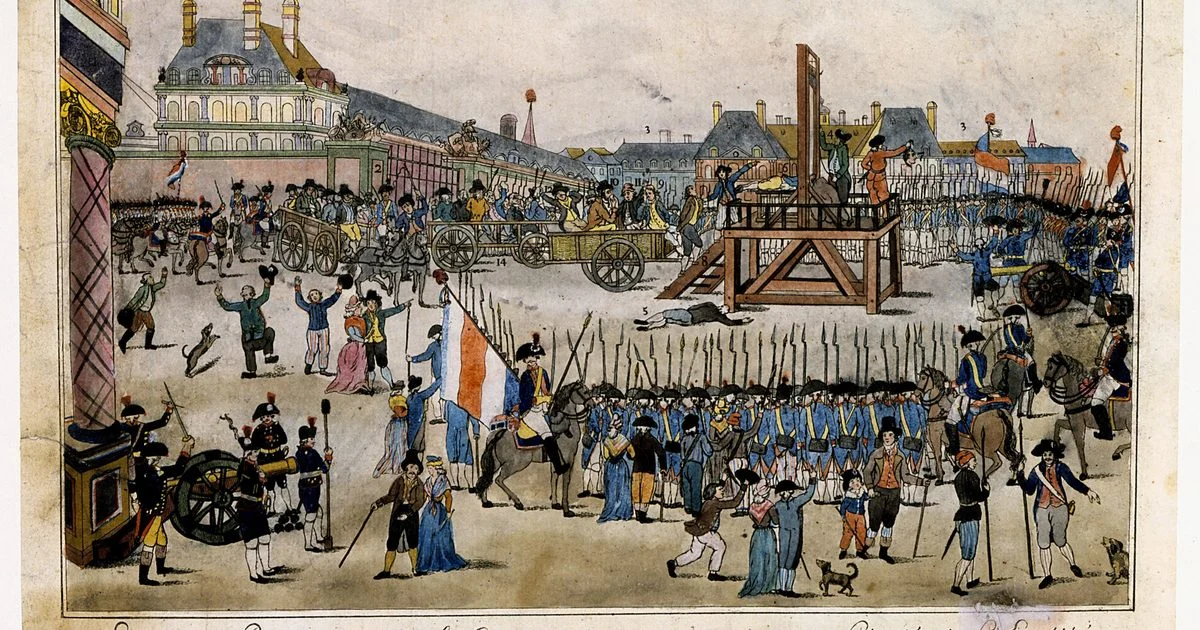
Louis XVI and Marie Antoinette are among the most recognizable figures of the French Revolution, symbols of a collapsing monarchy and a society in violent transition. Their executions in 1793 marked not only the end of royal rule in France but also a dramatic rupture in European history. Yet beyond the guillotine, the cheering crowds, and the political consequences, their deaths gave rise to one of the most unsettling legends of the revolutionary era: that spectators dipped handkerchiefs into the royal blood as souvenirs.
At first glance, the story sounds like revolutionary propaganda or gothic exaggeration. But the French Revolution was an age where violence, symbolism, and spectacle merged in extraordinary ways. Executions were public events, charged with political meaning, and the remains of the condemned were often treated as relics—either venerated or desecrated, depending on one’s allegiance. In 2011, this centuries-old story resurfaced in startling fashion when scientists analyzed a blood-stained handkerchief long believed to contain the blood of Louis XVI. Their findings suggested that the legend may not have been legend at all.
Revolutionary France and the Cult of Political Violence
The French Revolution unfolded in an atmosphere of intense emotion, ideological fervor, and collective anger. By the early 1790s, France was no longer merely reforming its monarchy; it was tearing apart centuries of tradition. The king, once viewed as God’s chosen ruler, was redefined as a traitor to the nation. Violence became both a tool and a language of politics, used to demonstrate loyalty to revolutionary ideals.
Public executions were central to this culture. They were not hidden acts of punishment but carefully staged events meant to educate, intimidate, and unify the population. Thousands gathered in Paris to witness beheadings, not as passive observers but as participants in a collective ritual. Cheers, insults, songs, and symbolic gestures filled the air. The guillotine itself became a revolutionary icon, praised as an instrument of equality because it executed nobles and commoners alike in the same manner.
Within this context, the taking of blood or personal effects from executed figures was not as shocking as it seems today. Revolutionary crowds often collected fragments of clothing, hair, or soil stained with blood. These objects carried meaning. For some, they were trophies celebrating the downfall of tyranny. For others, they were relics imbued with tragic or sacred significance. The Revolution blurred the line between justice and vengeance, and the body of the condemned became a political object.
This atmosphere helps explain why the blood of Louis XVI could become a sought-after souvenir. His death was not merely the execution of a man but the symbolic killing of monarchy itself. To touch, collect, or preserve his blood was to claim a personal connection to that historic moment.
The Execution of Louis XVI: January 21, 1793
Louis XVI was executed on January 21, 1793, in what is now the Place de la Concorde in Paris. Condemned for treason after a controversial trial, he faced the guillotine with composure that surprised many observers. Contemporary accounts describe him attempting to speak to the crowd before being silenced by revolutionary guards. Moments later, the blade fell, ending over a thousand years of continuous French monarchy.
The reaction was immediate and intense. Some in the crowd shouted “Vive la République!” while others stood in stunned silence. Executioners held up the severed head for all to see, a traditional gesture meant to confirm death and satisfy the public. It was in the chaotic aftermath of this moment that reports emerged of people rushing forward, dipping cloths, handkerchiefs, or scraps of fabric into the king’s blood.
These actions were not officially sanctioned, but they were not stopped either. The Revolution had loosened social restraints, and the presence of royal blood carried immense symbolic weight. For radical revolutionaries, it represented victory and liberation. For royalists and sympathizers, it was a relic of martyrdom. Blood, in this sense, became a political language spoken by opposing sides with very different meanings.
The execution of Marie Antoinette followed later that same year, on October 16, 1793. Though similar stories exist about souvenirs taken from her death, the case of Louis XVI is better documented and would later become the focus of scientific scrutiny.
Souvenirs, Relics, and Revolutionary Memory
The idea of collecting blood-soaked handkerchiefs may seem macabre, but it fits within a broader historical pattern. Human societies have long preserved physical remnants of significant deaths, especially those imbued with political or religious meaning. In medieval Europe, relics of saints—bones, blood, clothing—were venerated and believed to possess spiritual power. The French Revolution, despite its hostility toward religion, unconsciously adopted similar practices.
Revolutionary relics served secular purposes. They were tangible proof of participation in history, tokens of loyalty, or objects of remembrance. Just as fragments of the Bastille were sold as souvenirs, so too could the blood of a fallen king become a collectible artifact. These items circulated privately, hidden away or passed down through families, acquiring layers of meaning over generations.
Written accounts from the period mention blood-stained cloths preserved as mementos. Some were displayed proudly; others were concealed, especially during periods when political tides shifted and association with regicide became dangerous. Over time, many such objects were lost, destroyed, or stripped of their original context. What remained were stories—half-believed, half-dismissed—that lingered in the margins of history.
For centuries, the blood-soaked handkerchief attributed to Louis XVI existed in this uncertain space. It was preserved by a noble Italian family, accompanied by a gourd inscribed with “Maximilien Bourdaloue,” the name of a revolutionary known to have attended the execution. The object’s authenticity was debated, dismissed by some as a curiosity and by others as a powerful historical relic.
The 2011 Scientific Investigation
In 2011, modern science entered the story. A team of researchers led by geneticist Philippe Charlier set out to analyze the blood-stained handkerchief using contemporary forensic techniques. Their goal was not to confirm revolutionary legends but to examine whether the object could plausibly be linked to Louis XVI.
The scientists extracted DNA from the dried blood and compared it with genetic material believed to come from the mummified head of King Henri IV, an ancestor of Louis XVI. Despite contamination and degradation, they identified genetic markers consistent with the Bourbon lineage. Additional chemical analysis dated the blood to the late 18th century, aligning closely with the year 1793.
While the findings could not provide absolute certainty, they strongly suggested that the blood on the handkerchief was indeed royal and consistent with Louis XVI. The study did not prove that the cloth was dipped at the moment of execution, but it demonstrated that the long-dismissed story was scientifically plausible. What had once been treated as revolutionary myth suddenly carried the weight of empirical evidence.
The announcement attracted global attention. It reignited public fascination with the French Revolution and raised complex questions about how history, memory, and science intersect. A simple piece of cloth had become a bridge between centuries, connecting modern laboratories to the blood-soaked square of revolutionary Paris.
Marie Antoinette and the Culture of Revolutionary Hatred
Marie Antoinette’s execution carried its own intense symbolism. Reviled by revolutionaries as the embodiment of royal excess and foreign influence, she was subjected to relentless propaganda and public humiliation. Her trial was swift, her condemnation inevitable. When she faced the guillotine, she did so after months of imprisonment, isolation, and psychological torment.
Stories of souvenir-taking after her execution are less well documented but follow a similar logic. Her hair, clothing, and even imagined fragments of her body became objects of fascination. For her enemies, these items represented the destruction of corruption and privilege. For her supporters, they were sacred reminders of injustice and suffering.
Together, the deaths of Louis XVI and Marie Antoinette marked the Revolution’s point of no return. The monarchy was not merely dismantled; it was annihilated in full public view. The blood shed that day soaked not only into the ground but into collective memory, where it would remain contested and emotionally charged for generations.
What the Handkerchief Tells Us About History
The confirmation of the blood-stained handkerchief does more than satisfy curiosity. It reveals how deeply people of the revolutionary era understood history as something to be physically grasped. They did not experience events solely through words or ideas but through bodies, objects, and sensations. Blood was not abstract; it was visible, touchable, and meaningful.
This challenges modern assumptions about the past. It is tempting to view revolutionary crowds as irrational or barbaric, but their actions followed a logic shaped by centuries of cultural practice. The Revolution rejected monarchy and religion, yet it preserved the human impulse to create relics and symbols. In doing so, it transformed political violence into something almost ritualistic.
The handkerchief also illustrates how history can survive in unexpected forms. Official records, speeches, and laws tell one version of the past. Objects like this tell another—intimate, unsettling, and deeply human. They remind us that history is not only written by governments but carried by individuals who lived through extraordinary moments.
Why This Story Still Resonates
The fascination with royal blood reflects an enduring tension between power and mortality. Kings were once seen as untouchable, elevated above ordinary people. The French Revolution shattered that illusion in the most literal way possible. The blood of Louis XVI proved that even the highest authority could bleed, die, and be reduced to a stain on cloth.
In an age of scientific verification, the 2011 study added a new layer to this story. It showed that modern tools can engage with ancient emotions, confirming that the past is not as distant as it seems. The handkerchief stands as a rare convergence of legend and laboratory, where myth yields to evidence without losing its emotional power.
Ultimately, the story endures because it forces us to confront the raw reality of revolution. Behind slogans and ideals lie bodies, blood, and irreversible acts. Remembering this does not diminish the Revolution’s significance; it deepens our understanding of its cost.