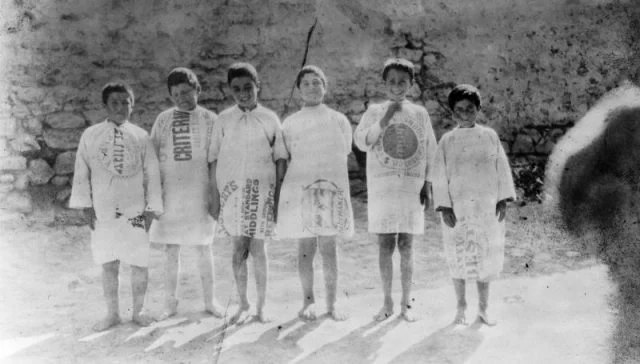
During the Great Depression, survival came before style, yet even in the harshest economic collapse in modern American history, people still found ways to express identity, dignity, and creativity through what they wore. As money vanished, jobs disappeared, and families struggled to afford even the most basic necessities, clothing quickly became a luxury item. New garments were simply out of reach for millions. Faced with threadbare wardrobes and growing children, families turned to whatever materials they could find—and one of the most abundant resources available was food packaging. Flour bags, feed sacks, potato sacks, and any available burlap material were transformed into shirts, dresses, underwear, aprons, and children’s clothing. What began as an act of desperation slowly evolved into a widespread cultural phenomenon. As demand for sack fabric grew, food distributors took notice and began producing sacks with colorful prints and decorative patterns, allowing families—especially women—to craft garments that were not just practical, but fashionable. This unlikely fusion of poverty and creativity created one of the most remarkable chapters in the social history of the Depression.
Why Food Sacks Became Clothing During the Great Depression
When the stock market crashed in 1929, it triggered a chain reaction that rippled through every corner of American life. Unemployment skyrocketed, banks collapsed, farms failed, and entire families lost their savings almost overnight. By the early 1930s, millions of Americans had no steady income and no reliable way to purchase basic goods. Clothing, which had already represented a significant household expense, became completely unattainable for many families. Children outgrew what little they owned. Adults wore shoes with holes and coats patched beyond recognition. In this environment, necessity reshaped ingenuity into an everyday survival skill.
Food sacks became an unexpected solution because they were everywhere. Flour, sugar, chicken feed, seed, potatoes, and livestock grain were commonly sold in sturdy cotton or burlap sacks. Unlike paper packaging, these cloth bags were meant to be reused. Families already saved them for cleaning rags, quilts, towels, and bedding. Turning them into clothing was a natural extension of that mindset. If cloth could be sewn into a blanket, it could be sewn into a dress.
For rural families especially, sack clothing became essential. Many farms still produced food, but cash was scarce. Flour sacks provided access to cotton fabric without requiring money. A single 100-pound flour sack could yield enough material for a child’s dress or a woman’s blouse. With careful cutting and piecing, several sacks could become a full adult outfit. Feed sacks were particularly valuable because they were often made from thicker, higher-quality cloth designed to endure heavy loads.
Mothers became masters of transformation. They soaked sacks to remove printed logos, bleached the fabric in the sun, and softened it through repeated washing. From there, they cut patterns by hand, stitched seams on hand-crank sewing machines, and tailored clothes with extraordinary precision. Children across the country grew up wearing shirts that once carried cornmeal or sugar. To outsiders, these garments may have looked humble, but within struggling households, they represented resilience, protection, and care.
What makes this period extraordinary is not just that people wore food sacks—it’s that they managed to preserve a sense of pride while doing so. Clothing still mattered. Respectability still mattered. And somehow, even in the bleakest years of economic collapse, people refused to surrender their humanity to poverty.
How Style Survived Poverty Through Clever Design and Reuse
At first, sack clothing was purely functional. Early feed and flour bags were plain white with brand names stamped in dark ink. The focus was survival, not beauty. But as more families began reusing sacks for clothing, people naturally grew sensitive to appearance. No one wanted their child going to school wearing a dress that clearly displayed the logo of a milling company across the chest. This created an incentive for both families and manufacturers to rethink what sack fabric could represent.
Homemakers developed creative techniques to hide unwanted markings. They carefully cut around printed logos, turned fabric inside out, or placed seams strategically to conceal ink. Aprons, collars, cuffs, and pleats were used not only for decorative purposes but as camouflage. When the print couldn’t be hidden, makers incorporated it into the design itself, turning necessity into intentional style. What could not be eliminated was transformed.
As demand grew, something remarkable happened: manufacturers began responding. By the mid-1930s, food distributors realized that women actively selected flour and feed brands based on fabric design rather than product price alone. A sack printed with flowers, polka dots, gingham, or checks was far more desirable than a plain white one. Companies started issuing sacks in pastel colors, floral motifs, and even child-friendly patterns. Some brands directly advertised their packaging as “dress-ready” fabric.
This moment represents one of the earliest examples of consumer-driven packaging design influencing industrial production on a national scale. The economic crisis forced manufacturers to understand that their products were not being used only as containers—they were being worn. Some companies even published sewing patterns on the backs of the sacks or in promotional pamphlets, encouraging women to turn emptiness into fashion.
The result was a subtle transformation of style culture within extreme poverty. Children in rural schools could be seen wearing matching dresses made from the same brand of flour sack. Sisters might coordinate outfits based on the same print. Quilts were pieced together from different feed sacks, preserving decades of pattern history in a single blanket.
Fashion did not disappear during the Great Depression—it adapted. The human desire to create beauty did not collapse alongside the economy. Instead, it reshaped itself using the most unlikely materials imaginable. Cloth sacks became symbols of quiet rebellion against hopelessness: proof that people could still choose color, shape, and identity even when choices were painfully limited.
The Role of Women in Creating Sack Clothing Culture
The transformation of food sacks into wearable garments was overwhelmingly driven by women. In a period when traditional gender roles placed enormous domestic responsibility on mothers, wives, and daughters, the pressure to clothe entire families fell nearly entirely on their shoulders. These women were not merely sewing for comfort—they were engineers of survival, converting agricultural packaging into dignity and warmth for households facing economic collapse.
Many had learned to sew long before the Depression, but the economic crisis forced them to elevate that skill to a form of daily craftsmanship. Sewing was no longer an optional hobby. It became essential labor. Women learned to measure with string, cut patterns from newspaper, and alter adult clothing into children’s sizes. They developed expertise in fabric salvage, combining multiple sacks to create garments large enough for adults or reshaping worn-out clothing into undergarments and linings.
Young girls, too, were trained early in needlework during these years. Sewing became a generational skill passed from mother to daughter as a necessary survival tool. In rural schools, home economics programs sometimes adapted to teach practical sack garment construction, recognizing its importance to local families.
These women did more than clothe their families—they protected social identity. In a culture that still judged respectability through appearance, clean and well-fitted garments mattered deeply. Sending a child to church or school in a well-made sack dress protected that child from shame and ridicule. It preserved a sense of belonging when poverty threatened to isolate entire families from the broader community.
There was also pride in craftsmanship. Some women became known locally for their skill with sack garments, admired for how invisible they made the fabric’s origin. A dress that once held 50 pounds of chicken feed could emerge as a tailored, ruffled outfit that revealed no trace of its former life. This quiet excellence became a form of resistance against despair.
Beyond practicality, sewing offered emotional refuge. In a time of relentless worry—about food, rent, health, and survival—creating something tangible, beautiful, and useful with one’s own hands offered psychological stability. Every finished garment represented a victory over scarcity. Women rebuilt normalcy one stitch at a time.
How Businesses Adapted to the Sack Clothing Trend
As sack clothing became widespread, manufacturers began acknowledging a reality they could no longer ignore: for millions of families, packaging was now fabric. What had once been disposable was now wearable. This forced a fundamental shift in how companies approached design, marketing, and production.
Food distributors quickly discovered that women exercised powerful purchasing influence based on sack appearance. If two brands of flour cost the same but one offered a colorful floral sack, consumers overwhelmingly chose the patterned option. Fabric beauty became an economic advantage. This transformed sacks from silent containers into selling points.
By the mid-1930s, major milling and feed companies were investing in higher-quality cotton, printed designs, and consistent dimensions that allowed predictable garment construction. Some brands switched entirely from rough burlap to soft cotton sheeting. Others began coordinating seasonal pattern releases much like modern fabric companies do today.
Advertising followed this shift. Promotional materials no longer focused solely on product quality—they highlighted how the empty sacks could be reused. Slogans emphasized thrift, beauty, and reuse. Some companies even included conversion charts explaining how many dresses or shirts could be made from a certain number of empty sacks.
This shift reflected a rare moment when consumer hardship directly shaped industrial aesthetics. Corporate decision-making was guided not by luxury buyer preferences but by the needs of struggling rural families. This stands as one of the most powerful examples of how mass poverty redirected commercial strategy during the Depression.
The pattern designs themselves often reflected hope. Bright colors, cheerful flowers, playful animals, and delicate prints dominated. Dark, heavy designs were less common. In a subtle way, manufacturers participated in lifting the visual spirit of communities living under economic darkness.
The sack clothing economy also helped sustain struggling textile producers, designers, and printers. Even as wages fell and orders declined elsewhere, the demand for printed sack fabric grew. A hidden ecosystem of production survived because families needed beauty even when they lacked comfort.
Thus, sack clothing was not just a grassroots survival practice—it became a mutually reinforcing system between desperate consumers and adapting businesses.
Why Sack Clothing Declined After the Depression
As the Great Depression slowly gave way to wartime mobilization in the 1940s, the American economy began to transform. World War II revived industrial production, created massive employment, and reshaped household income. As wages stabilized and consumer goods returned to store shelves, families gradually regained the ability to buy manufactured clothing.
At the same time, packaging technology changed. Paper, plastic, and synthetic materials replaced cloth sacks on a large scale. These new materials were cheaper to produce, lighter to transport, and unsuitable for clothing reuse. The era of the feed sack as fabric quietly came to an end.
Cultural attitudes also shifted. Sack clothing, once a badge of resourcefulness, gradually became associated with poverty and hardship. As communities recovered, many families distanced themselves from visible reminders of the Depression years. Parents who had grown up wearing feed sacks often preferred store-bought clothing for their children as a sign of progress and security.
Yet the impact of the practice never vanished entirely. Quilts made from feed sacks still survive in many families today. These quilts function as historical records of both economic suffering and inventive endurance. Museums preserve sack garments as artifacts of the Depression era, testifying to how ordinary people adapted to extraordinary circumstances.
Modern sustainability movements often look back to this era as a lost model of reuse culture. The idea that packaging should serve a second life has returned in different forms, but rarely with the same level of necessity-driven creativity that defined the Depression.
Sack clothing declined not because it failed, but because it succeeded: it carried families through the worst economic crisis in American history and then quietly stepped aside when circumstances allowed something easier to replace it.
Fashion Forged From Survival
The story of clothing made from flour sacks and feed bags during the Great Depression is not just about fabric—it is about human endurance. It reveals how dignity survives even when money disappears, how beauty persists even when luxury collapses, and how creativity thrives under pressure. When families had nothing left, they still made something.
What began as an act of desperation evolved into a nationwide culture of reuse that reshaped manufacturing, marketing, and fashion itself. Food distributors printed flowers where they once stamped logos because women demanded not only survival but self-respect. Mothers transformed agricultural waste into protection for their children. Entire communities stitched identity out of scarcity.
Sack clothing stands today as one of the most powerful symbols of the Depression—not because it was glamorous, but because it was deeply human. It represents a time when people refused to surrender to invisibility, when they rebuilt normal life from the materials of hardship.
The fabric may have faded, the prints may have worn thin, but the spirit behind those garments remains one of the clearest lessons the Great Depression left behind: when the world takes almost everything away, people still find ways to create warmth, color, and dignity out of what remains.
Research and further reading
For readers who want to verify details or continue researching this subject, these external reference collections provide useful starting points: