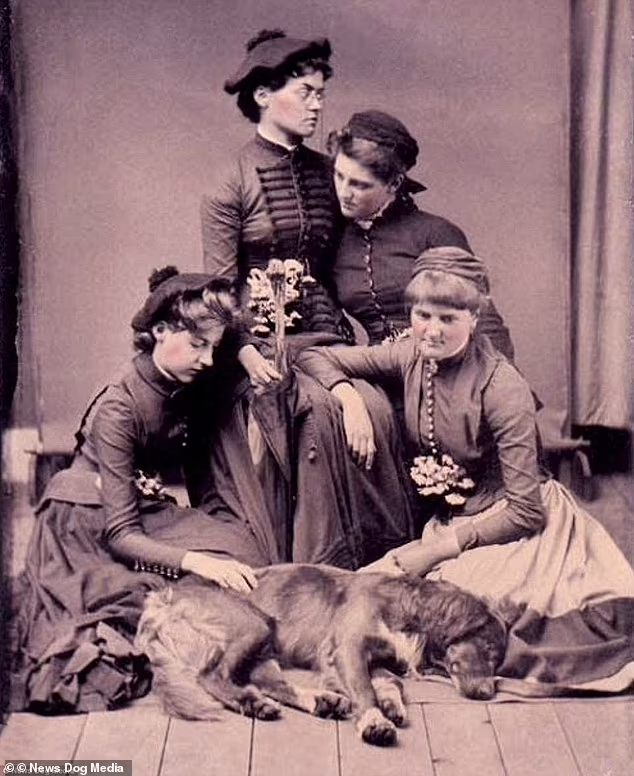
During the Victorian period, death was not a distant or hidden event—it was an intimate, ever-present reality woven into daily life. Disease, childbirth complications, industrial accidents, and poor sanitation meant that families encountered loss far more frequently than most people do today. Photography, a new and revolutionary technology at the time, arrived in the middle of this reality and offered something humanity had never truly possessed before: the power to permanently preserve a person’s physical likeness. For families who had never owned a portrait or painting of a loved one during life, the camera often captured their only visual memory after death. This led to a practice that feels unsettling to modern audiences but was once deeply compassionate and normal—post-mortem photography. Families dressed their deceased relatives in fine clothing, arranged them in peaceful, lifelike poses, and photographed them as a final act of remembrance. These images were not intended to be macabre. They were created out of love, grief, and the powerful human need to hold onto someone who had just slipped away forever.
Why Post-Mortem Photography Became Widespread in the Victorian Era
Post-mortem photography did not arise from morbid curiosity alone—it was born from social conditions, technological novelty, and emotional necessity. In the early and mid-19th century, photography was expensive and technically demanding. Long exposure times, delicate chemical processes, and costly equipment meant that most families could not afford regular portraits. For many working-class and even middle-class households, a photograph of a loved one taken while alive was a luxury out of reach.
At the same time, death was tragically common. Infant mortality rates were staggering. Infectious diseases swept through communities with little warning. Industrial workplaces were dangerous. For parents who lost a child at the age of two or three, there might never have been an opportunity to commission a portrait while the child lived. When death arrived suddenly, post-mortem photography became the only remaining chance to preserve the child’s face.
Victorian culture also encouraged physical expressions of mourning. Elaborate funeral customs, black clothing worn for extended periods, memorial jewelry made from hair, and detailed gravestone inscriptions were all socially accepted manifestations of grief. In this culture, photographing the dead did not violate sensibility—it fulfilled it. The photograph became a sacred object, a tangible anchor to a person who had just disappeared from the physical world.
The technological limitations of photography also made post-mortem portraits uniquely practical. Because early photographic exposures required subjects to remain completely still for extended periods, living sitters often had to use head braces to avoid motion blur. The dead, naturally still, became ideal photographic subjects. This grim practicality helped normalize the practice even further.
Importantly, these photographs were not meant to deceive. Families knew the person was dead. The illusion of life in the image was symbolic rather than literal—it represented how the deceased would be remembered, not an attempt to deny reality. The goal was not shock, but preservation. To grieving Victorians, a photograph taken after death was not a trophy of mortality. It was an act of love performed in the only visual language the era possessed.
How Families Prepared the Dead for Their Final Photograph
The preparation of the deceased for post-mortem photography was a delicate ritual that balanced grief, care, and presentation. Families did not treat this process casually. The body was washed, groomed, and dressed in the best available clothing, often reserved for church, weddings, or special family events. In many cases, the clothing selected was formal and immaculate, chosen with the same seriousness one would apply to a wedding portrait.
Hair was brushed, faces were cleaned, and hands were arranged thoughtfully. When possible, the eyes were gently positioned to appear closed in peaceful rest. In other cases, especially when families requested a more lifelike appearance, artists sometimes painted pupils directly onto closed eyelids after the photograph was developed—a practice that can appear uncanny to modern viewers but was considered a comforting illusion at the time.
The pose itself varied based on age and circumstance. Infants and young children were often placed in cradled positions or held by their mothers, who sometimes concealed their presence beneath blankets or behind furniture. Adults might be photographed lying in bed as if sleeping, seated upright in a chair, or even positioned standing with the support of hidden braces and architectural props.
Family members sometimes joined the photograph as well. Mourning parents, siblings, or spouses would gather beside the deceased, their expressions solemn but controlled. These images served not only as records of the dead, but as emotional documents of the living family’s final physical connection with the one they had lost.
Contrary to modern assumptions, these scenes were not chaotic or theatrical. They were quiet, reverent, and deeply intentional. The moment was treated almost as a sacred threshold between life and memory. The photograph captured not the violence of death, but the stillness after it—a final calm before the body entered burial and physical separation became permanent.
After the photograph was taken, the image was often placed into an album, framed for display in the home, or used to create small keepsakes such as lockets or memorial cards. These photographs were not hidden out of shame. They were integrated into the daily environment of the household as a continuing presence of the departed.
The Emotional Purpose Behind Photographing the Dead
For grieving Victorian families, post-mortem photography served a deeply emotional function that goes far beyond documentation. In a world without video recordings, digital archives, or abundant casual photography, a single image could become the only visual memory of a person’s face. When someone died suddenly, the shock of loss collided with the terror of forgetting. The photograph acted as a safeguard against that erasure.
Grief often disrupts memory. Faces blur over time. Details fade. The photograph froze the loved one at the boundary between life and absence. It allowed mourners to revisit that final moment as often as needed—to cry, to remember, to speak silently to the image as if the person might still hear.
For parents who lost children, these portraits carried extraordinary emotional weight. Many families never owned a living photograph of their child. The post-mortem image became the child’s only physical representation in the world. It was sometimes the only thing that proved the child had ever existed beyond memory alone.
These photographs also helped families process loss collectively. Viewing the image together created shared remembrance. It anchored stories, rituals, and anniversaries. The photograph was not a denial of death—it was an acknowledgment that love did not vanish simply because life had ended.
Victorian emotional culture accepted prolonged mourning as natural. Widows might wear black for years. Memorial rooms might preserve objects belonging to the deceased indefinitely. Post-mortem photography fit seamlessly into this worldview. It allowed grief to be visible, structured, and enduring rather than hidden.
In this way, the photographs were not about death at all. They were about continuity—about keeping the emotional bond intact even as physical bonds were severed. To look at a Victorian post-mortem portrait is to witness love captured at its most fragile moment, when memory is being forged in the midst of devastation.
Why the Practice Gradually Disappeared
As the 19th century gave way to the 20th, the social, medical, and technological conditions that had made post-mortem photography common began to change dramatically. Advances in medicine reduced infant mortality and extended adult life expectancy. Vaccinations, sanitation reforms, and improved public health dramatically lowered the frequency of death in daily life. Loss, while still painful, became less omnipresent.
At the same time, photography became increasingly affordable and accessible. Families could now photograph loved ones regularly while they were alive. Everyday moments—birthdays, weddings, holidays—were preserved with ease. The emotional necessity of post-mortem portraits diminished because memory no longer depended on a single image produced at the moment of death.
Cultural attitudes toward death also shifted. The Victorian period treated death as something to be observed, ritualized, and integrated into daily life. The modern era increasingly pushed death into institutions—hospitals, morgues, funeral homes—away from the domestic sphere. The dead body became something to be managed privately and professionally rather than presented within the household.
As this shift occurred, post-mortem photography began to feel uncomfortable to later generations. What had once been seen as tender gradually came to be viewed as disturbing. The same images that Victorians cherished as loving memorials now appeared uncanny to eyes unaccustomed to intimacy with death.
By the early 20th century, the practice had largely faded except in certain isolated regions or special circumstances. It survived in limited forms, such as memorial photography after tragic events, but the everyday normalization of photographing the dead disappeared.
What changed was not human grief—but how society allowed grief to be seen. The camera, once a bridge between life and death, became reserved for the living.
How Modern Audiences Misinterpret Victorian Post-Mortem Photography
In the present day, post-mortem images from the Victorian period often circulate online as “creepy” curiosities. Without historical context, modern viewers may assume these photographs were created out of obsession with death, superstition, or denial of reality. In truth, this interpretation reflects modern discomfort with mortality more than Victorian fascination with it.
Today, death is frequently hidden behind medical walls and sanitized processes. Many people never see a dead body outside of a funeral setting, and even then, the body is carefully prepared to minimize visible traces of death. This produces a cultural distance that makes Victorian images feel shocking rather than familiar.
Victorian families, however, lived with death in their homes. They washed bodies, prepared them for burial, and held wakes in their living spaces. Death was not abstract. It had texture, temperature, and presence. Photography simply captured what families were already experiencing directly.
What modern viewers often interpret as deception—the attempt to make the dead look alive—was not about denial. It was about representation. Families wanted to preserve how the person was known, not the wounds or decay that marked the last moments of physical life.
These photographs also challenge modern assumptions about emotional boundaries. Today, we often prefer to remember people in life through carefully curated images of happiness. Victorians accepted memory as layered with sorrow. Mourning did not need to be shielded from view—it was part of love’s full arc.
The discomfort many people feel when encountering these images today reveals how much cultural distance separates us from our ancestors. The images have not changed. Our emotional framework has.
A Final Image Made from Love, Not Morbidity
Victorian post-mortem photography was not born from darkness—it was born from devotion. In a world where death arrived frequently and photography was rare, families seized the only chance they had to preserve the face of someone they had loved with their entire being. They dressed the body with care, arranged it with tenderness, and stared into the lens not in horror, but in grief and longing.
These images were never intended for strangers. They were meant for families—for quiet rooms, private albums, and moments of remembrance when pain overwhelmed the living. They carried the weight of absence and the stubborn refusal to let memory dissolve.
Today, these photographs unsettle us because they force us to confront what we now hide so carefully: the fragile boundary between life and death. But when viewed through the eyes of their creators, they speak not of obsession with mortality, but of an unbreakable human need—to remember, to preserve, and to love even when nothing more can be done.
Research and further reading
For readers who want to verify details or continue researching this subject, these external reference collections provide useful starting points: