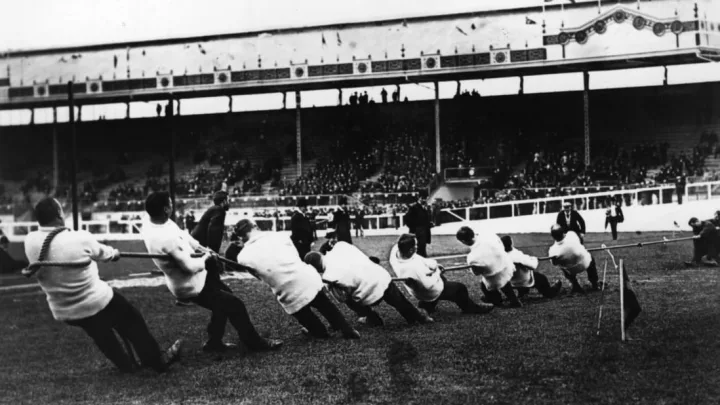
Today, tug of war is most often associated with school field days, summer camps, and casual team-building games where laughter matters more than victory. Yet not long ago, this seemingly simple contest of strength stood on the grandest athletic stage in the world. From 1900 to 1920, tug of war was an official Olympic sport, featured in five Summer Olympic Games as part of the athletics program. During those two decades, teams of elite competitors pulled for national pride, gold medals, and international prestige. The nation that dominated this unlikely Olympic discipline was Great Britain, which captured five total medals—more than any other country—while the United States followed with three. The story of tug of war’s Olympic career is both surprising and revealing. It exposes how differently early Olympic organizers understood sport, how national traditions shaped competition, and how the idea of what “belongs” in the Olympics has evolved over time.
How Tug of War Became an Olympic Sport
To understand how tug of war earned a place in the Olympic Games, one must return to the spirit of the early modern Olympic movement. When the first modern Games were held in 1896, organizers were still experimenting with what the Olympics should represent. There was no fixed definition of what constituted an Olympic sport. Instead, events were chosen based on physical challenge, classical inspiration, and popular athletic traditions.
Tug of war fit naturally into this framework. The contest had ancient roots in many cultures, with versions of rope pulling contests appearing in festivals, military training, and ritual competitions across Europe and Asia for centuries. The basic premise required minimal equipment, emphasized teamwork over individual performance, and showcased raw strength in a direct and dramatic way. For early Olympic planners seeking events that celebrated physical power and collective effort, tug of war checked all the right boxes.
By the time the 1900 Paris Olympics arrived, tug of war was already recognized internationally as a serious competitive discipline. It was considered part of track and field rather than a separate sport, since athletics at the time encompassed nearly all physical competitions. Early Olympic organizers viewed strength-based events as essential to demonstrating the full range of human physical potential.
The absence of rigid standardization in the early Games also played a role. Rules varied between competitions, weight classes were inconsistent, and national teams were sometimes composed of club athletes rather than official national squads. Tug of war thrived in this flexible environment. Its rules could be adapted easily to match local customs, and it allowed nations to field teams without requiring specialized stadiums or expensive infrastructure.
Importantly, the symbolic appeal of the sport mattered. Tug of war made for dramatic viewing. Two teams leaning backward at desperate angles, muscles straining, heels digging into the earth—it was easy for spectators to understand what was happening and who was winning. In an era before modern broadcast technology, visual clarity and immediate drama were valuable assets.
Thus, tug of war entered the Olympic program not as an odd novelty, but as a respected display of teamwork and raw physical power. For two decades, it stood shoulder to shoulder with sprinting, wrestling, and weightlifting as a legitimate Olympic pursuit.
The Five Olympic Games Where Tug of War Was Fought for Gold
Tug of war appeared in five Summer Olympic Games between 1900 and 1920. Each appearance reflected both the evolving nature of the Olympics and the growing intensity of international competition.
The first Olympic tug of war competition took place at the 1900 Paris Games. These Games were famously disorganized, spread across several months as part of the World’s Fair. Despite the confusion, tug of war drew serious competitors and international attention. Teams were often made up of athletic club members rather than formally organized national squads. The emphasis was less on nationalism and more on sporting prestige.
The sport returned at the 1904 Games in St. Louis, which were similarly embedded within a larger exposition. These Games were heavily dominated by American athletes due to the difficulty foreign competitors faced traveling to the United States. Tug of war reflected this imbalance, with American teams enjoying a strong advantage simply through participation numbers.
At the 1908 London Olympics, tug of war reached one of its most competitive and controversial moments. British teams dominated the event, but disputes arose over footwear, traction, and rule interpretations. Photographs from this period show teams wearing heavy boots for increased grip, which sparked protests from rival nations. These disputes revealed just how seriously tug of war was now being taken on the Olympic stage.
In 1912, at the Stockholm Games, tug of war continued as an established Olympic discipline. By this point, rules were more standardized, and national teams were more formally organized. The sport had settled into a recognizable pattern of international rivalry, particularly between Great Britain and Scandinavian teams known for their physical power and teamwork.
The final appearance of Olympic tug of war came at the 1920 Antwerp Games, held in the shadow of World War I. These Games marked both a return to international competition after global devastation and the end of tug of war’s Olympic run. After 1920, the sport was quietly dropped from the Olympic program, never to return.
Across these five Games—1900, 1904, 1908, 1912, and 1920—tug of war transitioned from experimental novelty to legitimate Olympic tradition and, finally, into historical memory.
Great Britain’s Dominance and the Rise of National Tug of War Power
No nation left a stronger mark on Olympic tug of war than Great Britain. Across its five appearances, British teams won a total of five medals, making them the most successful country in the sport’s entire Olympic history. This dominance was no accident. It reflected Britain’s strong tradition of athletic clubs, military-style physical training, and industrial labor culture that valued strength, endurance, and coordination.
British tug of war teams were often composed of policemen, dock workers, and military personnel—men whose daily lives involved physical exertion and collective discipline. Their training routines emphasized synchronization, leverage, and body positioning as much as brute force. Victory in tug of war depends not merely on individual strength but on timing, rhythm, and unified movement. British teams excelled in these areas.
At the 1908 London Games, Great Britain fielded multiple teams representing different police divisions. These teams trained rigorously and approached the contest with almost military precision. Their dominance that year became legendary, even as it stirred controversy over equipment and rules. The British use of heavy boots with reinforced soles gave them remarkable traction, which many rivals believed provided an unfair advantage. While protests were raised, the results stood, adding to Britain’s growing medal tally.
The United States emerged as Britain’s strongest rival, collecting three total medals across the Olympic tug of war competitions. American teams were typically drawn from athletic clubs and college sports programs. Their style often emphasized raw power and aggressive pulling, sometimes at the expense of synchronized technique. While this approach earned significant success, it proved less consistently dominant than the British model.
Other nations, including Sweden and Denmark, also fielded powerful teams, particularly in the later Games when Scandinavian strength sports were gaining prominence. Still, no country matched Britain’s consistent presence at the top of the podium.
The medal tally itself tells the story of national specialization. Britain’s five medals and America’s three stand as lasting symbols of a forgotten Olympic rivalry, fought not with speed or precision equipment, but with ropes, grit, and collective strain.
How Olympic Tug of War Was Actually Fought
To modern gym-class participants, tug of war may seem informal and playful. Olympic tug of war, however, was an intense, highly regulated contest governed by detailed rules designed to ensure fairness and maximize competitive drama.
Each team typically consisted of eight competitors. These athletes were carefully arranged along the rope in specific positions, with the strongest anchor at the rear and other pullers placed according to body weight and technique. The rope itself was thick, heavy, and standardized in length and circumference. A central mark on the rope aligned with a mark on the ground at the start of each match.
The objective was simple in principle: pull the opposing team a set distance, often several feet, across the central line. In practice, achieving that movement required extraordinary coordination. Teams did not pull continuously at maximum strength. Instead, they employed synchronized surges—short, explosive heaves timed perfectly across all eight bodies. If even one member fell out of rhythm, the surge lost power.
Matches could last for long, grueling stretches of time. Unlike speed-based sports, tug of war tested muscular endurance as much as explosive strength. Arms burned, legs trembled, and oxygen debt mounted with every second. Victory sometimes came not through overpowering force but through patience, waiting for the opposing team to exhaust itself.
Footwear, ground conditions, and body angle played enormous roles. Teams leaned backward at steep angles, nearly horizontal to the ground, using friction and body weight as much as arm strength. The anchor often wrapped the rope around their torso or shoulder, turning their entire body into a counterweight.
Injuries were not uncommon. Arms could be strained, shoulders dislocated, and falls could result in fractures or head injuries. Despite the absence of modern safety equipment, the danger was accepted as part of the contest’s seriousness.
Olympic tug of war demanded not childish effort but full athletic commitment. The athletes who competed at that level were among the strongest and most conditioned individuals of their era.
Why Tug of War Was Removed From the Olympic Program
After the 1920 Antwerp Games, tug of war vanished from the Olympic schedule. There was no dramatic ban, scandal, or dramatic voting process that ended its run. Instead, the sport quietly faded as the Olympic movement itself underwent profound transformation.
One of the primary reasons for its removal was the push to streamline the Olympic program. In the early 20th century, the Games were overcrowded with loosely defined events. Athletics alone encompassed a vast range of unrelated disciplines, from sprinting to rope climbing to tug of war. As international sport became more professionalized, organizers sought to refine what counted as a true Olympic sport.
Tug of war also faced the challenge of lacking consistent international governance. Unlike sports such as wrestling, fencing, or track and field, tug of war did not yet have a powerful, unified global federation capable of enforcing standardized rules worldwide. Without that structure, the International Olympic Committee gradually pushed it aside in favor of sports with clearer organizational backing.
There was also a growing desire to align the Olympics with events that emphasized individual performance and measurable outcomes. Tug of war, being a team-based strength contest with highly situational variables, did not fit neatly into this new model of quantifiable athletic comparison.
Finally, the cultural perception of the sport began to shift. As physical education programs around the world adopted tug of war as a recreational activity for children and community events, its elite competitive image slowly eroded. What had once been seen as a test of national strength started to look, to some organizers, like a playground game rather than a global championship discipline.
By the mid-1920s, tug of war had been fully removed from the Olympic program. Despite later efforts by international tug of war federations to have it reinstated, it has never returned as an official medal event.
The Strange Legacy of an Olympic Sport That Became a Playground Game
Few Olympic sports have experienced a transformation as dramatic as tug of war. Once contested by elite athletes before roaring international crowds, it gradually drifted into the realm of student competitions, charity events, and office picnics. This shift has created a peculiar historical disconnect. Millions of people have participated in tug of war without knowing it was once an Olympic discipline.
Yet the sport never truly lost its competitive identity. International tug of war federations still organize world championships, complete with weight classes, national teams, and strict technical regulations. In these arenas, tug of war remains a brutally intense test of collective strength and precision, closely resembling its Olympic-era form.
The Olympic legacy also serves as a reminder that the Games themselves are not static. What counts as an Olympic sport is shaped by politics, tradition, organizational power, and cultural taste as much as by athletic merit. Tug of war was not removed because it lacked physical challenge. It disappeared because the definition of “modern sport” changed around it.
There is also something symbolically poignant about tug of war’s Olympic fate. The sport’s central metaphor—a struggle between opposing forces—mirrors the broader tensions within the Olympic movement itself between tradition and modernization, inclusivity and exclusivity, spectacle and standardization. Tug of war lost that internal struggle not on the field, but in the meeting rooms of sport administrators.
Today, when spectators see old photographs of Olympic tug of war teams lined up in rigid formation, ropes taut, faces fixed with determination, the images feel strangely out of place in modern Olympic memory. And yet, they represent a real chapter in the story of global sport—a chapter where raw collective strength once stood as an equal alongside marathon running and high jumping.
When Pulling a Rope Meant Olympic Glory
For twenty years, tug of war was not a game—it was an Olympic battleground. From 1900 to 1920, teams of elite athletes strained against one another in five Summer Olympic Games, pulling not only for victory but for national honor. Great Britain emerged as the undisputed leader of this forgotten discipline, claiming five medals and establishing a dominance that has never been matched. The United States followed closely with three medals of its own, ensuring that this unlikely rivalry left a permanent imprint on Olympic history.
The disappearance of tug of war from the Olympic program reveals how dramatically the meaning of sport can change over time. What was once considered a premier athletic contest eventually became reclassified as informal recreation. Yet the physical demands of Olympic tug of war were real, the rivalries fierce, and the achievements undeniable.
Today, when children tug at ropes in schoolyards or adults compete in charity matches, they are unknowingly participating in a sport that once stood on the same stage as sprinting legends and world-record holders. Tug of war may no longer appear in Olympic stadiums, but its brief and powerful presence between 1900 and 1920 remains one of the most surprising and revealing chapters in the history of the Games.
Leave a Reply