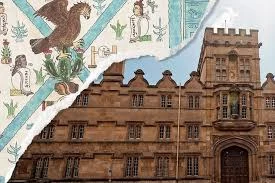
It sounds like a clever internet trivia fact at first—a surprising comparison meant to provoke disbelief. Yet it is entirely true. The University of Oxford is older than the Aztec Empire. Teaching was already underway in Oxford by the year 1096, nearly two and a half centuries before the Aztecs founded their great capital city of Tenochtitlán in 1325. At a time when Aztec civilization had not yet taken shape, scholars were already debating theology, philosophy, law, and medicine in stone halls along the River Thames. The contrast is staggering: a medieval European institution built on Latin learning predates one of the most powerful civilizations of the pre-Columbian Americas. This comparison not only reshapes how we think about timelines—it reveals how vastly different human societies were evolving simultaneously across the world, often completely unaware of each other’s existence.
How the University of Oxford Emerged in Medieval Europe
By the late 11th century, England was still emerging from the upheaval of the Norman Conquest. Castles were rising across the countryside, feudal systems were tightening their grip on daily life, and the Church dominated intellectual authority. It was within this world that organized teaching began in Oxford around 1096. There was no grand founding ceremony, no official charter at the beginning. Instead, Oxford grew organically as scholars gathered to teach theology, grammar, logic, arithmetic, and philosophy.
At the heart of this early university was the medieval belief that knowledge—especially religious knowledge—was a pathway to truth and divine understanding. Latin served as the universal language of learning, allowing scholars from across Europe to communicate and exchange ideas. Students traveled long distances to study under respected masters, often living in rented rooms and attending lectures in informal halls. Oxford offered something rare in medieval life: structured education outside monasteries.
By the early 12th century, Oxford had gained enough prominence to be recognized as a major intellectual center. It attracted students not only from England but from France, Germany, and beyond. The university’s rapid rise was fueled by a growing European hunger for legal, theological, and philosophical training, especially as royal governments and the Church required educated administrators.
What is extraordinary is not just that Oxford existed in 1096, but that it survived. Fires, plagues, political upheavals, religious revolutions, and world wars would come and go, yet the institution endured continuously. While empires rose and vanished, Oxford remained—a living thread connecting the medieval world to the modern age.
By the time the Aztecs founded Tenochtitlán in 1325, Oxford had already been operating for more than two hundred years. Professors had debated Aristotle, students had staged protests, kings had intervened in university politics, and entire philosophical movements had already passed through its halls. When the Aztec Empire was taking its first steps toward greatness, Oxford was already ancient by medieval standards.
The Birth of the Aztec Empire and the Founding of Tenochtitlán
While Oxford was flourishing in medieval England, the lands that would later become the heart of the Aztec Empire were home to various competing cultures and city-states in Mesoamerica. The Mexica people, who would later be known as the Aztecs, were late arrivals to the region. They were nomadic at first, migrating for generations before finally settling in the Valley of Mexico.
According to Aztec tradition, their gods guided them to a specific sign: an eagle perched on a cactus while devouring a serpent. That vision, they believed, marked the place where they were destined to build their great city. In 1325, they found this sign on an island in Lake Texcoco. There, in a challenging and swampy environment, they founded Tenochtitlán.
At the beginning, Tenochtitlán was not an empire’s capital—it was a struggling settlement surrounded by stronger rivals. The Mexica were initially viewed as outsiders and mercenaries rather than rulers. But through warfare, strategic alliances, and ruthless political maneuvering, they slowly transformed themselves into the dominant power of central Mexico.
Within just two centuries, the Aztec Empire would extend its influence over millions of people. Tenochtitlán grew into one of the largest and most sophisticated cities in the world at the time, with massive temples, canals, marketplaces, and causeways connecting it to the mainland. By the early 16th century, its population rivaled that of the largest European cities.
Yet all of this occurred long after Oxford was already a deeply established institution. When Aztec engineers were carving stone pyramids and constructing waterways, Oxford scholars were printing books, debating church reform, and teaching mathematical astronomy. These two civilizations—one academic, the other imperial—were unfolding on parallel timelines separated by thousands of miles and entirely different worldviews.
The founding of Tenochtitlán in 1325 marks the true beginning of the Aztec state. That date sits more than two centuries after Oxford had already begun shaping students’ minds. This single comparison shatters simple assumptions about “old” and “new” civilizations.
What Oxford Was Teaching While the Aztecs Had Not Yet Arrived
By the time the Aztecs founded their first settlement, Oxford was already a fully functioning medieval university with defined traditions, faculties, and academic authority. Students in the 12th and 13th centuries pursued what was known as the trivium and quadrivium—grammar, rhetoric, logic, arithmetic, geometry, music, and astronomy. These were not casual subjects but the intellectual backbone of medieval European civilization.
Theology stood at the center of Oxford’s identity. Scholars debated the nature of God, the structure of the universe, the meaning of salvation, and the boundaries between faith and reason. Great medieval thinkers passed through Oxford’s early intellectual orbit, either directly or through written influence. The university became a breeding ground for legal experts, clerics, royal administrators, and philosophers.
Oxford was also deeply entangled with political power. English kings relied on its scholars for advice and administration. When conflicts erupted between crown and church, Oxford often became a battleground of ideology. Students and masters occasionally clashed with local townspeople, sometimes violently. These tensions reveal that Oxford was never an isolated ivory tower—it was woven tightly into the political bloodstream of medieval England.
By the 1200s, Oxford already had colleges—self-governing academic communities within the larger university. These institutions introduced structured student housing, scholarships, and governance systems that still influence modern universities today. That means the very concept of organized higher education as we recognize it was already mature long before the Aztec Empire existed.
While Mexica ancestors were still migrating toward Lake Texcoco, Oxford had already produced centuries of scholarship, trained generations of elites, and planted the seeds of Western academic tradition. Printing had not yet arrived, but handwritten manuscripts circulated widely. Intellectual culture at Oxford shaped future developments in law, science, and philosophy that would echo across Europe.
The age gap is staggering. When the Aztecs began, Oxford was not a young institution—it was already old, respected, and foundational.
How Two Vastly Different Civilizations Developed Side by Side
One of the most fascinating elements of this comparison is that Oxford and the Aztecs evolved entirely independently of each other. There was no exchange of knowledge, no shared technology, no awareness between the medieval scholars of England and the Mexica builders of Mesoamerica. They existed in parallel worlds that would not collide until European contact in the 16th century.
Oxford developed in a Christian, feudal society rooted in Roman inheritance and Biblical theology. Knowledge flowed through Arabic translations of Greek philosophy, filtered through church doctrine. Education served the needs of monarchy, law, and religion. Scholarship emphasized written texts, formal debate, and hierarchical authority.
Aztec civilization, by contrast, was built on a worldview centered around cyclical time, divine sacrifice, and warrior honor. Their educational systems existed too, though in a very different form. Aztec youth were trained in calmecac and telpochcalli schools, where they learned warfare, religion, astronomy, and social discipline. Their science was observational, their mathematics sophisticated, their architecture monumental.
Even without metal tools or wheeled transport, the Aztecs created engineering marvels. Their capital city rested on artificial islands supported by causeways and canals. Their chinampa farming system produced extraordinary agricultural yields. Their markets rivaled any European trading hub in complexity and scale.
What makes the Oxford-Aztec comparison so powerful is not just the age difference, but the simultaneous achievement. While Oxford scholars debated philosophical abstractions in candlelit halls, Aztec priests calculated ritual calendars and guided massive imperial ceremonies under open skies. Both civilizations were at the height of human organization in their respective environments.
Timeline comparisons like this force us to abandon Eurocentric and linear models of “progress.” The world has never advanced in a single direction at a single pace. Multiple centers of civilization rise independently, each shaped by geography, belief, and historical accident.
The Fall of the Aztecs and the Continued Life of Oxford
The Aztec Empire’s collapse was sudden, violent, and catastrophic. In 1519, Spanish conquistadors arrived in Mesoamerica, exploiting internal political divisions and wielding unfamiliar weapons, horses, and diseases. By 1521, after a brutal siege, Tenochtitlán lay in ruins. The Aztec emperor was captured, tens of thousands perished, and the empire that had risen in less than two centuries was annihilated in a matter of years.
Meanwhile, Oxford continued uninterrupted. While the Aztecs were falling to European conquest, Oxford scholars were participating in the early waves of the Renaissance, printing books, reforming religious thought, and developing early scientific theory. The institution did not collapse when empires fell. It adapted.
Oxford lived through the Protestant Reformation, when England broke from the Catholic Church. It survived the English Civil War, during which its colleges were occupied by soldiers. It endured plagues, fires, and financial crises. Each time, it reshaped itself without surrendering its core mission: teaching and scholarship.
This contrast is haunting. The Aztec Empire rose rapidly, shone brightly, and vanished abruptly. Oxford, by contrast, evolved slowly, persistently, and continuously. One civilization was monumental and brief. The other was institutional and enduring.
The ruins of Tenochtitlán lie buried beneath modern Mexico City. Oxford’s colleges still stand along medieval streets, still educating students nearly a thousand years after their beginnings. The difference reveals how fragile political power can be compared to intellectual institutions designed for continuity rather than expansion.
Why This Comparison Feels So Surprising to Modern Minds
Most people instinctively think of ancient civilizations like the Aztecs as unimaginably old, while viewing institutions such as universities as relatively recent. This perception comes from how history is taught. Pre-Columbian civilizations are often grouped together as “ancient,” even though many of them flourished in what Europeans would call the Middle Ages.
In reality, the Aztec Empire was not ancient by the time Europeans encountered it. It was young, dynamic, and rapidly expanding. Many of its buildings were newer than Oxford’s oldest classrooms. The idea that the Aztecs belong to some remote, distant past is a distortion created by the shock of their destruction and the way colonial history framed them as vanished primitives.
By contrast, Oxford’s age is quietly hidden behind continuous use. Because it never collapsed, it does not feel ancient in the same way ruined empires do. People walk through Oxford daily, attend lectures, eat in medieval dining halls, and scroll on smartphones. The presence of modern life disguises the age beneath it.
The comparison unsettles us because it reverses expectations. We expect empires to be older than schools, monuments to outlast classrooms. Yet Oxford stands while Tenochtitlán fell. The timeline reveals that “old” is not about how long something existed in the past—it is about whether it still exists now.
What This Timeline Teaches Us About Civilization and Memory
The fact that Oxford is older than the Aztec Empire carries deeper implications than novelty. It reveals how civilization does not follow a single path of progress. Different societies build different kinds of legacies. Some leave stone ruins. Others leave institutions and ideas that continue living through people.
It also reminds us that survival is not determined solely by greatness. The Aztecs built one of the most impressive cities on Earth. Oxford built an academic framework. One was destroyed by invasion and disease. The other adapted to Reform, revolution, and industrialization.
History often remembers what survives, not what was grand. The Aztecs were technologically sophisticated, artistically refined, and politically powerful. But their civilization was extinguished. Oxford’s physical survival allows it to dominate historical imagination in ways that destroyed civilizations cannot.
This comparison also humbles modern timelines. What feels ancient to us may be relatively recent, and what feels modern may be rooted in a nearly thousand-year-old foundation. Time is not intuitive—it must be confronted with numbers, not impressions.
Oxford and the Aztecs stand as proof that human achievement unfolds in overlapping waves, not clean succession. While one civilization taught Latin grammar beside the Thames, another raised pyramids on a lake island an ocean away. Both were modern in their own worlds.
When a University Outlived an Empire
The University of Oxford first opened its doors to students around 1096. The Aztecs would not found their capital city until 1325. By the time Tenochtitlán rose from the waters of Lake Texcoco, Oxford had already educated generations, formed colleges, trained religious leaders, and shaped medieval political thought. By the time the Aztec Empire reached its height, Oxford was already reshaping European science and scholarship.
This comparison is not merely a curiosity—it is a powerful reminder of how uneven, overlapping, and surprising human history truly is. Civilizations rise suddenly and fall abruptly. Institutions sometimes endure far longer than the empires that surround them. What survives reshapes how we remember the past.
Oxford still stands. Tenochtitlán does not. Yet both once represented the peak of human ingenuity in their respective worlds. One continues teaching. The other survives through archaeology, memory, and legend.
The timeline does not diminish the achievements of either—it simply reveals that the story of human civilization is far more intertwined, uneven, and astonishing than most people ever realize.
Research and further reading
For readers who want to verify details or continue researching this subject, these external reference collections provide useful starting points: