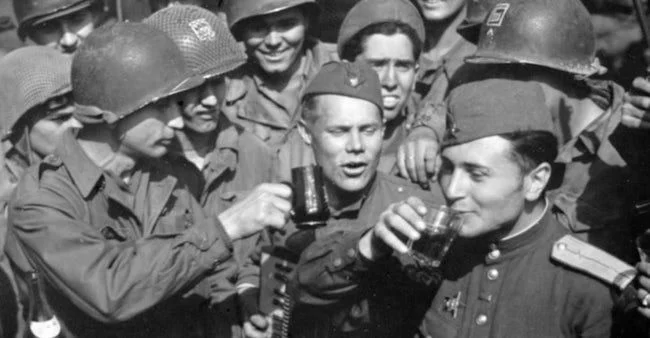
When the guns finally fell silent in Europe in May 1945, the relief that swept across the Eastern Front was unlike anything the modern world had ever seen. For nearly four years, cities across the Soviet Union had endured relentless bombardment, starvation, mass displacement, and loss on a scale that defies comprehension. Then, suddenly, the war was over. Germany had surrendered. Victory had come at an unthinkable cost, but it had come. What followed was one of the most intense, emotionally charged celebrations in human history—so intense, in fact, that according to widely repeated accounts, the Soviet Union drank through its national vodka reserves in just 22 hours. Whether taken literally or symbolically, the story captures the raw release of a people who had survived the deadliest war their nation would ever face.
The Immense Emotional Pressure of a Nation at War
To understand how celebratory drinking could reach legendary proportions, it is essential to grasp what the Soviet population had lived through between 1941 and 1945. The Eastern Front was not merely another theater of World War II. It was the central arena of annihilation. Over 27 million Soviet citizens—soldiers and civilians combined—would die before the war’s end. Entire cities were flattened. Villages vanished. Families were wiped out across generations.
In places like Leningrad, civilians endured nearly 900 days of siege, with starvation so severe that survival itself became a daily act of defiance. In Stalingrad, fighting was so close that opposing soldiers could hear each other breathing through shattered walls. Across Ukraine, Belarus, and western Russia, retreating German forces left scorched earth behind them. Every family carried grief. Almost no household was untouched.
At the same time, the Soviet state mobilized its people with unmatched intensity. Wartime propaganda framed survival itself as a heroic act. Workers labored in frozen factories stripped of resources. Teenagers replaced fallen adults on farms and assembly lines. The war was not just fought at the front—it consumed every dimension of life.
By the spring of 1945, exhaustion had reached a breaking point. Soldiers were physically shattered. Civilians were traumatized beyond language. Fear had been constant for nearly four years. When victory finally arrived, it did not feel like the end of struggle—it felt like the sudden collapse of an emotional dam that had held back oceans of grief, rage, and relief. The celebration that followed was not just joy. It was release after prolonged psychological captivity.
Victory Day and the Eruption of Street Celebrations
On the night of May 8–9, 1945, news of Germany’s surrender spread rapidly through Soviet cities. Church bells rang. Factory whistles screamed. People poured into the streets without waiting for official instructions. Moscow, Leningrad, Kyiv, and countless smaller cities transformed into seas of humanity almost instantly.
Strangers embraced. Soldiers fired into the air in elation. People danced atop tanks, sang wartime songs, and wept openly with relief. Fireworks—both organized and improvised—lit the sky. Some people had waited four years for this night. Others had waited their entire lives to see the end of an apocalypse.
What made the celebrations so intense was not only the triumph over Nazi Germany, but the survival of the Soviet state itself. Many had feared annihilation in 1941. Entire regions had nearly collapsed. Victory was not guaranteed until very late in the war. That uncertainty magnified the emotional shock of success.
Alcohol flowed freely almost immediately. Vodka, deeply embedded in Russian and Soviet social rituals, became the symbolic fuel of the celebration. Bottles were shared between soldiers and civilians, between factory workers and party officials, between grieving parents and returning sons. There was no separation of class or role in that moment—only shared survival.
Accounts from witnesses repeatedly describe continuous drinking for days. Streets became open-air banquets. Food was scarce but whatever existed was shared. Toasts lasted through the night. For many, this was the first time in years they were not listening for bombs or sirens. Sleep itself felt unfamiliar without fear.
This was not a measured celebration planned by the state. It was a spontaneous social eruption. And it is within this context that the legendary claim emerged: that the Soviet Union drank through its vodka reserves in just 22 hours.
Did the Soviet Union Really Run Out of Vodka in 22 Hours?
The claim that the nation’s vodka reserves were exhausted in just 22 hours has circulated for decades in memoirs, documentaries, and popular history accounts. On the surface, it sounds almost mythical—too dramatic to be literal. After all, a state as vast as the Soviet Union maintained enormous alcohol production capacities even during wartime.
Strictly speaking, there is no surviving centralized document confirming that every drop of vodka in the entire Soviet Union vanished in less than a day. Alcohol production and distribution varied enormously by region. Some rural areas had homemade spirits. Some military units received special rations. Some cities had stockpiles separate from national reserves.
Yet many historians agree that something extraordinary did occur in those first hours of peace. Vodka distribution surged at unprecedented rates. Military depots, state warehouses, and commercial stores released their supplies with minimal restriction. Party officials often authorized massive releases of alcohol as a reward for endurance. In some cities, official reserve stocks intended to last months were emptied within a day.
Thus, the “22-hour” claim should be understood not as a mathematically precise national audit, but as a symbolic expression of how fast official vodka stocks disappeared in major population centers. In Moscow and several other large cities, stores reportedly sold out completely in well under 24 hours. Military units drank through rations meant for weeks. Trains carrying alcohol were redirected directly to city centers.
What matters most is not whether the number is perfectly accurate, but what it represents. It captures how consuming the victory became. The people did not pace their exhaustion. They drank as if the future itself had finally returned and could not be trusted to remain.
For millions, vodka was not just alcohol—it was emotional anesthesia, ritual closure, and communal bonding rolled into one. The speed with which it vanished underscored the depth of psychological trauma the population had endured.
Vodka, War, and the Soviet Social Contract
Vodka occupied a unique position in Soviet society long before 1945. It had been taxed, regulated, prohibited, and reintroduced multiple times across Russian and Soviet history. The state both relied on it as a source of revenue and feared it as a cause of social disorder. During wartime, vodka became something else entirely: a morale tool.
Soviet soldiers at the front received the famous “Frontline 100 grams”—a daily vodka ration issued to boost courage and dull fear. This ritual became deeply embedded in the war experience. Men toasted fallen comrades with it. They drank before assaults. They drank after survival. Vodka became a liquid symbol of endurance under terror.
Civilians, however, had far less consistent access during the war. Production was tightly controlled. Distribution to the civilian population was limited as resources were diverted to the military. For many on the home front, actual vodka was a memory rather than a constant presence during the harshest years.
Victory changed that balance instantly. What had been restricted was suddenly released. What had been rationed was suddenly overflowing. The release of vodka stocks became both practical—clearing warehouses—and symbolic—marking the return to life.
In Soviet cultural logic, shared drinking marked transitions: births, funerals, departures, reunions. Victory Day was the greatest transition imaginable. It was the end of organized mass death. It marked the moment when survival gave way to remembrance. Vodka, as it had for centuries, became the medium through which that transition was made communal.
Importantly, these celebrations occurred before the full postwar repression resumed. For a brief moment, joy was permitted without restraint. The state would soon return to strict controls, reconstruction discipline, and renewed ideological pressure. But in those first hours after victory, emotion outran regulation.
The Dark Side of Unleashed Celebration
While the celebrations were overwhelmingly joyful, they also carried darker consequences. Hospitals quickly filled with cases of alcohol poisoning, injuries, and accidents. Soldiers discharged in euphoric confusion sometimes fired weapons carelessly. Fires broke out. Traffic deaths spiked. Medical infrastructure, already stretched thin by years of war, struggled to handle the surge.
In some areas, celebratory violence flared. Personal grudges long suppressed by wartime discipline surfaced under intoxication. Black markets exploded as official supplies disappeared. Local authorities were often too overwhelmed—or too drunk themselves—to impose control.
These incidents do not diminish the legitimacy of the joy people felt. Rather, they show how completely normal systems of restraint had been overwhelmed by emotional release. When fear has defined daily life for years, the sudden absence of that fear produces a volatile psychological vacuum. People filled it however they could.
It is also worth noting that for many families, celebration and grief unfolded simultaneously. Toasts were raised beside photographs of the dead. Victory brought safety but not reunion for the millions who would never return. Vodka helped people hold joy and loss in the same breath.
In later years, Soviet official memory would emphasize disciplined patriotism and heroic sacrifice. The raw chaos of the first Victory Day celebrations would gradually be smoothed into ceremonial parades and formal rituals. But for those who lived through that first night, the memory of uncontrolled celebration burned just as brightly as the victory itself.
Why the Vodka Story Endured Through Generations
The story of the Soviet Union running out of vodka in 22 hours endured because it works simultaneously as fact, exaggeration, metaphor, and cultural truth. Even if not every region exhausted its supply instantly, enough people experienced empty shelves and dry stores to make the idea credible.
It also functions as a perfect shorthand for the psychological scale of the event. Saying “the vodka ran out” communicates something posture and speeches cannot: that people celebrated so intensely they briefly consumed faster than production could respond. In a nation built on industrial imagery—factories, quotas, output—this metaphor carries special power.
The story also humanizes victory. Military histories often reduce war to maps and operations. The vodka story returns victory to the bodies of ordinary people—their thirst, trembling hands, shaking nerves, and exhausted joy. It reminds us that wars do not end politely. They end in eruptions.
Finally, vodka as a national symbol means the story resonates far beyond 1945. Even decades later, when alcoholism became a severe social problem in the Soviet Union, the Victory Day drinking legend stood apart. It was rarely framed as vice. It was framed as catharsis.
What This Episode Reveals About War, Memory, and Survival
The idea that an entire nation could symbolically drink its way through victory in less than a day reveals something unsettling and profoundly human. It shows that survival under prolonged mass trauma creates pressures that cannot be released gently. Four years of terror, hunger, and mourning compressed emotion to explosive levels.
It also reveals how memory selects what it preserves. The trenches, the corpses, the mass graves—all exist in historical record. But communities also preserved the moment when laughter returned to streets that had only known sirens. The vodka story captures that pivot with almost brutal simplicity.
In psychological terms, Victory Day functioned as a collective shock reset. People transitioned instantly from emergency mode to release mode. Normal emotional pacing had no time to return. The result was an emotional whiplash that only sheer excess could satisfy.
In political terms, the event demonstrated how deeply culture can overtake ideology. The Soviet state may have planned victorious parades and speeches. What it got first was spontaneous flood. No decree could have matched that force.
A Nation That Drank to Prove It Was Still Alive
When news of victory arrived in May 1945, the people of the Soviet Union did not respond with quiet dignity. They responded with uncontrolled life. They filled streets with noise, with song, with tears, with embraces, and yes—with vodka on a scale that quickly overwhelmed state supplies. Whether or not every last national reserve vanished in exactly 22 hours matters less than what the story tells us about human endurance.
After years of starvation, bombardment, and mass death, the sudden return of safety felt unreal. Drinking became proof that the nightmare had ended. It marked the transition from survival to memory. It bonded strangers who had shared nothing but fear. It allowed grief and joy to collide openly.
The Soviet Union did not simply celebrate the end of World War II. It detonated emotionally. And in that explosion of relief, vodka became both symbol and solvent—dissolving four years of terror into one unforgettable, sleepless, history-defining night.
Research and further reading
For readers who want to verify details or continue researching this subject, these external reference collections provide useful starting points: