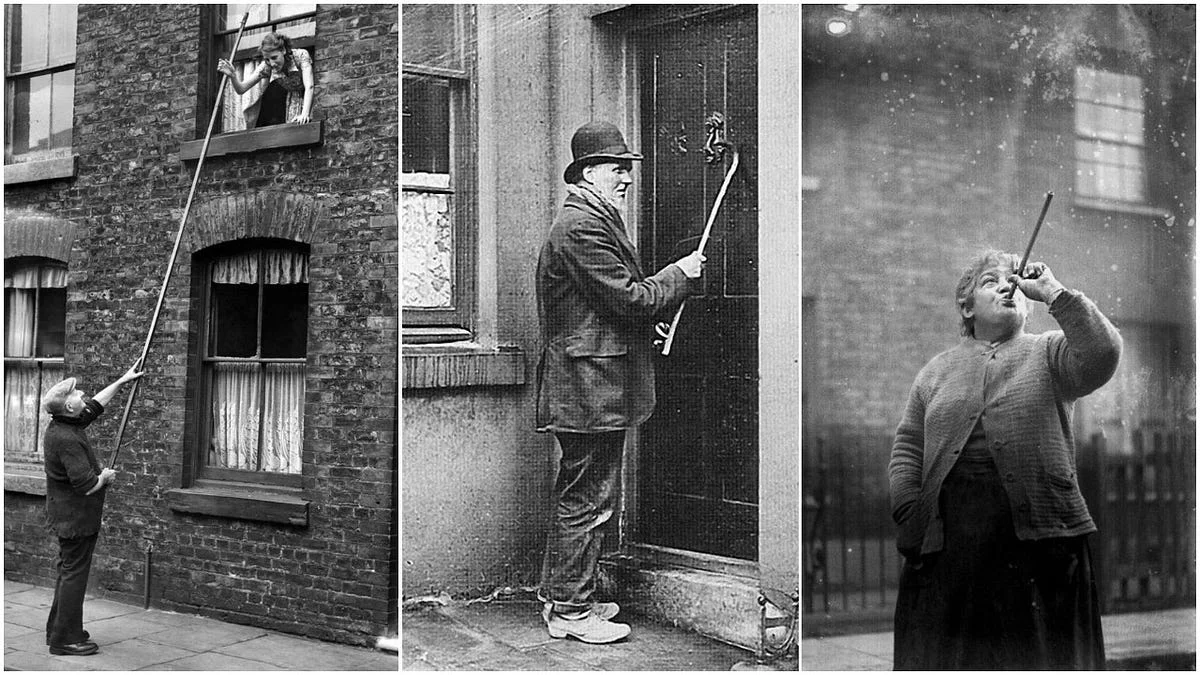
Long before the familiar blare of alarm clocks—or the quiet buzz of smartphone alarms—waking up on time for work depended not on technology, but on people. In the industrial cities of Britain and Ireland, and later parts of Europe, a unique profession emerged: the knocker-upper. These early-morning human alarm clocks patrolled dark streets armed with long poles, bamboo canes, soft hammers, rattles, and even pea shooters, which they used to tap, knock, or ping at upper-floor bedroom windows. Their job was simple, but vital: wake workers before sunrise so they could reach the mills, factories, and docks on time. Astonishingly, knocker-uppers were still active in some towns until the 1970s, long after the invention of alarm clocks. Their persistence reveals much about industrial society, working-class life, and the slow adoption of new technology.
Why the Knocker-Upper Profession Emerged in the First Place
To understand why people once paid strangers to wake them up, we must step back into the industrializing world of the 19th century. Cities like Manchester, London, Liverpool, and Dublin experienced explosive population growth. Thousands of workers lived in cramped rows of rented rooms, basements, and attic flats. Their schedules were rigidly dictated by factory bells, work whistles, and employers who demanded punctuality above all else. Being late—even once—could cost workers their jobs or result in harsh wage docking. In an era without labor protections, this was a terrifying risk.
Alarm clocks did exist, but they were luxuries. Early mechanical alarms were expensive, finicky, and unreliable. They were often priced far beyond what a factory worker or dock laborer could afford. Poor families struggled even to keep a clock in the home, let alone one with a built-in waking mechanism. Many households, especially in crowded slums, shared a single timepiece. Even then, its accuracy depended on careful winding, maintenance, and access to a clockmaker for repairs.
Compounding this issue was the lack of standardized time itself. Before the introduction of railway time and later coordinated national timekeeping, towns often ran on local time measured by church clocks or sun dials. Trains, factories, and public schedules slowly forced a synchronized modern clock culture, but ordinary people did not always benefit from it. They relied instead on the church bell, the factory whistle, or neighbors shouting along the street at dawn.
Enter the knocker-upper. These human alarm clocks filled a glaring need in working-class communities: affordable, reliable, and personal wake-up services. They operated long before sunrise, moving from house to house according to a list of clients who paid a small weekly fee. For many workers, this service was the only dependable way to ensure timely arrival at demanding jobs. The existence of knocker-uppers tells a deeper story about a world caught between tradition and modernity, where time was becoming industrialized faster than ordinary people could keep up with it.
How Knocker-Uppers Actually Woke People: Tools, Techniques, and Ingenuity
The image of a knocker-upper tapping on a window with a long pole is charming, but the actual practice required more skill, stamina, and resourcefulness than one might expect. Each knocker-upper built a personal toolkit suited to the neighborhoods they served. In tightly packed working-class districts with multi-story tenements, long bamboo poles—sometimes reaching eight to ten feet—were the primary instrument. These poles often had a rubber tip or small padded head to deliver a firm but quiet knock directly to the glass without breaking it.
In more affluent neighborhoods, where homes were set back from the street or windows were smaller, knocker-uppers adapted with pea shooters. A precise tap of dried peas on glass produced a crisp, unmistakable sound that was loud enough to wake the client but gentle enough not to disturb the entire household. A handful of peas could last days, making it a surprisingly efficient tool. Other knocker-uppers preferred rattles—a method borrowed from night watchmen—or small hammers wrapped in leather to soften the blow.
Timing was everything. Clients depended on their knocker-upper to arrive at exactly the right minute. Some workers began shifts at predawn hours, such as 4:00 a.m. or even earlier, meaning the knocker-upper’s rounds began in pitch darkness. They navigated narrow alleys, slippery cobblestone streets, and maze-like tenement blocks guided only by lantern light or whatever natural light the early morning offered. Missteps could be disastrous: waking the wrong person, missing a client, or arriving late could cause real harm to workers’ livelihoods. A reliable knocker-upper took meticulous notes, memorized routes, and planned their paths to account for weather, distance, and overlapping schedules.
Knocking itself required finesse. Too soft, and the client would sleep through it. Too hard, and the knocker-upper risked breaking the window—an expense they could not afford. Some workers developed hand signals with their clients or created unique knock rhythms so the person inside knew exactly who was calling. The profession demanded precision and personal attention. Each client had different habits and sleeping depths; some required gentle tapping, others repeated knocking or rattling. Far from a simple mechanical act, waking people was a skilled service shaped by human familiarity.
Who Became a Knocker-Upper? The Surprising Diversity of the Job
Knocker-uppers came from all walks of life. Many were older men and women who could no longer perform physically demanding labor but still needed income. The job required good stamina and early rising but not heavy lifting or long hours. It allowed people to earn a steady living on their own schedule. Elderly widows, in particular, found the work a valuable source of independence.
Other knocker-uppers were night-shift workers—policemen, lamplighters, watchmen—who took on extra work after finishing their rounds. For them, waking others dovetailed naturally with their nocturnal routines. Some lamplighters, after extinguishing street lamps at dawn, transitioned directly into knocking duties. Their familiarity with the local streets made them ideal candidates.
Perhaps most surprising were the knocker-upper family dynasties. In some British towns, the work passed from parent to child. Entire households organized their mornings around the business. Children were sometimes employed to reach difficult or especially high windows, as their lighter bodies could climb and maneuver quietly. While child labor was a grim reality of the industrial era, these tasks were considered relatively mild compared to factory work or street labor. Still, the involvement of children reveals how deeply knocker-up work integrated into family economies.
Women were especially prominent in this profession. Historical photographs from the late 19th and early 20th centuries frequently show older women holding long knocking poles. They became local fixtures—familiar figures whose reliability earned trust across working-class neighborhoods. In communities where women were often expected to stay close to home, this job provided a rare avenue for public, paid work that was socially accepted.
This diversity underscores the nature of urban life in industrial Britain. Entire professions emerged not from luxury or convenience but from necessity, improvisation, and the drive for survival in rapidly changing economic landscapes.
Knocker-Uppers and the Social World of Industrial-Time Culture
The existence of knocker-uppers highlights a profound shift in how people understood and experienced time. For much of human history, time was fluid. Days were structured by natural cycles—sunrise, sunset, seasonal rhythms—and by communal markers like church bells. People worked until the task was done, not according to factory whistles.
Industrialization shattered that ancient pattern. Factory labor operated on strict schedules. Whistles signaled the beginning, breaks, and end of the workday. Employers tracked punctuality with increasing precision, and lateness became a punishable offense. Time ceased to be a natural phenomenon and became a commodity—measured, controlled, bought, and sold.
Knocker-uppers became essential mediators between old rhythms and new demands. They bridged a world where ordinary people still lived in homes without clocks but now worked in factories where minutes determined wages. The knocker-upper transformed industrial time from a rigid external force into a personalized service—humanizing the brutal schedules of the era by offering reliability with a friendly face.
Their rounds also strengthened community relationships. They knew who worked which shifts, who struggled to wake up, who needed extra tapping, and who kept odd hours. In crowded urban landscapes where neighbors often lived in close proximity but led separate lives, knocker-uppers connected households. They were part security, part schedule-keeper, part neighborly figure. Many clients greeted their knocker-uppers at the window or left small tokens of appreciation.
The presence of knocker-uppers also reveals how incomplete technological adoption often is. Alarm clocks existed long before the profession died, but people continued to rely on human wake-up calls because the devices were unreliable, unaffordable, or simply unfamiliar. Social trust and routine mattered more than novelty.
The Tools of the Trade: From Pea Shooters to Long Poles
One of the most delightful aspects of the knocker-upper tradition is the creativity behind their tools. Every method evolved to suit different kinds of housing, neighborhoods, and client needs. Long poles—sometimes made of bamboo, sometimes simple wooden rods—were the most iconic. They allowed knocker-uppers to reach second- and third-story windows without shouting or climbing. Some poles had detachable heads, soft tips, or even small metal fixtures designed to create distinct knocking sounds.
Pea shooters, usually associated today with children’s play, were prized by knocker-uppers for their accuracy and sound quality. A dried pea striking glass produced a surprisingly sharp noise that instantly cut through morning silence. Unlike stones or gravel, peas would not damage the window. This allowed knocker-uppers to wake clients discreetly without disturbing entire streets.
Some used rattles carved from wood or metal—similar to those used by watchmen or night guards. These created rhythmic, repetitive sounds ideal for deep sleepers. Others used lightweight mallets wrapped in cloth. In narrow alleys, where echoing was a concern, these tools delivered soft but insistent taps.
The diversity of tools shows how personalized the profession was. A knocker-upper adapted to their environment, weather conditions, and individual customers. The goal was always the same: wake a specific person at a specific time, without waking the wrong person or attracting unnecessary attention.
How Much Did It Cost to Hire a Knocker-Upper?
Hiring a knocker-upper was surprisingly affordable—a necessity for working-class families living on fragile margins. Clients typically paid a small weekly fee, sometimes just a few pence. Rates varied by region, distance, and number of windows. Some knocker-uppers offered package deals for households where multiple members needed waking at different times. Others charged extra for extremely early shifts, such as dockworkers leaving before dawn.
Payments were usually made in cash, but bartering occurred as well. Some clients offered food, coal, or sewing repairs. In poorer districts, the knocker-upper’s income came from dozens of tiny payments rather than large sums—steadily accumulated but dependent on consistent rounds and reliable service.
The affordability of the service explains why it endured for so long. Even after mass-produced alarm clocks became available, many people preferred to spend a small amount to ensure a dependable human alarm. Mechanical devices failed, but a knocker-upper could be trusted to return again and again—especially since their own income depended on accuracy.
The Slow Decline of the Knocker-Upper Profession
The decline of knocker-uppers was not immediate. Even as alarm clocks grew cheaper in the early 20th century, distrust of mechanical devices lingered. Early mechanical clocks were prone to jamming, running fast or slow, or failing altogether. Electricity, which helped stabilize clock accuracy, did not reach all neighborhoods at the same pace. In working-class homes without electricity or reliable batteries, a knocker-upper remained the most dependable option.
World War II accelerated the decline. Workers in wartime industries were often issued standardized alarm clocks or given access to communal waking systems. Mass production, improved engineering, and rising wages made personal clocks more accessible. By the 1950s and 60s, the knocker-upper was already becoming a nostalgic figure in many cities.
Yet the profession survived longer than expected. In some parts of northern England, knocker-uppers continued working into the 1970s, especially in areas with older residents who trusted tradition. Local newspapers occasionally featured profiles of the last knocker-uppers—often elderly women who had been waking their neighbors for decades.
Eventually, the spread of cheap, reliable alarm clocks rendered the profession obsolete. But its cultural imprint remained. Songs, poems, photographs, and oral histories preserved the memory of these human alarm clocks as symbols of a bygone era when waking up for work was not merely a mechanical process, but a human interaction.
What the Knocker-Upper Tells Us About Work, Technology, and Community
The knocker-upper profession highlights an overlooked truth: technological change is never instantaneous, and human systems often persist long after inventions enter the market. People adopt new tools slowly, cautiously, and unevenly. A cheap alarm clock may be available, but if a community trusts a familiar person more than a machine, tradition prevails.
It also reminds us that industrial society was not merely governed by machines and factory whistles—it was held together by ordinary people performing small but essential tasks. The knocker-upper represents a fragile form of social infrastructure built on trust and personal reliability. They ensured that factories functioned, goods were produced, and daily schedules ran smoothly long before automation took over.
Most importantly, the profession reveals how community networks once filled the gaps left by early industrial systems. People depended on each other in intimate, practical ways. Today, we rely on apps, alarms, and digital reminders; then, people relied on human voices, knocks, and familiar routines.
The story of the knocker-upper is charming, but it also carries deeper significance. It reminds us that before the age of automation and digital scheduling, time itself was managed by human hands.
When Waking Up Was a Human Job
The knocker-upper is one of history’s most unusual professions—part alarm clock, part community caretaker, part early-morning wanderer of quiet industrial streets. Armed with pea shooters, long poles, rattles, and soft mallets, these human timekeepers made sure ordinary workers reached their jobs on time. Their persistence into the late 20th century proves that technology does not instantly replace old habits; people hold tightly to what works, especially when livelihoods depend on it.
Though the knocker-upper has disappeared, their legacy lingers in stories, photographs, and the humor of their tools. More than that, they symbolize a time when even the simple act of waking up was a shared human experience—one small but essential thread in the vast fabric of working-class life.
Research and further reading
For readers who want to verify details or continue researching this subject, these external reference collections provide useful starting points: