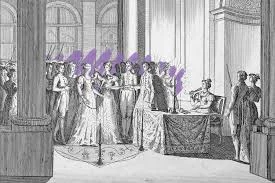
In the shadowy corners of 18th-century Europe, where Enlightenment ideas clashed with religious authority and secret societies flourished, an unlikely organization quietly took shape in Bavaria. Known as the Order of the Pug, this eccentric and semi-secret group was founded in 1740 by Roman Catholics who were barred from joining traditional Masonic lodges. Instead of square-and-compass symbolism and solemn rituals, the Order embraced something far more peculiar: pugs. New initiates were required to wear dog collars, scratch at the door to be admitted, and swear loyalty not on sacred texts, but on the virtues symbolized by the pug—loyalty, steadfastness, and discretion. While the rituals may sound absurd to modern ears, the Order of the Pug was no joke. It functioned as a serious para-Masonic society with political, social, and cultural significance, reportedly remaining active in various forms until 1902. Its story offers a fascinating glimpse into how secrecy, symbolism, and satire intertwined in early modern Europe.
Why the Order of the Pug Was Created in Catholic Bavaria
To understand why the Order of the Pug existed at all, one must look at the religious and political climate of 18th-century Bavaria. At the time, Bavaria was a deeply Catholic region within the Holy Roman Empire, governed by rulers who closely aligned state authority with the Catholic Church. Freemasonry, which had spread rapidly across Europe during the Enlightenment, was viewed with suspicion by Catholic authorities. Masonic lodges promoted ideals of rationalism, tolerance, and fraternity that often conflicted with church doctrine and hierarchical power structures.
In 1738, Pope Clement XII issued the papal bull In eminenti apostolatus specula, formally condemning Freemasonry and forbidding Catholics from joining Masonic lodges under penalty of excommunication. This edict created an immediate social problem for Catholic elites who were intellectually curious, socially ambitious, and drawn to the networking opportunities offered by secret societies. These individuals wanted the camaraderie, symbolism, and mutual support of Freemasonry—but without violating Church law.
The Order of the Pug emerged as a clever workaround. Founded in 1740, it presented itself as a para-Masonic society—one that mimicked many Masonic structures while avoiding direct affiliation. Because it was explicitly Catholic in membership and tone, it existed in a gray area that allowed members to participate without openly defying ecclesiastical authority.
The choice of Bavaria was no accident. The region had a strong tradition of guilds, confraternities, and private societies, many of which blended religious devotion with social bonding. The Order of the Pug fit neatly into this tradition while also embracing Enlightenment-style satire. It allowed members to critique authority indirectly, using humor and symbolism as protective camouflage.
In this sense, the Order was both a product of restriction and creativity. It arose not despite Catholic prohibition, but because of it—demonstrating how limitations often give rise to the most unusual cultural innovations.
The Symbolism of the Pug: Loyalty, Satire, and Subversion
The most striking feature of the Order of the Pug was its chosen mascot: the pug dog. At first glance, the pug seems like an odd symbol for a secret society. Small, flat-faced, and often associated with domesticity, it lacked the grandeur of lions, eagles, or serpents favored by other orders. Yet this was precisely the point.
In 18th-century Europe, pugs were popular pets among the aristocracy, particularly in German-speaking regions. They were valued for their loyalty, alertness, and steadfastness—traits the Order sought to emulate. Unlike hunting dogs bred for aggression or speed, pugs were companions, known for devotion rather than dominance. This made them an ideal symbol for a society that prized discretion and faithfulness over power.
The pug also served a satirical function. By adopting an animal widely viewed as comical, the Order subtly mocked the seriousness of other secret societies. This self-awareness offered protection. Outsiders who heard rumors of dog collars and scratching rituals were likely to dismiss the group as frivolous or absurd, reducing the risk of scrutiny. Humor became a shield.
Symbolically, the pug represented obedience without servility. Members pledged loyalty to one another, not to a monarch or institution. This was a quiet but meaningful distinction in a time when oaths of allegiance were politically sensitive. The pug’s unwavering loyalty was framed as moral rather than hierarchical.
Visual representations of the Order often featured pugs wearing collars adorned with insignia, sometimes seated beside Masonic symbols like compasses or keys. These images reinforced the society’s dual nature: playful on the surface, serious underneath.
In choosing the pug, the Order of the Pug crafted an identity that was memorable, ironic, and subversive—using a humble animal to express ideals that might otherwise have attracted unwanted attention.
Initiation Rituals: Dog Collars, Scratching, and Symbolic Humiliation
Perhaps the most famous aspect of the Order of the Pug is its initiation ritual, which was deliberately theatrical and slightly humiliating. New members were required to wear a dog collar—often engraved with symbolic markings—and scratch at the door of the meeting room to request entry. Only after performing this act of symbolic submission would they be allowed inside.
While these actions may seem absurd, they were rich with meaning. Initiation rituals in secret societies often involve symbolic death and rebirth, humility, and the surrender of ego. By asking initiates to behave like dogs, the Order emphasized the importance of obedience, loyalty, and the willingness to set aside social status.
This was especially significant given that many members were aristocrats, clergy, or educated elites. Asking such individuals to crawl, scratch, or wear collars inverted traditional hierarchies, reminding participants that within the Order, all members were equal. The ritual acted as a social leveling mechanism.
The scratching ritual also reinforced secrecy. Only those who knew the correct gestures and signals could gain entry. To outsiders, the behavior would appear nonsensical, further discouraging investigation. The absurdity was intentional—it functioned as both initiation and camouflage.
Accounts suggest that initiates were also required to swear oaths of loyalty and discretion, sometimes in candlelit rooms decorated with pug imagery. These oaths emphasized moral conduct, mutual aid, and silence regarding the Order’s activities.
Far from being meaningless antics, the initiation rituals were carefully designed. They blended parody with seriousness, using humor to reinforce commitment. In a world where secret societies could attract suspicion or persecution, the Order of the Pug mastered the art of hiding significance behind silliness.
Membership, Gender, and Social Reach of the Order
One of the most unusual aspects of the Order of the Pug was its inclusive membership policies, particularly regarding gender. Unlike many Masonic lodges of the time, the Order reportedly admitted women as full members. This was highly unusual in 18th-century Europe and suggests that the society operated with more flexible social norms than its Masonic counterparts.
Women in elite circles often participated in salons and literary societies, but formal membership in secret orders was rare. The Order of the Pug provided an alternative space for intellectual and social engagement across gender lines. This inclusivity may have been another reason the Order was viewed with suspicion by authorities—or dismissed as unserious.
Membership appears to have included nobles, clergy, military officers, and educated professionals. Because it operated semi-secretly, precise membership lists are difficult to reconstruct. However, surviving documents and illustrations suggest that the Order had a respectable following, particularly in southern Germany and Austria.
Meetings likely involved discussions of philosophy, morality, and current events, though explicit political activity remains unclear. As with many Enlightenment-era societies, the line between social bonding and ideological exchange was blurred. The Order offered a safe environment for conversation among like-minded individuals constrained by religious and political boundaries.
The reported longevity of the Order—remaining active in some form until 1902—suggests that it adapted over time. As Freemasonry became more accepted and religious restrictions softened, the Order’s original purpose may have shifted. What began as a workaround for Catholic prohibition likely evolved into a tradition sustained by ritual and identity rather than necessity.
Relationship to Freemasonry and Church Authority
The Order of the Pug occupied a delicate position between imitation and independence. It borrowed heavily from Masonic structures—lodges, initiation rituals, symbolic language—yet it avoided direct affiliation. This allowed members to enjoy many of the benefits of Masonic life without openly violating Church bans.
Church authorities were not entirely fooled. While there is limited evidence of direct suppression, the Order existed in a climate of suspicion. The Catholic Church remained wary of any organization that operated in secrecy, regardless of its stated loyalty. However, the Order’s explicitly Catholic membership and humorous exterior likely reduced the perception of threat.
Freemasons themselves reportedly viewed the Order with mixed feelings. Some saw it as a harmless parody; others viewed it as an unauthorized imitation. Yet this ambiguity may have worked in the Order’s favor. By never fully aligning with or opposing Freemasonry, it remained difficult to categorize.
This ambiguous positioning highlights a broader truth about secret societies in early modern Europe: they were not monolithic. They existed on a spectrum ranging from political conspiracies to social clubs. The Order of the Pug leaned toward the latter, but its very existence reflected tensions between authority, identity, and intellectual freedom.
Decline and Disappearance by the Early 20th Century
By the late 19th century, the conditions that gave rise to the Order of the Pug had largely disappeared. Catholic prohibitions against Freemasonry softened, Enlightenment ideas became mainstream, and secrecy lost much of its protective necessity. As societies modernized, the social role of secret orders diminished.
The Order reportedly persisted in some form until 1902, though by then it was likely more ceremonial than influential. Its rituals may have survived as tradition rather than necessity, maintained by members who valued continuity and symbolism.
Eventually, the Order faded from active memory, leaving behind scattered references, illustrations, and anecdotes. Its obscurity today is part of its charm—a reminder that history is filled with organizations that once mattered deeply to their members but left only faint traces behind.
Serious Meaning Behind Playful Rituals
The Order of the Pug stands as one of the strangest and most fascinating secret societies in European history. Founded by Roman Catholics in Bavaria in 1740, it used humor, symbolism, and absurdity to navigate a restrictive religious landscape. Dog collars, scratching rituals, and pug imagery were not mere jokes—they were tools of inclusion, secrecy, and subtle resistance.
Active for more than a century and a half, the Order demonstrates how people adapt when authority limits expression. It reveals that satire can be a form of survival and that even the most eccentric rituals can carry deep social meaning.
In a world that often associates secret societies with dark conspiracies, the Order of the Pug offers a different perspective: one where loyalty, companionship, and a sense of humor held the group together. Beneath the scratching paws and wagging tails was a serious human desire—to belong, to think freely, and to do so safely.
Research and further reading
For readers who want to verify details or continue researching this subject, these external reference collections provide useful starting points: