Most nursery rhymes live in a hazy space between myth and memory. They are repeated so often, and from such an early age, that few people ever stop to ask whether they came from real lives and real moments. “Mary Had a Little Lamb” is one of the most famous examples. For generations, it has been treated as a charming piece of children’s verse, untethered from history. Yet behind the simple lines lies a documented story involving a real child, a real lamb, and a very specific place and time in nineteenth-century New England.
Mary was not a fictional invention, nor was the lamb a poetic symbol. Mary Sawyer was an actual girl, and her lamb was a real animal whose behavior astonished classmates and teachers alike. The incident that inspired the rhyme took place in a rural community shaped by farming, religion, and tight-knit social bonds. What began as an ordinary act of affection between a child and her pet gradually transformed into one of the most enduring verses in the English language.
Even more surprising is what happened later in Mary Sawyer’s life. Long after the rhyme became famous, she used the lamb’s wool to raise money for a struggling church, connecting her childhood experience to community service and local history. The story of Mary and her lamb is not just a curiosity behind a nursery rhyme; it is a window into nineteenth-century American childhood, education, and memory.
Mary Sawyer and Her New England Childhood
Mary Sawyer was born into a rural New England world where daily life revolved around agriculture, family labor, and faith. Contrary to popular retellings that place her in a bustling city, Mary lived in the countryside of Sterling, not Boston itself. Her family were farmers, and like many children of the era, Mary was accustomed to caring for animals from a young age. Livestock were not distant or abstract; they were part of everyday survival.
The lamb that would later become famous was an orphaned animal that Mary helped nurse back to health. This detail matters because it explains the unusually strong bond between the girl and the lamb. In rural nineteenth-century America, animals were rarely treated as pets in the modern sense. They were working creatures, raised for wool, meat, or labor. Mary’s lamb, however, had been bottle-fed and raised by hand, imprinting on her as a caregiver rather than seeing humans as distant figures.
This closeness explains why the lamb followed Mary everywhere. To the animal, Mary was not just a familiar presence but a source of safety. Such behavior, while uncommon, was not impossible under these circumstances. The lamb’s devotion reflected Mary’s patience and kindness, qualities often emphasized in later retellings of the story.
Mary’s childhood also unfolded in a community where education was becoming increasingly important. Public schooling in New England was expanding, and children like Mary attended small, local schoolhouses. These were modest buildings, often with a single room and one teacher instructing students of various ages. It was into this environment that the lamb unexpectedly wandered, setting the stage for an event that would echo far beyond Sterling.
The Day the Lamb Followed Mary to School
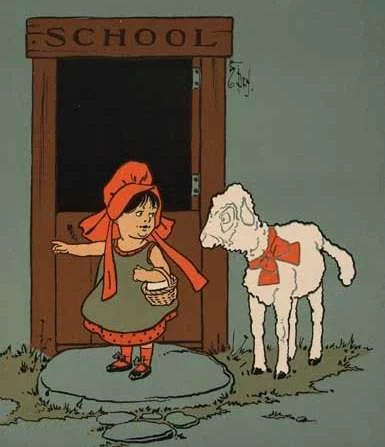
The most famous moment in Mary Sawyer’s life occurred when her lamb followed her to school, an event that was both amusing and disruptive. On that morning, Mary left her family farm for the local schoolhouse, unaware that the lamb was trailing behind her. Given the animal’s attachment to her, this behavior was entirely natural, though highly unusual in a classroom setting.
When the lamb entered the schoolhouse, it caused immediate distraction. Classmates laughed, whispered, and stared, while the teacher struggled to maintain order. Schools of the time were strict environments, emphasizing discipline and obedience. Animals had no place in the classroom, and the lamb’s presence was seen as a breach of decorum, however charming it appeared.
Mary was reportedly embarrassed rather than delighted. She had not intended to cause trouble and was distressed by the attention. Eventually, the lamb was escorted outside, restoring order to the classroom. Yet the incident lingered in memory, precisely because it disrupted the rigid expectations of school life with a moment of warmth and innocence.
What transformed this local curiosity into a cultural phenomenon was the presence of an observer who recognized its narrative power. The image of a loyal lamb following a child into a place of learning resonated deeply with nineteenth-century ideals of purity, affection, and moral instruction. It was a scene that begged to be preserved, not as a report, but as a story.
From Classroom Incident to Famous Verse
The classroom episode might have faded into local folklore had it not been for the involvement of Sarah Josepha Hale, a prominent writer and editor of the time. Hale was known for her interest in moral education and children’s literature. Upon hearing the story of Mary and her lamb, she recognized its potential as a teaching tool wrapped in gentle verse.
Hale wrote the poem that would become “Mary Had a Little Lamb,” publishing it in the early nineteenth century. The poem emphasized the lamb’s loyalty and Mary’s kindness, transforming a spontaneous event into a moral lesson about love and responsibility. Importantly, Hale did not invent the story from whole cloth; she shaped an existing incident into a literary form that could be easily remembered and shared.
The poem spread rapidly, appearing in schoolbooks and children’s collections. Its simple language made it accessible to young readers, while its imagery reinforced values that educators and parents prized. Over time, the rhyme became so familiar that its origins were forgotten, and Mary herself faded into obscurity.
This erasure of the real person behind the poem is not unusual. Many historical figures, especially children and women, were absorbed into legend without credit. In Mary Sawyer’s case, the poem’s fame eventually overshadowed her identity. Yet local histories preserved her name, ensuring that the story could later be reclaimed as more than just a rhyme.
The Lamb, the Wool, and the Church Fundraiser
One of the least-known but most revealing chapters of Mary Sawyer’s story occurred decades later. In the late 1860s, long after the poem had become famous, Mary was involved in raising funds for an old church in her community. Rather than relying on donations alone, she turned once again to the lamb that had defined her childhood.
Mary sold wool from the lamb, using it to generate income for the church. This act connected the poetic image of the lamb to its practical reality as a source of wool, grounding the sentimental story in the economic life of rural New England. It also demonstrated Mary’s continued sense of responsibility toward both her community and the animal that had brought her unexpected fame.
The fundraiser attracted attention precisely because of the poem’s popularity. People were intrigued by the idea that the lamb from the famous rhyme had been real and that its wool was now supporting a religious institution. This blending of folklore, faith, and community service resonated strongly in a society that valued moral continuity.
Mary’s involvement in the fundraiser also suggests that she embraced her connection to the story rather than resenting it. By leveraging the lamb’s legacy for a charitable cause, she reclaimed agency over a narrative that had largely escaped her control. The lamb was no longer just a symbol in a poem; it was part of a living history that continued to shape her community.
Separating Myth from Historical Reality
Over time, the story of Mary and her lamb accumulated embellishments. Some accounts incorrectly placed Mary in Boston rather than rural Massachusetts, while others altered her age or the circumstances of the school incident. These distortions highlight how easily history can blur when filtered through popular culture.
Primary sources and local records, however, confirm key elements of the story. Mary Sawyer was real. The lamb existed. The school incident occurred. The church fundraiser took place. While certain details may have been romanticized, the core narrative remains intact. This balance between fact and embellishment is common in stories that transition from lived experience to cultural myth.
Understanding this distinction enriches rather than diminishes the rhyme. Knowing that Mary was a real child living in a specific historical context adds depth to the verse. It transforms a nursery rhyme into a fragment of social history, reflecting how children, animals, education, and religion intersected in nineteenth-century America.
The persistence of inaccurate details, such as the claim that Mary lived in Boston, also reveals how audiences reshape stories to fit familiar settings. Boston, as a major cultural center, feels more plausible to many listeners than a small farming town. Yet the truth is more instructive. The rhyme emerged not from urban sophistication, but from rural life and ordinary experience.
Why the Story Endured for Generations
The enduring appeal of “Mary Had a Little Lamb” lies in its emotional clarity. The story captures a universal experience: the bond between a child and an animal. This relationship transcends time, culture, and geography. Whether in a nineteenth-century farm community or a modern household, the affection between child and pet remains instantly recognizable.
The story also aligns neatly with educational values. The lamb’s loyalty mirrors the ideal behavior of a student, following Mary to school and remaining attentive. Teachers and parents found in the rhyme a gentle way to discuss obedience, kindness, and empathy without resorting to punishment or fear.
Mary Sawyer’s real-life actions later reinforced these themes. Her decision to use the lamb’s wool to support a church reflects continuity between childhood innocence and adult responsibility. This arc gives the story moral weight that goes beyond sentimentality.
Finally, the rhyme’s simplicity ensured its survival. Short, rhythmic, and easy to memorize, it passed effortlessly from generation to generation. Yet beneath that simplicity lies a layered history that connects literature, education, religion, and community life. That depth is why the story continues to invite rediscovery rather than fading into irrelevance.
A Real Child Behind a Timeless Rhyme
The revelation that Mary indeed had a little lamb does more than satisfy curiosity. It reminds us that many cultural artifacts originate in real lives shaped by ordinary circumstances. Mary Sawyer was not a symbol or an invention; she was an eleven-year-old girl whose compassion for an orphaned lamb created a moment that resonated far beyond her small community.
Her story bridges the gap between history and imagination. The lamb that followed her to school became a literary icon, while the wool she later sold supported a struggling church. These details anchor the rhyme in lived experience, enriching its meaning rather than diminishing its charm.
In recognizing Mary Sawyer as a historical figure, we restore agency and humanity to a story long treated as anonymous folklore. The rhyme endures not because it is fictional, but because it is true in the ways that matter most: it reflects real affection, real community, and real memory.
Research and further reading
For readers who want to verify details or continue researching this subject, these external reference collections provide useful starting points: