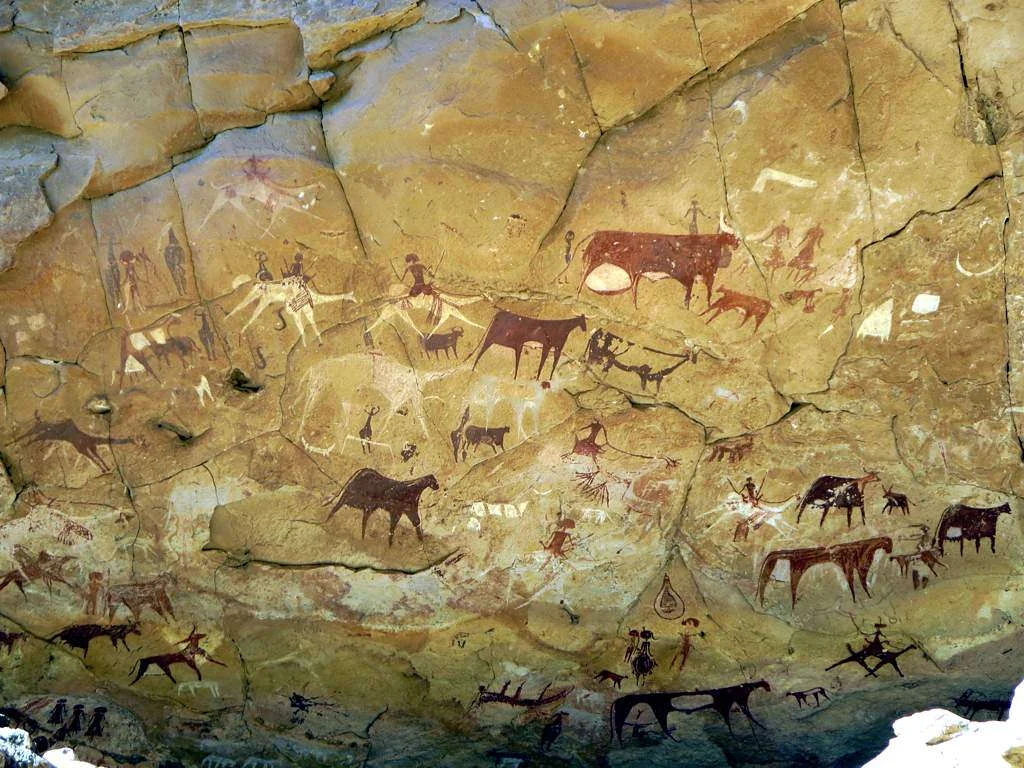
Sahara Desert is today synonymous with endless dunes, searing heat, and near-total absence of life. It is one of the harshest environments on Earth, a place where survival itself feels improbable. Yet this familiar image hides a deep and astonishing past. Around 100 million years ago, during the height of the age of dinosaurs, the Sahara bore no resemblance to the desert we know today. Instead, it was a vast, green landscape filled with rivers, floodplains, dense vegetation, and an extraordinary abundance of life. Towering dinosaurs roamed its plains, enormous fish filled its waterways, and some of the most fearsome predators ever known ruled both land and water.
Among these predators was a group of crocodiles unlike anything alive today. These were not the sluggish, semi-aquatic ambush hunters we associate with modern crocodilians. Some species possessed long, powerful legs built for life on land, capable of lifting their bodies high off the ground and moving with startling speed. Fossil evidence suggests that certain species could even gallop, using bounding movements similar to mammals. This shocking revelation rewrote what scientists thought they knew about crocodile evolution and painted a vivid picture of a prehistoric Sahara that was dynamic, violent, and teeming with competition.
The Sahara Before the Sands: A Lost World of Rivers and Forests
To understand how galloping crocodiles could exist in the Sahara, one must first discard the modern image of the desert entirely. One hundred million years ago, the region sat closer to the equator and experienced a warm, humid climate shaped by different atmospheric and oceanic circulation patterns. Instead of sand seas, the landscape was carved by massive river systems that rivaled today’s Amazon in scale. These rivers flooded seasonally, creating lush wetlands, forests, and grassy plains that supported an enormous variety of plants and animals.
Fossilized pollen, ancient soils, and sedimentary rock layers reveal a world dominated by cycads, ferns, and early flowering plants. These plants formed dense habitats that offered food and shelter to herbivorous dinosaurs, which in turn attracted large carnivores. Fish grew to gigantic sizes in the rivers, some exceeding six meters in length, while turtles with car-sized shells basked along the banks. This abundance of prey created ideal conditions for predators to diversify into many ecological niches.
Crocodilians were among the most successful of these predators. Unlike their modern descendants, many ancient crocodiles were not restricted to water. Evolution pushed them in multiple directions, producing species adapted for fish-eating, dinosaur-hunting, scavenging, and even fully terrestrial lifestyles. In this environment, competition was fierce, and the ability to move quickly across land could mean the difference between securing a meal and starving. The Sahara was not a marginal habitat where animals barely survived; it was a biological hotspot where evolution experimented boldly, producing creatures that now seem almost unbelievable.
The Evolution of Land-Running Crocodiles
Modern crocodiles appear clumsy on land, but this impression is misleading. Even today, crocodilians are capable of a “high walk,” lifting their bodies off the ground and moving with surprising agility. Some can even perform brief galloping motions. Fossil evidence suggests that their prehistoric relatives took these abilities much further. Around 100 million years ago, certain crocodile lineages evolved long, muscular limbs positioned more vertically beneath their bodies, a configuration better suited for sustained movement on land.
These adaptations did not happen by accident. In a predator-rich ecosystem like the ancient Sahara, crocodiles faced intense competition from large theropod dinosaurs. To survive, some species abandoned a purely aquatic lifestyle and became fast-moving terrestrial hunters. Their skeletons reveal lighter builds, flexible spines, and joint structures that allowed for bounding strides. Rather than dragging their bellies through mud, these crocodiles could raise themselves high and cover ground rapidly, potentially reaching speeds that would have shocked any modern observer.
This evolutionary path challenges the outdated notion that crocodiles are “living fossils” that have remained unchanged for millions of years. In reality, crocodilians were once among the most diverse and adaptable reptile groups on the planet. The galloping crocodiles of the Sahara represent a peak of this experimentation, showing how environmental pressures can transform even the most familiar animal body plans into something radically different. They were not evolutionary dead ends but successful predators finely tuned to their world.
The 2009 Fossil Discovery That Changed Everything
For decades, scientists suspected that unusual crocodiles once lived in Africa, but definitive proof remained elusive. That changed in 2009, when fossil hunters working in the Sahara uncovered remarkably well-preserved crocodilian remains. These fossils included limb bones, vertebrae, and skull fragments that clearly did not match any known modern crocodile anatomy. The legs were especially revealing: long, slender, and built for bearing weight on land rather than paddling through water.
Detailed analysis confirmed that these animals belonged to a group of terrestrial crocodiles that lived during the mid-Cretaceous period. The structure of their joints suggested a range of motion far greater than that of modern species. Their hips and shoulders allowed for powerful strides, while the curvature of their spines indicated flexibility necessary for galloping. This was not speculation based on artistic imagination but a conclusion drawn directly from anatomy preserved in stone.
The discovery sent ripples through the paleontological community. It forced researchers to reconsider long-held assumptions about crocodile behavior and ecology. These animals were no longer seen as evolutionary side notes but as central players in prehistoric ecosystems. Media coverage captured the public’s imagination, painting vivid pictures of crocodiles sprinting across ancient floodplains in pursuit of prey. While the term “breakneck speeds” is a colorful exaggeration, there is little doubt that these animals were far faster and more agile than any crocodile alive today.
Life and Death in a Predator-Dominated Ecosystem
The ancient Sahara was not merely lush; it was brutally competitive. Large predators were everywhere, and survival demanded constant adaptation. Galloping crocodiles likely occupied a unique ecological role, hunting along riverbanks, open plains, and forest edges where dinosaurs and other animals gathered to drink. Their speed allowed them to exploit opportunities unavailable to slower, ambush-based crocodiles.
These crocodiles may have hunted small to medium-sized dinosaurs, juvenile individuals, or other reptiles, using speed and surprise rather than brute force alone. Their teeth, often laterally compressed and serrated, suggest a diet that included flesh rather than just fish. At the same time, they themselves were prey for larger predators, including massive theropods that dominated the region. Life was a constant arms race, with each species evolving new strategies to gain an edge.
This intense pressure created an ecosystem where no single predator reigned supreme. Instead, dominance shifted depending on environment, season, and circumstance. During floods, aquatic hunters held the advantage; during dry periods, fast land predators like terrestrial crocodiles thrived. The Sahara was a mosaic of habitats, and its inhabitants moved fluidly between them. This dynamic balance explains why such unusual animals could evolve and flourish, even if only for a few million years.
Why the Galloping Crocodiles Disappeared
Despite their impressive adaptations, galloping crocodiles did not survive indefinitely. Gradual but profound environmental changes reshaped Africa over millions of years. Shifting tectonic plates altered ocean currents, which in turn transformed climate patterns. Rainfall decreased, river systems shrank, and lush landscapes slowly gave way to drier conditions. As water became scarce, the ecological niches that supported large terrestrial crocodiles began to vanish.
At the same time, competition intensified. Dinosaurs continued to evolve, producing faster and more specialized predators. Mammals, though still small at the time, were beginning their own evolutionary ascent. The highly specialized nature of terrestrial crocodiles may have worked against them, making it difficult to adapt once their preferred habitats disappeared. By the end of the Cretaceous, most of these land-dwelling crocodilian lineages had vanished.
Modern crocodiles represent a different survival strategy. By returning to a semi-aquatic lifestyle, they found a stable niche that allowed them to endure dramatic global changes, including mass extinctions. The loss of galloping crocodiles was not a failure but a natural outcome of environmental transformation. Their fossils serve as reminders that evolution is not a straight line toward perfection but a branching path filled with remarkable experiments, many of which are lost to time.
What These Crocodiles Teach Us About Earth’s Deep Past
The story of galloping crocodiles in the Sahara is more than a curiosity; it is a powerful lesson about Earth’s capacity for change. Landscapes we consider permanent are anything but. Deserts can become forests, rivers can vanish, and animals we view as immutable can once have been radically different. This deep-time perspective is essential for understanding both the past and the future of our planet.
These discoveries also highlight the importance of continued fossil exploration. Vast regions of the Sahara remain unexplored, and each expedition has the potential to uncover species that challenge existing theories. Galloping crocodiles remind us that science advances not only through new technologies but through the willingness to question assumptions. What seems impossible today may simply be a truth we have not yet uncovered.
In the end, imagining crocodiles racing across a green Sahara forces us to rethink our relationship with time. Human history spans only a blink of geological existence, yet the planet has hosted worlds more alien and dramatic than any science fiction. The fossils buried beneath the desert sands tell stories of resilience, adaptation, and loss, offering a humbling reminder that Earth’s history is far richer and stranger than we often assume.