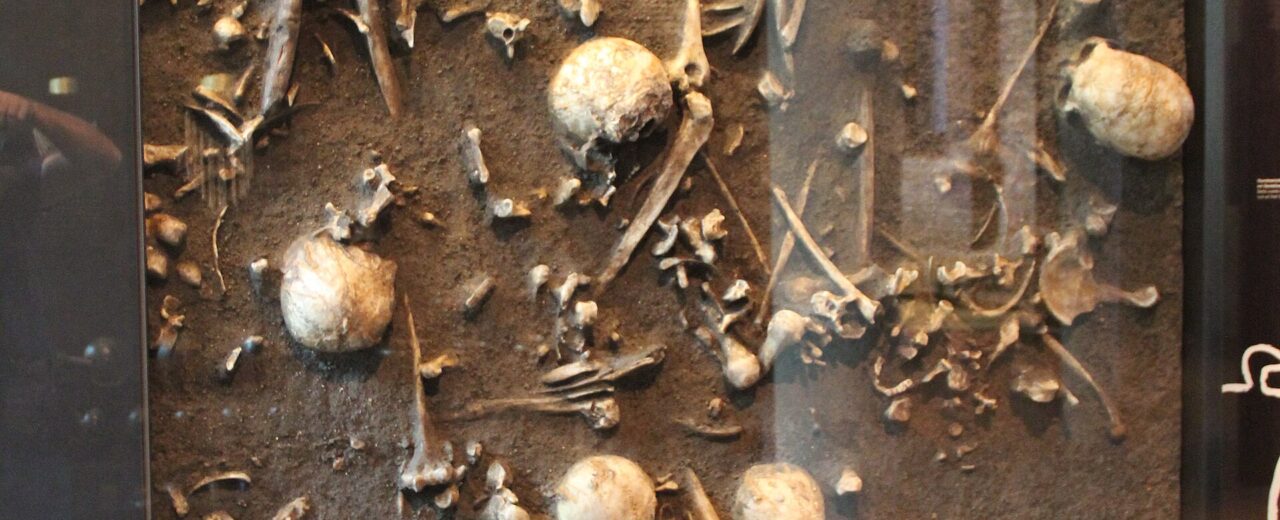
Tollense Valley battlefield is a revealing historical subject because it opens a clear path into the people, events, and wider changes that shaped its era.
For centuries, prehistoric Europe was often imagined as a world of scattered farming communities, local rivalries, and occasional skirmishes rather than large-scale organized warfare. That picture began to change in a striking way in 1996, when a chance discovery in northern Germany’s Tollense Valley opened a window onto a violent event that had been hidden in the landscape for more than 3,000 years. What archaeologists eventually uncovered was not a small burial ground or a lone tragedy, but the remnants of what is now widely regarded as Europe’s oldest known battlefield.
The Tollense Valley battlefield has become one of the most important archaeology discoveries in recent decades because it challenges assumptions about the Bronze Age in northern Europe. The site is remarkable not only for its scale, but for what it reveals about mobility, social organization, and the capacity for warfare in a period long thought to be far less complex than later ancient civilizations. The bones, weapons, and artifacts recovered from the valley suggest a conflict that involved many people, possibly including fighters from far beyond the local region.
In archaeology, extraordinary discoveries often begin with ordinary moments. A stray object in a field, an unusual concentration of bones, or erosion along a riverbank can all hint at a past no one expected. The Tollense Valley is a powerful reminder that history is not always preserved in texts or monuments. Sometimes it survives in the soil, waiting for a careful eye and a bit of luck to bring it back into view.
The accidental discovery that changed Bronze Age history
The story of the Tollense Valley battlefield began in 1996, when a hobby archaeologist found a human arm bone near the Tollense River in Mecklenburg-Western Pomerania, in northern Germany. At first, such a find might have seemed isolated, perhaps the disturbed remains of a burial or an accidental loss in later centuries. But as more material came to light, the pattern became impossible to ignore. Additional human bones, horse remains, bronze objects, and weapon fragments appeared along the river corridor, suggesting a much larger and more complex deposit.
What made the discovery so important was not just the presence of human remains, but their context. These were not neatly arranged burials. They were scattered in a landscape where waterlogged soils had helped preserve organic material that would normally decay. Over time, archaeologists realized they were looking at the aftermath of a violent event that unfolded along a strategic route through the valley. The location mattered: river crossings and narrow corridors could become chokepoints where groups met, clashed, and suffered heavy losses.
By the early 2000s, systematic excavations confirmed that the site represented a battlefield from the Bronze Age, dated to around the 13th century BCE. That dating places it in a period when metal weapons, expanding exchange networks, and increasingly hierarchical societies were transforming parts of Europe. In the public imagination, this era can seem remote and vaguely peaceful compared with the kingdoms and empires of the Mediterranean. Tollense shattered that simplification. The battlefield showed that organized violence on a significant scale was not confined to literate states.
The discovery also illustrates how archaeology works as a discipline. A major historical revelation did not emerge from a single object alone, but from years of patient excavation, survey, scientific analysis, and interpretation. In that sense, Tollense belongs in the same category as other finds that transformed historical understanding, whether it is the rediscovery of Girsu or the unsettling evidence preserved in the body of Lindow Man. Each discovery forces us to rethink the people who came before us, often in ways that are more complex and more dramatic than expected.
What archaeologists found in the Tollense Valley
The Tollense Valley battlefield is extraordinary because it contains many kinds of evidence from the same catastrophic event. Thousands of human bones and bone fragments have been recovered, representing a minimum of many dozens of individuals and likely far more. The remains show signs of trauma, including injuries consistent with blunt force, piercing weapons, and violent impact. Some bones carry unmistakable traces of battle damage, offering rare physical proof of combat in prehistoric Europe.
Alongside the human remains were weapons and tools associated with Bronze Age conflict. Archaeologists found arrowheads, spear points, and fragments of equipment that point to a coordinated struggle rather than a simple ambush by a few raiders. The river and surrounding wetlands also preserved organic clues that are seldom available on dry sites. Wooden objects, plant remains, and the arrangement of finds helped researchers reconstruct the environment in which the fighting took place. A battlefield is not just where people died; it is where geography shaped movement, visibility, and survival.
The preservation conditions in the valley made Tollense especially valuable to archaeologists. In many parts of Europe, Bronze Age violence is hard to study because skeletons have been disturbed, cremated, or poorly preserved. Here, however, the waterlogged landscape acted almost like a time capsule. As a result, investigators could study injuries, ages, and patterns of destruction in unusual detail. The evidence suggests that the dead were not all local inhabitants, and the mixture of artifacts points to a more complicated social world than a simple village dispute.
That complexity is one reason Tollense has generated so much interest beyond academic archaeology. It is not merely a battlefield; it is a rare case where the material record captures an event, a place, and a moment of human catastrophe. Each bone and arrowhead contributes to a story that is both specific and broadly transformative. The site demonstrates how archaeology can reveal a past that written sources never recorded. In that sense, the Tollense battlefield is as much about discovery as it is about conflict.
How science rebuilt the battle step by step
Once researchers recognized the significance of the Tollense Valley, scientific analysis became essential to understanding what had happened there. Radiocarbon dating placed the event in the late Bronze Age, around the 13th century BCE, making it astonishingly old for a battlefield of such scale. From there, osteological studies began to identify the injuries, estimating the age and sex of the dead and examining whether the remains belonged to local people or outsiders. The picture that emerged was of a large and violent confrontation, not a single burial episode or a ritual deposit.
One of the most important insights came from the study of arrowheads. According to newer research highlighted in recent reporting, the shape and construction of some of these projectile points suggest connections to regions beyond northern Germany. That matters because it raises the possibility that the combatants did not all come from one local community. Instead, the battlefield may have involved fighters traveling long distances, whether as mercenaries, allies, raiders, or participants in wider networks of political competition. This is a crucial clue for understanding Bronze Age mobility. People, weapons, and ideas were moving across Europe far more than older models often allowed.
Isotope analysis has also helped archaeologists investigate origins and movement. Different regions leave different chemical signatures in teeth and bones, allowing researchers to compare where a person may have grown up with where they died. Findings from Tollense have encouraged the view that the battlefield drew in people from diverse backgrounds. If true, that makes the valley not just the site of a local conflict but a crossroads of Bronze Age interaction.
The battle’s scale may have been substantial enough to involve several hundred fighters, though the exact size remains debated. What is clear is that this was not a small family feud or a brief roadside ambush. It was an organized, lethal confrontation with enough participants to leave an archaeological footprint that can still be traced millennia later. Science did not merely confirm an event; it reconstructed a hidden chapter of European prehistory from scattered fragments, proving once again that archaeology can recover history where texts never existed.
What the battlefield reveals about Bronze Age Europe
The Tollense Valley battlefield forces historians to rethink the Bronze Age as a period of surprising social and military complexity. For a long time, northern Europe was often portrayed as a landscape of relatively small communities that rarely engaged in anything resembling large-scale warfare. The evidence from Tollense does not support that simplistic image. Instead, it suggests that societies in the region had the organizational capacity to gather fighters, move them over distance, and sustain a conflict substantial enough to leave hundreds of dead.
This has major implications for how we understand power in prehistoric Europe. Warfare is rarely just about violence. It also reflects leadership, alliance building, resource competition, and control of movement. A river crossing like the one at Tollense could matter enormously if it sat on a route connecting communities, trade networks, or politically important territories. If people were fighting there, they may have been contesting access, influence, or prestige as much as land itself.
The site also points to a world of mobility that is easy to underestimate. Bronze Age Europe was not isolated. Metal objects, raw materials, styles of weaponry, and perhaps even people moved across broad regions. The arrowheads from Tollense hint at these connections in a tangible way. If some combatants came from far away, then the battlefield becomes evidence of communication networks and political relationships that stretched across large distances. That is a far cry from the old image of prehistoric communities as static and inward-looking.
Perhaps most importantly, Tollense reminds us that archaeology can overturn long-held assumptions about the past. A single discovery can redraw entire maps of historical possibility. Just as the study of unexpected remains has transformed how we think about ritual, death, and identity in other contexts, the Tollense Valley battlefield has changed the conversation about warfare in prehistoric Europe. It has shown that organized conflict, strategic movement, and interregional contacts were already shaping lives thousands of years before classical antiquity.
Why Tollense still matters to archaeology and public history
The significance of the Tollense Valley battlefield extends far beyond the Bronze Age. It matters because it shows how chance discovery and careful research can work together to transform historical understanding. A bone found by accident in 1996 led to one of the most important archaeology investigations in Europe, proving that landscapes still hold secrets capable of rewriting the past. In a field built on fragments, patience and curiosity are often as important as technology.
Tollense also matters because it broadens public awareness of what archaeology can reveal. Many people think of archaeology as the study of tombs, temples, or treasure, but the discipline is equally capable of uncovering violence, migration, and social complexity. The battlefield is a vivid example of how scientific methods—excavation, dating, isotopic analysis, and artifact study—can reconstruct events that no written chronicle ever recorded. It is a reminder that the prehistoric world was not simple, quiet, or provincial. It was dynamic, connected, and at times brutally contested.
There is also an emotional dimension to the site. The Tollense Valley battlefield is a place where human lives ended violently in a moment long forgotten by history. Archaeology restores a degree of presence to those people, even if their names are lost. Their bones, injuries, and belongings allow us to sense the scale of the event and the reality of ancient suffering. That is part of why the site remains a subject of study not just scholars, but anyone interested in the human story behind the evidence.
As new findings continue to emerge, including evidence from arrowheads and other material remains, Tollense will likely remain central to discussions of Europe’s earliest large-scale warfare. It stands as a landmark discovery in the archaeology of conflict and as a powerful example of how much can be learned from a landscape that once seemed ordinary. The valley in northern Germany has become a place where the hidden history of Europe speaks clearly. What began as a chance find has become a lasting reminder that even the oldest battlefields can still change how we see the past.
Research and further reading
For readers who want to verify details or continue researching this subject, these external reference collections provide useful starting points: