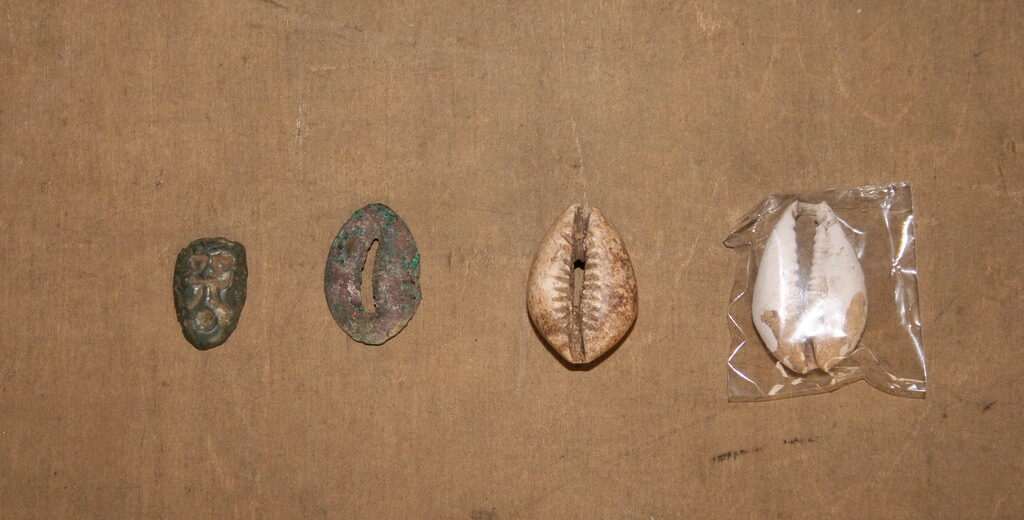
cowrie shell money is a revealing historical subject because it opens a clear path into the people, events, and wider changes that shaped its era.
For thousands of years, people have searched for forms of money that could be trusted, carried, counted, and exchanged across distance. Long before paper notes, bank accounts, or digital payments, one of the world’s most remarkable currencies was small enough to fit in a palm: the cowrie shell. Smooth, durable, and unmistakable in shape, cowries became much more than ornamental objects. They moved from ritual and prestige into the practical world of buying, selling, taxing, and paying wages. In the process, they helped create one of history’s most unusual global shell-money economies.
The story of cowrie shells is not just about a curious kind of money. It is about the economics of scarcity and abundance, the power of trade routes, and the way trust can turn a natural object into an accepted medium of exchange. Cowries were prized in parts of Asia and Africa because they were portable, divisible, relatively uniform, and difficult to counterfeit in the same way as hand-struck metal coins. Yet their value was never purely “natural.” It depended on where they came from, who controlled their supply, and how far they had to travel before reaching the people who used them. That made them ideal for a world of merchants, empires, and intermediaries.
As global commerce expanded, especially across the Indian Ocean and later through European maritime networks, cowries were harvested in enormous quantities, shipped across seas, and redistributed far from their source. Their journey reveals how money can be manufactured by trade itself. It also shows how colonial expansion could destabilize older economic systems by flooding markets with currency and changing the rules of value. The rise and eventual decline of cowrie money is therefore a vivid chapter in economic history: a reminder that money is never just metal, paper, or shell, but a social agreement shaped by power.
From sacred object to everyday money
Before cowrie shells became a global commodity, they occupied a world of symbolic value. Their glossy surfaces, natural symmetry, and closed shape made them attractive as ornaments and ritual items in many coastal and inland societies. In some communities they were associated with fertility, protection, and status. That early prestige mattered, because objects that signal rarity and beauty often become candidates for exchange. When an item is admired and limited in supply, people begin to attach value to it beyond its immediate practical use. Over time, that value can harden into a monetary role.
Cowries were particularly well suited to this transformation. Unlike bulky commodities, they were easy to carry in strings or bags. Unlike many forms of tribute or barter goods, they could be counted precisely. Their similar size encouraged standardization, which is one of the quiet foundations of monetary systems. A shell that is accepted today because it is accepted tomorrow by someone else has entered the logic of money. This trust-based quality is why cowrie shells could travel from adornment to accounting.
In parts of Asia, cowrie money was especially important because small transactions required a medium finer than large silver or gold units. Everyday trade needed change. A farmer buying salt, a household paying a tax, or a laborer receiving small wages required currency that could be divided without awkwardly splitting a precious metal coin. Cowries filled that gap. In this sense, they were not a primitive substitute for “real” money; they were a practical answer to a specific problem of exchange. Economic history often shows that so-called simple currencies survive because they solve real market needs better than more prestigious alternatives.
The transition from prestige object to money also reveals a deeper truth: value becomes stable when enough people agree to use the same thing for repeated exchange. Cowries acquired that stability because they sat at the intersection of culture and commerce. They were beautiful enough to inspire trust, but common enough in trade networks to be convenient. That combination allowed them to become more than decoration. They became a language of payment.
The Indian Ocean and the making of a shell-money network
The Indian Ocean world was one of the great highways of premodern commerce, linking East Africa, Arabia, South Asia, and beyond. Cowrie shells thrived in this maritime environment because their natural habitat was concentrated in the Maldives, where they could be collected in enormous numbers. From there, they moved outward along merchant routes, carried by sailors and traders who understood both the demand for small change and the profit to be made from transport and resale. The farther the shells traveled from their source, the more valuable they could become.
This is one of the most important economic facts about cowrie money: its value depended on geography. A shell gathered in the Maldives had one price near the source and another in distant markets where supply was less direct. Transport costs, merchant markups, and control over routes all shaped the final price. In that sense, cowries behaved like many commodities, but with a twist. Their usefulness as money meant they were not only bought and sold; they were also used to measure value in the markets they entered. Once accepted, they became part of the very infrastructure of exchange.
Indian Ocean merchants helped normalize this system by moving cowries alongside cloth, beads, spices, and metals. In some regions, rulers and traders preferred cowries for local taxes and everyday payments because they could circulate in large quantities and support the small transactions that grand silver currencies could not handle efficiently. The shell-money economy was therefore not a fringe phenomenon. It was part of a sophisticated commercial world in which multiple forms of money coexisted, each serving different purposes.
The cowrie trade also demonstrates a central theme in economic history: money does not simply emerge from state decree. It can grow through merchant practice, repeated use, and network effects. A shell could become currency because enough people believed others would accept it. That belief was reinforced by trade routes, political authority, and the steady flow of shells across oceans. Cowries were thus both a product and a tool of globalization long before that word existed.
West Africa and the power of portable currency
If the Indian Ocean gave cowries their long-distance commercial life, West Africa gave them some of their most consequential monetary roles. By the early modern period, cowrie shells circulated widely in many West African economies, where they became essential for market exchange, taxes, bridewealth, and other payments. Their appeal lay in the same qualities that made them valuable elsewhere: they were portable, easy to count, and useful in daily transactions. But in West Africa, cowries became more than a convenience. They became embedded in statecraft, regional trade, and social life.
The use of shell money in West Africa cannot be understood without recognizing local economic sophistication. Societies across the region already had systems of exchange that balanced commodity trade, credit, and social obligation. Cowries entered this landscape not as an alien invention but as a flexible medium that fit existing needs. They were especially useful in markets where small denominations mattered. A currency that could pay for food, cloth, or services in modest increments gave traders and households practical precision.
As demand increased, so did the scale of supply. European merchants became significant distributors of cowries, not because they invented shell money, but because they recognized its commercial power. By transporting large quantities from Indian Ocean source areas to West African ports, they inserted themselves into an already functioning monetary system and profited from the spread. This redistribution was not neutral. It altered prices, expanded circulation, and tied local economies more tightly to Atlantic trade. In effect, cowries became one of the hidden engines of early globalization.
The consequences were profound. In some places, cowries supported trade and helped standardize small exchange. In others, they became entangled with coercive systems, including taxation and the slave trade. Money always reflects the society that uses it, and shell money was no exception. The same shells that enabled market life could also be drawn into extractive imperial economies. That complexity is part of what makes cowrie history so important to economic historians. It shows how a currency can empower exchange while also being woven into structures of domination. For readers interested in similar private and coercive currency systems, it is worth comparing this history with company scrip: the private money that trapped workers, another case where money shaped power relationships in daily life.
How Europeans turned shells into a global commodity
European expansion transformed cowries from a regional or interregional currency into a globalized commodity. Once merchants understood that cowrie shells could function as money in African markets, they began to move them in vast quantities. This did not require Europeans to control the cultural meaning of the shells. It required only control over shipping, access to supply chains, and the ability to exploit price differences between source and destination. In that sense, the cowrie trade is a textbook example of arbitrage in the age of sail.
The scale of redistribution became immense. Cowries were gathered in the Indian Ocean, shipped to European trading centers, then sent onward to African ports. Their circulation was accelerated by commercial competition among empires and trading companies that saw advantage in supplying a currency in high demand. When shells are cheap at the source and essential at the destination, the profit lies in logistics. That is what made the cowrie trade so attractive to merchants with ships, warehouses, and political backing.
This process also reveals how global markets can reshape the value of ordinary objects. A shell’s worth was not fixed by nature; it was created by the distance it traveled and the labor involved in moving it. The same object that might have been abundant near the Maldives could become a powerful monetary instrument thousands of miles away. Its value increased because access was controlled. Scarcity, in this context, was not simply about nature. It was about trade management.
The European role in cowrie distribution also had consequences for knowledge and power. Merchants and colonial administrators studied local monetary practices because they needed to understand how to profit from them. In doing so, they documented and often distorted African economies through the lens of imperial interests. Yet their involvement did not erase indigenous monetary systems; rather, it interacted with them, sometimes strengthening circulation, sometimes destabilizing it. Cowries were global because they moved through many hands, but they were never neutral. They were embedded in the politics of empire, a theme that also appears in other commodity booms such as the guano trade: and the fertilizer boom, where distant demand and extraction reshaped entire economies.
Inflation, colonial reform, and the end of shell money’s dominance
Like all currencies, cowrie shells eventually faced the problem of changing economic conditions. Their very success could undermine them. Once shells were imported in larger and larger quantities, their scarcity diminished, and with it their purchasing power. Inflation in shell-money economies was not merely a matter of too many units chasing too few goods; it was also tied to the political economy of colonial trade. When foreign merchants could flood a region with shells, they gained influence over local prices and exchange relationships.
Colonial administrations often pushed formal monetary reforms that privileged coinage, paper currency, and later bank-based systems over shell money. These reforms were presented as modernization, but they also served imperial control. Standardized state money made taxation, wage labor, and trade easier to regulate from the colonial center. Cowries, by contrast, represented an older, decentralized monetary order that was harder to govern in the same way. Replacing shells with official currency was therefore not only an economic change but also a political one.
Still, the decline of cowrie money was not immediate or uniform. In many places shells continued to circulate alongside other currencies for a long time. People do not abandon money just because officials declare a reform. They change habits when the new system proves more useful, more stable, or more enforceable than the old one. As metal coinage and paper currencies expanded, cowries became less competitive for large and medium transactions. They were sometimes pushed into narrow rural uses or phased out under inflationary pressure. Once their supply became too abundant relative to demand, their old advantages weakened.
The broader lesson is that currency systems live or die by trust, scarcity, and institutional support. Cowries had all three at different moments in history. They flourished when supply was controlled, networks were strong, and users believed the shells would be accepted. They declined when colonial imports, monetary reform, and inflation altered those conditions. Their history is a powerful reminder that money is never merely technical. It is a social arrangement shaped by trade routes, state power, and the constant negotiation of value. In that respect, cowrie shells belong to the same long history that includes other forms of controlling exchange and labor, even in later periods of private currency and dependence.
What makes the cowrie shell story so compelling is that it brings together the local and the global, the humble and the imperial, the practical and the symbolic. A small shell from the sea became a unit of account, a store of value, and a tool of power across continents. It helped people buy food, settle debts, and pay obligations, but it also moved through empires and commercial empires that used money to organize inequality. The rise of a global shell-money economy reminds us that economic history is not only about banks and bullion. Sometimes it is about the smallest objects carrying the largest consequences.
Research and further reading
For readers who want to verify details or continue researching this subject, these external reference collections provide useful starting points: