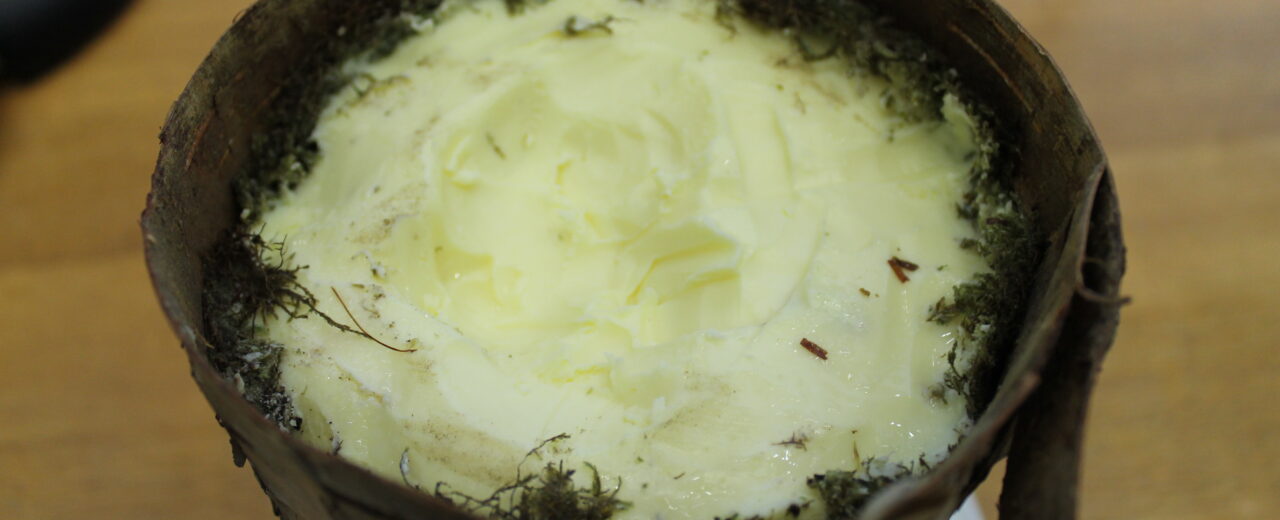
In the Irish countryside, beneath waterlogged peat and layers of dark, compressed earth, archaeologists have found an unexpectedly rich kind of time capsule: butter and animal fat sealed away for months, years, or even centuries. These finds are known as bog butter, and they have long fascinated historians because they sit at the crossroads of food, storage, wealth, and survival. At first glance the practice can seem strange, even mystical. Why would anyone bury valuable dairy products in a bog? Yet when viewed through the lens of economic history, the answer becomes clearer. Bog butter reveals how rural households managed surplus, protected perishable goods, and navigated uncertainty in a world where refrigeration did not exist and where wealth was often measured in livestock, dairy, and the ability to keep them safe.
Far from being a quirky footnote, bog butter opens a window onto the practical intelligence of past communities. It shows how people made use of the landscape not just for farming, but for storage, concealment, and perhaps ritual acts tied to status and belief. The deposits span a remarkably long period, from the early medieval era into more recent centuries, suggesting that the practice was not a one-time custom but part of a durable tradition of managing food value in rural Ireland. Some containers were simple and utilitarian, while others were carefully wrapped in bark, wood, or animal skin. The bog itself did the rest, preserving the contents in conditions that were cool, acidic, low in oxygen, and resistant to microbial decay.
Understanding bog butter means understanding an economy in which dairy was not merely a kitchen staple but a store of value. Butter could be eaten, traded, gifted, taxed, or hidden. It could represent household security in lean months and social standing in good ones. The bog, in this context, functioned as a kind of natural vault. This article explores what bog butter is, why Irish communities buried it, how the peat environment preserved it, and what these deposits tell us about the economics of everyday life in historical Ireland.
What bog butter actually is, and why it mattered economically
Bog butter is the modern name given to lumps or containers of dairy fat found buried in peat bogs, most famously in Ireland but also in parts of Britain and Scandinavia. In many cases the substance is butter; in others it is clarified fat, tallow-like material, or a dairy mixture that has changed over time. When recovered, it can be remarkably well preserved, sometimes retaining a pale color, a waxy texture, and a faint smell that alerts archaeologists to its origin. The term sounds playful, but the material itself belongs to the serious business of household economics. In preindustrial societies, butter was not a casual extra. It was a calorie-dense, storable, and high-value foodstuff produced from the labor of milking, churning, and managing livestock.
In agrarian Ireland, cows were central to wealth. Milk products could be consumed fresh, turned into butter or cheese, or rendered into fat for longer keeping. Because butter was portable and valuable, it functioned as more than food. It could be an asset. Households with surplus dairy had options: they could use it immediately, exchange it locally, present it as rent or tribute in some contexts, or protect it against spoilage and theft. The existence of bog butter suggests that storing value was as important as producing it. For a small farming household, the question was not only how to make butter, but how to keep it safe until it could be eaten, traded, or used in winter.
This is where bog butter becomes especially revealing for economic history. In a pre-refrigeration society, perishable wealth carried risk. If butter spoiled, the labor invested in its production was lost. If it was stolen, the household lost both food and future bargaining power. By placing butter in a bog, people could convert a fragile product into something protected by environment and time. The bog became a storage technology, one rooted in landscape rather than machinery. It is a reminder that older economies were ingenious in ways that do not always leave obvious traces in documents.
Why peat bogs were such effective storage spaces
Peat bogs are wet, acidic, and low in oxygen, which makes them surprisingly good at preserving organic material. Those same conditions that are so hostile to ordinary decay can protect wood, textiles, leather, hair, and food. In the case of bog butter, the bog slows the biological processes that would normally cause fats to go rancid or be consumed by bacteria. If the butter was placed in a container, wrapped well, and lowered into the right part of the bog, the environment could keep it intact for a very long time. The bog did not preserve it in a modern culinary sense, of course. Over time the taste and texture may change significantly. But from an archaeological perspective, the result can be extraordinary.
The practical choice of a bog also makes sense in relation to the Irish landscape. Peat bogs were widespread, familiar, and often available near rural settlements. They were not empty wastelands but working landscapes, used for cutting fuel, grazing animals around the edges, and moving through seasonal rhythms. Their remoteness could help conceal stored goods, and their cold, damp conditions could help protect them. In this way, the bog operated as a kind of natural pantry or vault. It was not safe because it was dry and sealed like a modern cellar, but because its chemistry and ecology worked against decay.
Scientific studies help explain why some buried fats survive so long. Research on ancient fatty materials has shown that peat environments can be especially effective in slowing decomposition and stabilizing organic compounds. The Museum of Archaeology in Dublin highlights bog butter as one of the striking examples of what Irish bogs can preserve, while modern analyses have shown that these finds can endure through complex interactions between fat composition, wrapping materials, and the bog environment itself. For economic history, this matters because preservation technologies shape behavior. When a landscape offers reliable storage conditions, households can manage surplus differently. They can postpone consumption, avoid immediate waste, and hold value across seasons. In that sense, the bog was part of the infrastructure of rural life.
Why Irish communities buried butter in the ground
There is no single agreed-upon answer to why people buried butter in bogs, and that uncertainty is part of what makes the topic so compelling. Historians and archaeologists generally consider three broad explanations: practical storage, protection from theft or spoilage, and ritual or symbolic offering. These explanations are not mutually exclusive. In many premodern societies, a practical act could also carry social or religious meaning. Still, economic logic sits at the center of the discussion. Butter represented concentrated value, and burying it may have been a sensible response to the challenges of holding that value safely over time.
One likely use was seasonal storage. Butter could be made in periods of abundance, then hidden away until food was scarcer or until a household needed a reserve for cooking and exchange. This fits well with a rural economy shaped by fluctuating production. Milk supply rises and falls across the year, and butter-making could transform a temporary surplus into a more durable asset. A family with no secure indoor storage, or one living in a setting where theft and spoilage were real concerns, might regard the bog as an ideal hiding place. In that sense, bog butter worked a bit like an emergency account, except that the vault was made of peat rather than metal.
There is also a social dimension. Dairy wealth in Ireland was tied to household status, labor organization, and land use. The ability to produce excess butter indicated control over cattle and grazing, and perhaps over labor as well. Buried butter may therefore represent surplus that was deliberately taken out of circulation. Sometimes valuable items are hidden not because they are unimportant, but because they are important enough to protect. The practice reminds us of other historical systems in which communities relied on unconventional stores of value and trust, whether through objects, shells, or specialized forms of payment such as company scrip. In each case, people adapted to constraints by creating practical solutions for managing worth.
Some bog butter may also have had a ritual function. Burying food in a boundary zone like a bog could have symbolized an offering, a request for protection, or a response to belief systems that linked land, fertility, and prosperity. The challenge for historians is that ritual and utility often overlap. A deposit may have been both a safeguarding measure and a meaningful act. That ambiguity is not a weakness in the evidence; it is a reminder that past economic behavior was shaped by culture as much as by calculation.
What archaeology has revealed about the age and spread of bog butter
Bog butter is not confined to a single historical moment. Finds have been recovered from a wide time span, with some examples dating back many centuries and others belonging to more recent periods. This broad chronology indicates that the practice was not just an isolated survival from a distant age, but a recurring habit in rural life. Archaeological evidence from Ireland has been especially important, and the National Museum of Ireland has identified bog butter among the notable discoveries that illuminate the country’s material past. In some cases, the containers are preserved as well as the contents, allowing researchers to study construction methods, wrapping materials, and placement.
The diversity of finds matters. Some bog butter deposits are large, weighing many kilograms, which suggests substantial surplus production and the ability to set aside a meaningful reserve. Others are smaller and may have been more personal or local in use. The form of the container can also reveal economic and technical choices. Bark buckets, wooden vessels, and wrapped packages all speak to the careful handling of a valuable commodity. When the packaging survives, it can indicate whether the butter was hidden quickly or prepared deliberately for long-term storage.
Modern scientific analysis has deepened the story. Recent research published in Scientific Reports has examined bog-buried fats and their preservation, helping explain why some samples survive so well and how their chemistry changes in the peat environment. This kind of work matters because it bridges archaeology and economic history. It shows that the material traces of old food practices are not random curiosities; they are evidence of organized behavior, technical knowledge, and environmental adaptation. Each find is a data point in a larger history of household management.
Just as other historical commodities have depended on unusual systems of transport, storage, and trust, bog butter reflects a creative response to economic constraints. Across time, communities have turned to distinctive methods to protect value, from the global movement of ice in the age of the Ice trade: The Ice King to the use of nonstandard forms of currency such as cowrie shell money. Bog butter belongs to this wider human story of working around limits. Its archaeological record tells us that the countryside was not economically passive. It was inventive.
What bog butter reveals about rural household economies in Ireland
The economic history of bog butter is really the economic history of the household. In rural Ireland, as in many preindustrial societies, the household was the basic unit of production, storage, and risk management. Families had to decide how much milk to consume fresh, how much to churn into butter, how much to preserve, and how much to give away or exchange. Those decisions were shaped by seasons, livestock numbers, labor availability, and social obligations. Bog butter offers rare physical evidence of those choices. It suggests that some households were capable of producing more butter than they needed immediately, and that they had to think carefully about how to preserve that surplus.
Surplus production is one of the defining features of an economy that is growing more complex. It is not enough simply to produce food; there must also be ways to store, move, and allocate it. Bog butter points to a rural world in which stored dairy could help bridge the gap between abundant and lean months. It may also have supported exchange relationships between neighbors, kin, or local elites. A household able to produce and preserve butter had leverage. It could decide when to release that value into circulation. In this sense, bog butter was not just food but a kind of rural capital.
It also tells us something about risk. Farming communities lived with uncertainty: bad weather, poor grazing, illness in cattle, and the possibility of theft or conflict. Burying butter in a bog was one strategy among many for managing such uncertainties. It was a low-tech but sophisticated response to a difficult environment. The landscape itself became part of the household economy, extending storage capacity beyond the walls of the home. That kind of adaptation is easy to underestimate if we picture premodern economies as static or primitive. Bog butter shows the opposite. These communities were observant, flexible, and economically inventive.
In the end, bog butter survives because it was once valued enough to hide. That simple fact gives it unusual historical power. It connects animal husbandry, food processing, property, trust, and landscape use in one story. It also reminds us that economic history is not only about markets, coins, and trade routes. It is also about the quieter decisions made in kitchens, byre yards, and remote stretches of peat. A lump of preserved butter buried in a bog may seem modest, but it can tell us an extraordinary amount about how people earned, stored, protected, and imagined value.
That is why bog butter remains such a compelling subject. It is a physical trace of practicality, but also of adaptation and meaning. Irish communities did not bury dairy in peat because they were careless with food; they did it because they understood scarcity, seasonality, and the vulnerability of wealth. The bog offered a solution shaped by the environment itself. In doing so, it preserved not just butter, but a history of rural economic intelligence that still speaks clearly today.
Research and further reading
For readers who want to verify details or continue researching this subject, these external reference collections provide useful starting points: