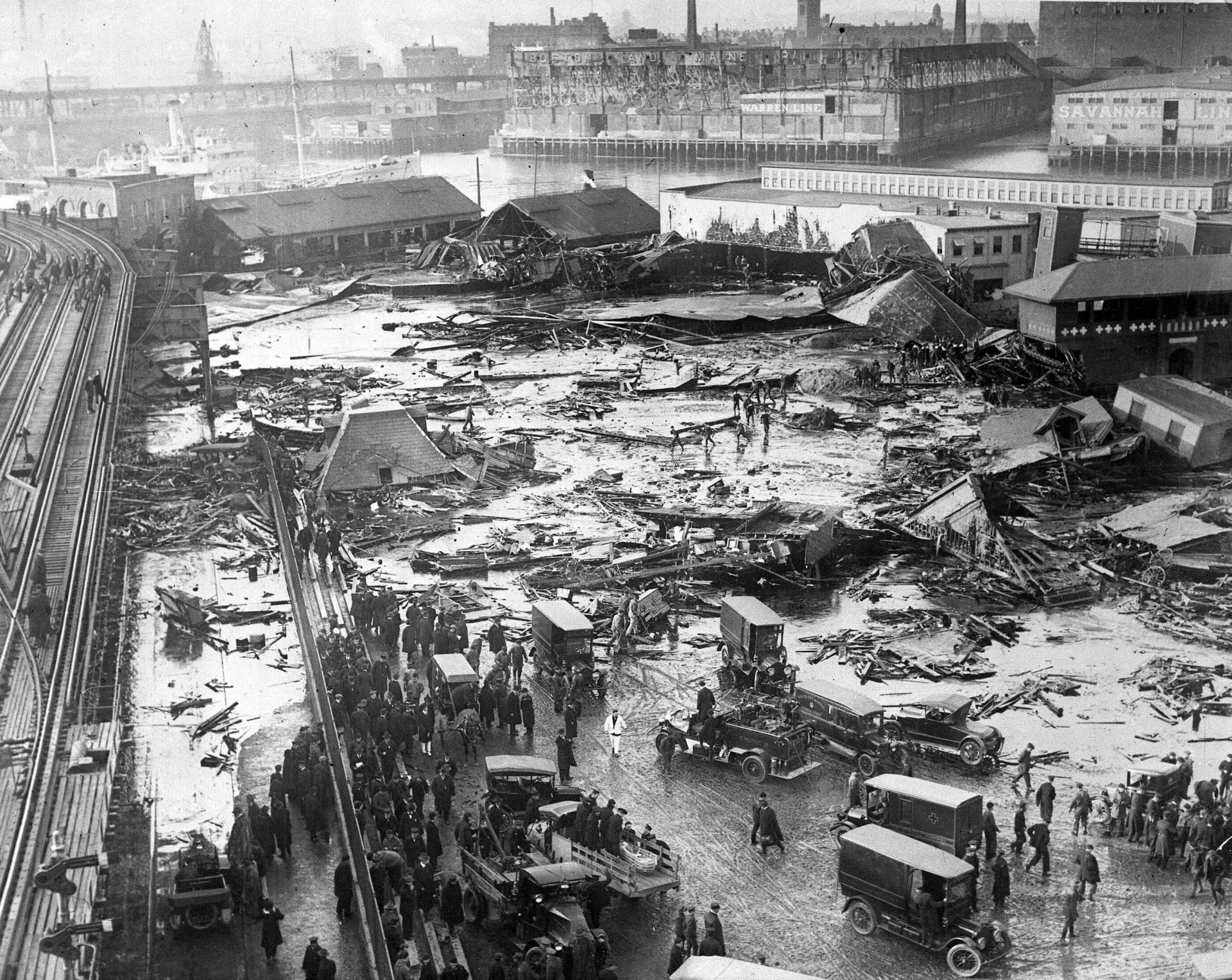
On a cold January afternoon in 1919, the North End of Boston was turned into a place of chaos by something so ordinary, so sticky, and so absurd that it still sounds almost unbelievable today: a wave of molasses. The Great Molasses Flood was not just a bizarre urban disaster. It was a deadly industrial catastrophe that killed 21 people, injured many more, and left a strange brown stain on the city’s history for decades. More than a century later, it remains one of those events people hear once and never forget.
At first glance, the story seems almost like a dark joke. Molasses, a pantry staple, became a force powerful enough to crush buildings, derail an elevated train, and send people and horses fighting for their lives. But beneath the surreal imagery was a serious failure of engineering, oversight, and corporate accountability. The disaster exposed how dangerous industrial expansion could become when speed, profit, and weak regulation outweighed safety. In that sense, the flood belongs alongside other infamous urban calamities that revealed the hidden costs of modern life, much like the Great Stink of London forced people to confront the consequences of neglect in a crowded city.
The Great Molasses Flood of 1919 is one of the most memorable events in American industrial history because it combines drama, tragedy, and legal drama in a way few disasters do. It is also one of the clearest early examples of a public reckoning over industrial responsibility. The story begins with a giant tank in Boston, but it ends with a major shift in how safety, inspection, and corporate duty were understood in the United States.
The tank that looked harmless but was anything but
The disaster began with a massive storage tank owned by the Purity Distilling Company, which was a subsidiary of United States Industrial Alcohol. The company used the tank to store molasses, a key ingredient in the production of industrial alcohol, which had become especially valuable during the First World War. Boston’s North End waterfront, dense with workers, rail lines, and homes, was a practical place for a large commercial storage operation. It was also, in hindsight, a terrible place to store tens of thousands of gallons of heavy liquid in a hastily built container.
The tank itself was enormous, standing about 50 feet tall and holding roughly 2.3 million gallons of molasses. It was also reportedly built with troubling shortcuts. Accounts from later investigations described thin steel plates, poor riveting, and design flaws that made the structure vulnerable to pressure. Even before the collapse, residents had complained about leaks. Children were said to collect molasses that seeped from the tank’s seams, which is the sort of detail that feels almost too strange to be true, yet it speaks volumes about how visibly compromised the tank had become.
What makes the tank such a central part of the story is that its failure was not a random act of nature. The collapse was rooted in engineering decisions and in a failure to take warnings seriously. On the day of the disaster, temperatures had risen after a cold stretch, and the molasses inside may have begun to loosen under changing conditions. The exact mechanics were examined later with great care, and modern analysis has shown that the contents, the tank’s structure, and the surrounding conditions all contributed to the rupture. But the broad lesson is simple: this was not just a freak accident. It was a preventable industrial failure.
In a city increasingly shaped by factories, railroads, and heavy construction, the tank stood as a symbol of modern convenience. It was supposed to make business efficient. Instead, it became a monument to careless design. The Great Molasses Flood reminds us that disasters often start long before the dramatic moment of collapse, in the quieter decisions made during planning, construction, and inspection.
The day Boston was swallowed by molasses
When the tank gave way on January 15, 1919, the failure was sudden and violent. Witnesses described a thunderous sound followed by an immense wave of molasses racing through the streets at frightening speed. It was not the slow, syrupy spill people might imagine. The mass moved like a destructive wall, carrying enough force to knock down buildings, overturn vehicles, and sweep people off their feet. In an instant, the North End was overwhelmed.
The flood reached a height of roughly 25 feet in some places, and the impact was devastating. Horses were thrown or trapped. Wooden buildings collapsed. A nearby structure used by the Boston Elevated Railway was damaged, and the train trestle became a symbol of how vulnerable the neighborhood was to the force of the wave. The molasses was warm enough to flow quickly at first, but as it met the colder winter air, it thickened and became even more difficult to escape. That made the rescue work even harder, because survivors were not simply wading through a liquid. They were struggling through a glue-like trap that hardened around debris, wreckage, and bodies.
People in the neighborhood reacted with immediate bravery. Workers, police officers, firefighters, and ordinary residents rushed to help the injured and trapped. Some climbed over wreckage to reach windows and rooftops. Others used ladders, ropes, and whatever tools were at hand to pull people free. The scene was chaotic, disorienting, and dangerous. Searching for survivors in a sticky, debris-choked flood zone was unlike anything most rescuers had ever faced.
The dead included workers and passersby, as well as a child and an animal, which reinforced how indiscriminate the disaster was. The molasses filled basements, coated streets, and lodged in the smallest spaces. For days afterward, the smell lingered through the neighborhood, and cleanup crews had to work in cold, ugly conditions to remove the thick residue from brick, wood, and pavement. Boston was left with the uncanny experience of having a disaster that was both horrific and strangely visible. The damage could not be hidden. The city had to look directly at what had happened.
Rescue work, community response, and the grim cleanup
The rescue effort after the Great Molasses Flood was heroic, but it was also physically punishing. First responders had to move through a landscape of collapsed structures, tangled timbers, and trapped victims. The molasses was so dense that it made movement exhausting. People and equipment got stuck. Every step required effort, and every minute mattered. Some victims were pulled out alive, but many others were found too late. The disaster’s odd nature did not make the losses any less real. If anything, the strange medium of death made the suffering more haunting.
Local hospitals were quickly overwhelmed with the injured. Those who survived often endured broken bones, exposure, infections, and the physical trauma of being submerged or pinned down. The cleanup itself became a major task. Workers used saltwater, sand, and large amounts of labor to wash away and scrape up the thick residue. In winter temperatures, molasses could become even harder to remove, and the sticky mess seeped into cracks, foundations, and railroad equipment. Streets had to be scrubbed repeatedly. The cleanup took weeks, and the aftermath was unpleasant enough to become part of the city’s memory.
There was also a deeply human side to the response. Neighbors helped neighbors. Families searched for missing loved ones. Volunteers came forward in the days that followed to assist with the grim work. The disaster created a brief but intense shared experience in the neighborhood, one where grief, shock, and practical determination all existed at once. It was a moment of collective endurance in a place that had suddenly become unrecognizable.
From a historical perspective, rescue and cleanup matter because they show how communities absorb the blow of industrial disasters. In many ways, the response in Boston mirrored the response to other urban crises throughout history: ordinary people stepped in where systems failed. That pattern appears again and again in city history, whether in fire, flood, disease, or pollution. Industrialization produced wealth and growth, but when it failed, the burden fell first on the people nearest the damage. The Great Molasses Flood captured that reality with unusual force, literally and figuratively.
The lawsuit that exposed corporate negligence
In the aftermath, the legal battle became one of the most important consequences of the disaster. Families of victims and injured survivors sought accountability from the company responsible for the tank. The lawsuit, which unfolded over several years, became a landmark case in the history of industrial negligence. At the center of the case was a simple but powerful question: had the company built and maintained the tank responsibly, or had it ignored obvious dangers in pursuit of profit?
The trial examined engineering records, construction methods, and witness testimony. Evidence suggested that the tank’s design and materials were inadequate for such a huge load. Witnesses also pointed to prior leaks and the lack of proper testing. Rather than being viewed as an unavoidable accident, the flood increasingly appeared to be the result of a careless corporate system that had not taken the safety of surrounding residents seriously enough. That shift in perspective was crucial. It meant the disaster would be remembered not only as a tragedy, but also as a case study in responsibility.
The case ended with the company being held liable, and the settlement was substantial for the time. The outcome mattered beyond the money. It signaled that corporations could be challenged in court for failing to protect the public, especially when they operated dangerous facilities in populated areas. In that respect, the Great Molasses Flood helped strengthen the broader expectation that industrial enterprises had obligations beyond their own balance sheets.
This was part of a wider evolution in modern history. Cities were becoming denser and industries more powerful, but legal systems were slowly catching up. Public outrage after events like this helped shape new attitudes toward inspection, regulation, and engineering standards. The flood did not instantly transform every industry, but it added to the pressure for better oversight. It also left behind a warning that remains relevant today: if a company stores or produces hazardous materials, the community nearby should never be treated as an afterthought.
How the Great Molasses Flood changed industrial safety expectations
The Great Molasses Flood is remembered because it was so unusual, but its deeper significance lies in what changed afterward. The disaster became a reference point for industrial safety, showing that serious harm could come not only from explosive chemicals or obvious machinery, but also from failures in structural design and maintenance. In other words, danger was not always dramatic in advance. Sometimes it sat quietly in plain sight until the day it failed.
After Boston, businesses and regulators had even more reason to think carefully about tank construction, inspection routines, and engineering standards. The event demonstrated that large containers had to be designed for the specific stresses they would face, including temperature changes, material weight, and the environment around them. It also highlighted the importance of independent review rather than relying solely on a company’s own assurances. Those lessons sound obvious now, but at the time they had to be learned through catastrophe.
The flood also became part of a larger historical pattern in which disasters exposed the costs of weak regulation. That is one reason it still appears in discussions of public safety and corporate accountability. It shows how a single failure can influence broader expectations, much as major urban crises in other eras pushed authorities to rethink infrastructure and governance. History is full of these turning points, where an event is so shocking that it changes the rules of what people consider acceptable.
Today, visitors to Boston can still learn about the flood through plaques and local history, and the event remains a subject of study because it is both bizarre and serious. The image of molasses pouring through city streets is unforgettable, but the real history is about more than spectacle. It is about the lives lost, the neighborhood disrupted, the legal struggle that followed, and the slow but important advancement of industrial safety thinking. The Great Molasses Flood remains one of the most vivid reminders that modern disasters often begin with human choices, not fate.
Looking back, the lesson is clear. The flood was not merely a strange episode in Boston’s past. It was a warning written in syrup and steel about what happens when industrial ambition outruns responsibility. That warning still matters. Whether the hazard is chemical, structural, or environmental, communities pay the price when safety is treated as optional. The Great Molasses Flood of 1919 endures in historical memory because it turned an everyday substance into a deadly force and, in doing so, helped push society toward a higher standard of care.
Related reading: Roman rapid-fire weapon, Great Stink of London.
Key sources used for this review
Research and further reading
For readers who want to verify details or continue researching this subject, these external reference collections provide useful starting points: