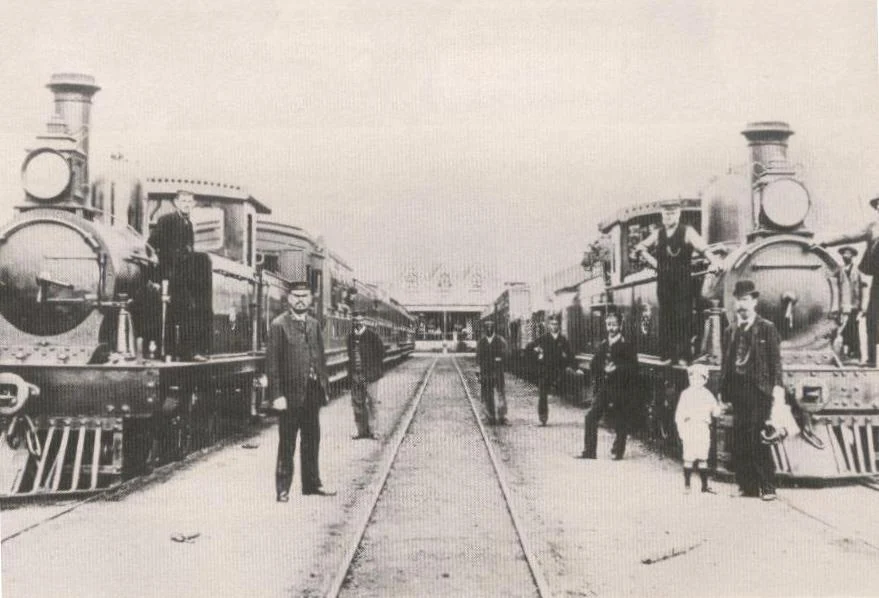
In the late nineteenth century, at a time when railways symbolized modernity, precision, and human engineering prowess, one of the most extraordinary workers in industrial history quietly took his post in South Africa. He wore no uniform, signed no contract, and could not speak a single human word. Yet for eight years, he performed his duties flawlessly. His name was Jack, and he was a baboon. Employed by the South African railway system, Jack operated track signals with such reliability that he became a local legend—and later, a historical curiosity that still challenges assumptions about intelligence, labor, and the boundary between humans and animals.
This story is not folklore or exaggeration. It is documented, witnessed, and reported in contemporary newspapers and railway records. Jack the Baboon never caused an accident, never misread a signal, and never endangered a train. In an era when rail travel was dangerous and mistakes were often fatal, his perfect record stands out as remarkable. More than a novelty, Jack’s employment reveals much about nineteenth-century technology, disability, colonial society, and the underestimated cognitive abilities of animals. What began as a practical solution to a human problem became one of the most unusual chapters in railway history.
Railways, Risk, and Life in Colonial South Africa
By the mid-to-late 1800s, railways were transforming South Africa. Under British colonial rule, rail lines expanded rapidly to support trade, mining, and military movement. Steam locomotives connected ports to inland regions, moving diamonds, gold, and agricultural goods across vast distances. But this expansion came with danger. Railway signaling was still largely manual, relying on human operators to switch tracks, raise signals, and coordinate train movements with precision. A single error could result in catastrophic collisions.
Railway signalmen occupied positions of immense responsibility. They worked long hours, often in isolation, exposed to the elements, and under constant pressure. There were no automated fail-safes. Human attention and judgment were the system. In this context, reliability mattered more than anything else. A signalman who was distracted, intoxicated, or careless could cost dozens of lives.
South Africa’s railways also reflected the inequalities of colonial society. Jobs were rigidly stratified, wages were low, and workers with disabilities had few opportunities. Industrial safety standards were inconsistent, and accidents were common. Yet the railway system demanded absolute obedience to rules and signals, regardless of who—or what—was operating them.
It was into this world that a railway employee named James Edwin “Jumper” Wide entered history. A skilled signalman, he would lose both legs in a tragic accident and, in doing so, inadvertently set the stage for one of the most extraordinary employment stories ever recorded. The conditions of nineteenth-century railroading made Jack the Baboon not just a curiosity, but a solution to a very real and dangerous problem.
James Edwin Wide, Disability, and an Unlikely Partnership
James Edwin Wide worked as a railway signalman near Cape Town. His job required physical mobility: moving levers, crossing tracks, and maintaining constant vigilance. That ability was taken from him when he fell beneath a train and lost both legs. In an era with little social support for injured workers, Wide faced unemployment and poverty. Rather than accept defeat, he adapted. He continued working as a signalman using a hand-powered trolley to move along the tracks.
It was during this period that Wide acquired a chacma baboon, later known as Jack. Baboons were common in South Africa, often regarded as pests or curiosities. Wide initially trained Jack to push his trolley along the tracks, effectively replacing the mobility Wide had lost. The baboon proved unusually intelligent and attentive, quickly learning routines and responding to commands.
Over time, Wide realized that Jack could do far more than push a trolley. The railway signaling system relied on a series of levers, each corresponding to a specific track or signal. Trains followed strict schedules, and signal changes occurred in predictable patterns. Wide began teaching Jack which levers to pull and when, using visual cues and repetition rather than abstract instruction. Astonishingly, Jack learned.
The baboon did not simply mimic movements. Witnesses observed that Jack watched trains approach, listened for whistles, and waited for specific signals before acting. He understood cause and effect: pulling the wrong lever at the wrong time would result in reprimand, while correct actions were rewarded. This was not random behavior; it was learned operational competence.
Eventually, Jack took over most of the physical signaling work while Wide supervised. What began as a workaround for disability evolved into a full-fledged partnership. Jack was no longer just an assistant. He was, in practice, a signalman.
Official Employment and Eight Years Without Error
At first, railway authorities were skeptical. The idea that a baboon was operating railway signals sounded absurd, even dangerous. Concerns were raised about safety, liability, and public perception. An investigation was launched. Officials observed Jack at work, watching him respond to approaching trains and manipulate the correct levers with consistent accuracy.
What they saw defied expectation. Jack never pulled the wrong signal. He never acted prematurely. He never panicked. He followed the routine precisely, day after day. After careful evaluation, the railway company made an unprecedented decision: Jack was officially employed by the railway.
Jack was assigned wages—reportedly paid in beer and fruit—and was registered as a railway employee. This was not symbolic or humorous. It was a practical acknowledgment that Jack performed his duties to a standard equal to or exceeding that of human workers. Over the course of eight years, Jack worked without a single recorded mistake. No accidents. No near-misses. No disciplinary issues.
This record is extraordinary even by modern standards. Human operators, subject to fatigue and error, rarely achieve perfect performance over such a long period in safety-critical roles. Jack’s consistency suggests not only intelligence, but a temperament uniquely suited to repetitive, rule-based tasks.
His performance also forced observers to confront uncomfortable questions. If a baboon could operate railway signals flawlessly, what did that say about assumptions of human uniqueness? Was intelligence defined by species, or by ability? In a rigidly hierarchical colonial society, these questions went largely unspoken—but Jack’s existence quietly challenged them nonetheless.
Intelligence, Instinct, and the Limits of Assumption
Jack the Baboon’s success cannot be dismissed as mere instinct or mimicry. Railway signaling requires situational awareness, memory, and decision-making based on external cues. Jack demonstrated all three. He differentiated between trains, responded to whistles, and executed sequences of actions in the correct order. Modern animal cognition research suggests that primates possess advanced problem-solving abilities, but Jack’s case was documented decades before such science existed.
In the nineteenth century, animals were generally viewed as tools or commodities, not thinkers. Darwin’s ideas about evolution and cognition were still controversial. Jack’s work contradicted prevailing beliefs about the mental limits of non-human animals. Yet rather than inspiring scientific inquiry, his case was largely treated as an amusing anomaly.
That reaction itself is revealing. Jack’s intelligence was accepted only because it was useful. He was valued not for what his abilities suggested about animal minds, but for the fact that he reduced risk and increased efficiency. This utilitarian lens allowed society to benefit from his skills without reexamining its assumptions.
From a modern perspective, Jack’s story aligns with what is now known about primate cognition. Baboons can recognize patterns, learn complex tasks, and adapt behavior based on feedback. Jack’s training exploited these capacities long before they were formally acknowledged.
His flawless service record suggests something else as well: that intelligence paired with consistency can outperform intelligence paired with overconfidence. Jack did not improvise. He followed rules. In a system where deviation could be deadly, that restraint was an asset. In many ways, he was the ideal signalman.
Legacy, Memory, and a Forgotten Pioneer
Jack the Baboon died around 1890, after approximately eight years of service. His passing did not make international headlines, and his story gradually faded from public memory. Yet it survived in local accounts, railway lore, and historical records, resurfacing periodically as one of the most unusual employment stories ever told.
Today, Jack is remembered not just as a novelty, but as a symbol of adaptability and underestimated intelligence. His partnership with James Edwin Wide highlights how disability can drive innovation when rigid systems fail to accommodate human needs. Wide did not abandon his profession; he reimagined it. Jack was not a replacement for a man, but a collaborator who made continued employment possible.
Jack’s story also challenges modern readers to reconsider boundaries. The line between human and animal labor, between instinct and understanding, is far less clear than nineteenth-century society believed. Jack was not a mascot. He was a worker who met the highest safety standards of his time.
This episode belongs to the modern period of history, shaped by industrialization, colonial expansion, and emerging scientific thought. Yet it carries lessons that remain relevant. Intelligence is not always where we expect it. Competence does not require conformity. And sometimes, the most reliable worker on the line is the one no one thought to hire.
Research and further reading
For readers who want to verify details or continue researching this subject, these external reference collections provide useful starting points: