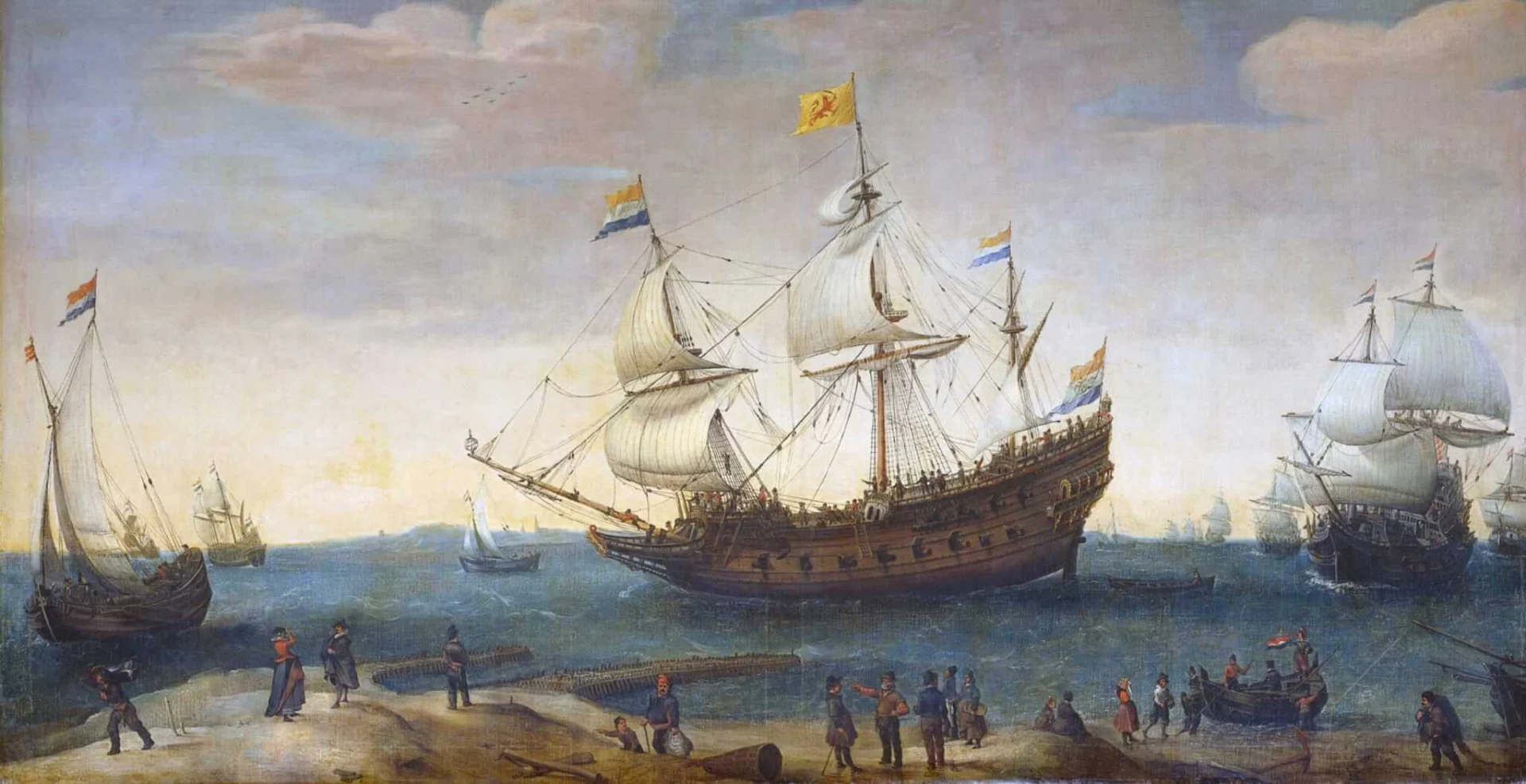
In the long and often violent chronicle of European warfare, it is easy to assume that every declared war must be marked by thunderous cannon fire, sieges, and bloodshed. Yet history has a way of surprising us. One of the most curious examples is the so-called Dutch-Scilly War, a conflict that officially lasted 335 years, from 1651 until 1986, without a single battle fought or a single life lost. It began in the turbulence of civil war, simmered in diplomatic limbo for centuries, and ended not with a treaty hammered out after bitter struggle, but with a handshake and mild embarrassment.
To understand how such an improbable situation unfolded, we must step back into the mid-seventeenth century, a time when England was torn apart by ideological and political strife. The Dutch-Scilly War was not an isolated quarrel between two small entities. Rather, it was a by-product of the larger and more consequential upheaval known as the English Civil War, a conflict that reshaped the political landscape of Britain and had ripple effects across Europe.
The English Civil War and the Isles of Scilly
The mid-1600s were a volatile period in English history. The English Civil War, fought between the Royalists who supported King Charles I and the Parliamentarians who opposed him, tore the kingdom apart between 1642 and 1651. What began as a dispute over royal authority and parliamentary power quickly escalated into full-scale armed conflict. By the late 1640s, Parliament’s New Model Army had gained the upper hand, and in 1649 King Charles I was executed, an unprecedented act that shocked monarchies across Europe.
However, even after the king’s death, Royalist resistance did not simply evaporate. Pockets of loyalty to the Crown remained scattered throughout the British Isles. One of the most significant Royalist strongholds toward the end of the war was the Isles of Scilly, an archipelago off the southwestern coast of England. The islands’ remote location and natural defenses made them an ideal refuge for Royalist naval forces who were unwilling to surrender.
From these islands, Royalist privateers began raiding shipping in the English Channel. Their targets included merchant vessels belonging to the Dutch Republic, a powerful maritime nation whose economy depended heavily on trade. The Dutch had aligned themselves with the Parliamentarians, viewing them as the more stable and commercially favorable faction. This alignment, combined with the Royalists’ desperate need for resources, created a volatile situation.
As Royalist ships seized Dutch vessels in retaliation for perceived support of Parliament, tensions escalated. The Isles of Scilly became not just a haven for defeated Royalists but a base for maritime retaliation. In this charged atmosphere, a localized grievance began to morph into an international diplomatic incident.
The Dutch Response and Declaration of War
By 1651, the Dutch Republic had grown weary of losing merchant ships and cargo to Royalist raids. The Dutch were a formidable naval power, and they did not take lightly the disruption of their lucrative trade routes. Seeking compensation for their losses, the Dutch dispatched a fleet under the command of Admiral Maarten Tromp to the waters around the Isles of Scilly.
The Dutch objective was clear: demand reparations from the Royalist forces responsible for the attacks. The Royalists, however, were in no position to comply. By this stage of the Civil War, they were effectively cornered and financially exhausted. The Isles of Scilly may have provided temporary refuge, but they offered little in the way of economic resources. The Royalist leadership simply did not have the funds to compensate the Dutch merchants.
Faced with refusal or inability to pay, the Dutch took a formal step that would echo unexpectedly through the centuries. They declared war on the Isles of Scilly in 1651. It was a limited and highly specific declaration, aimed not at England as a whole but at the Royalist-held islands. In theory, this meant that a state of war existed between the Dutch Republic and the Isles of Scilly.
Yet events moved swiftly. Soon after the declaration, Parliamentarian forces defeated the remaining Royalists on the islands. The Isles of Scilly surrendered to Parliament in June 1651. With the Royalist threat neutralized and the immediate cause of Dutch grievances removed, the Dutch fleet departed. The pressing issue had effectively resolved itself. However, amid the broader political reshuffling of post-war England, no formal peace treaty was signed between the Dutch and the Isles of Scilly.
It was not so much negligence as oversight. The Dutch had declared war in a moment of frustration, and when circumstances changed, they simply sailed home. The paperwork, so to speak, was left unfinished.
Three Centuries of Forgotten War
What followed is perhaps the most remarkable aspect of this story: nothing. For 335 years, from 1651 until 1986, the Dutch Republic—and later its successor state, the Kingdom of the Netherlands—remained technically at war with the Isles of Scilly. In practice, there was no hostility, no naval skirmishes, and no diplomatic friction related to the declaration. The “war” existed only as a historical footnote, buried in archives and forgotten by generations.
During those three centuries, Europe underwent dramatic transformations. The Dutch Republic evolved, experienced a Golden Age, faced wars of its own, and eventually became the modern Kingdom of the Netherlands. England transitioned from monarchy to commonwealth and back again, later uniting with Scotland to form Great Britain, and eventually the United Kingdom. The Isles of Scilly themselves became a peaceful part of Cornwall, known more for their mild climate and scenic beauty than for any military significance.
The absence of a peace treaty did not affect daily life in any tangible way. Trade continued, alliances shifted, and the two nations interacted as friendly states. There were periods of Anglo-Dutch warfare in the seventeenth century, but these were separate, formally declared conflicts between larger powers, not connected to the narrow declaration involving the Isles of Scilly.
The forgotten war persisted purely because no one had reason to revisit the technicality. Diplomatic records from the seventeenth century were not easily searchable, and the Isles of Scilly were a minor administrative region within England. In essence, the “war” became a ghost of history—real on paper, irrelevant in practice.
Rediscovery and the 1986 Peace Treaty
The story might have remained buried indefinitely if not for historical curiosity. In the 1980s, local historian Roy Duncan began researching the history of the Isles of Scilly. During his investigations, he uncovered references to the 1651 Dutch declaration of war. Intrigued, he contacted the Dutch embassy to inquire whether a formal peace treaty had ever been signed.
The response was surprising. Dutch officials examined their records and found no evidence of a treaty formally ending the conflict. Technically speaking, the state of war declared in 1651 had never been officially terminated. While the idea of active hostilities was absurd, the legal technicality remained.
Rather than dismiss the matter, both sides decided to address it properly. In 1986, representatives of the Isles of Scilly and the Dutch government organized a formal ceremony to sign a peace treaty. On April 17, 1986, the long-overlooked conflict was officially concluded. The treaty was largely symbolic, accompanied by humor and goodwill. There had never been casualties, never been combat, and never been animosity in any meaningful sense.
The event attracted media attention precisely because of its peculiarity. A war lasting 335 years without a single shot fired challenges our assumptions about what war entails. The ceremony served as a reminder that history is not only shaped by grand battles and sweeping campaigns, but also by administrative oversights and forgotten paperwork.
Why the Dutch-Scilly War Still Fascinates
The Dutch-Scilly War endures in popular imagination because it highlights the quirks of diplomatic history. It reveals how declarations of war in the seventeenth century were sometimes impulsive, reactive, and limited in scope. It also demonstrates how easily minor conflicts could be overshadowed by larger geopolitical events.
At a deeper level, the story invites reflection on the nature of war itself. War is often defined by violence, suffering, and destruction. Yet in this case, the concept existed entirely in the realm of legality and theory. The war’s duration—335 years—was longer than many of the bloodiest conflicts in human history. And yet, it left no scars, no ruins, and no graves.
The Dutch-Scilly War also underscores the importance of historical research. Without the curiosity of a local historian, the technical state of war might never have been discovered or resolved. It shows that even in an age of advanced record-keeping, history can contain overlooked anomalies.
Moreover, the story carries a certain charm. In an era often dominated by grim headlines, it is refreshing to encounter a tale of a war that harmed no one. The peaceful resolution in 1986 stands in stark contrast to the violence that marked its origins in the English Civil War. It is a testament to how dramatically Europe changed between the seventeenth and twentieth centuries.
A War Without War
In the end, the Dutch-Scilly War was less a conflict and more a historical curiosity born of circumstance. It began with real grievances during a brutal civil war, escalated to a formal declaration, and then quietly faded into irrelevance. For over three centuries, it lingered unnoticed, a relic of a time when communication was slow and diplomatic formalities were sometimes incomplete.
Its conclusion in 1986 did not alter borders, shift alliances, or change the course of history. Instead, it offered a moment of reflection and a touch of humor. The idea that two entities could remain technically at war for 335 years without realizing it speaks volumes about how much the world has changed.
The Dutch-Scilly War belongs primarily to the Early modern period, as it originated in 1651 during the aftermath of the English Civil War. However, its official conclusion in 1986 also connects it to the Modern period, bridging centuries in a way few historical events ever do.
Research and further reading
For readers who want to verify details or continue researching this subject, these external reference collections provide useful starting points: