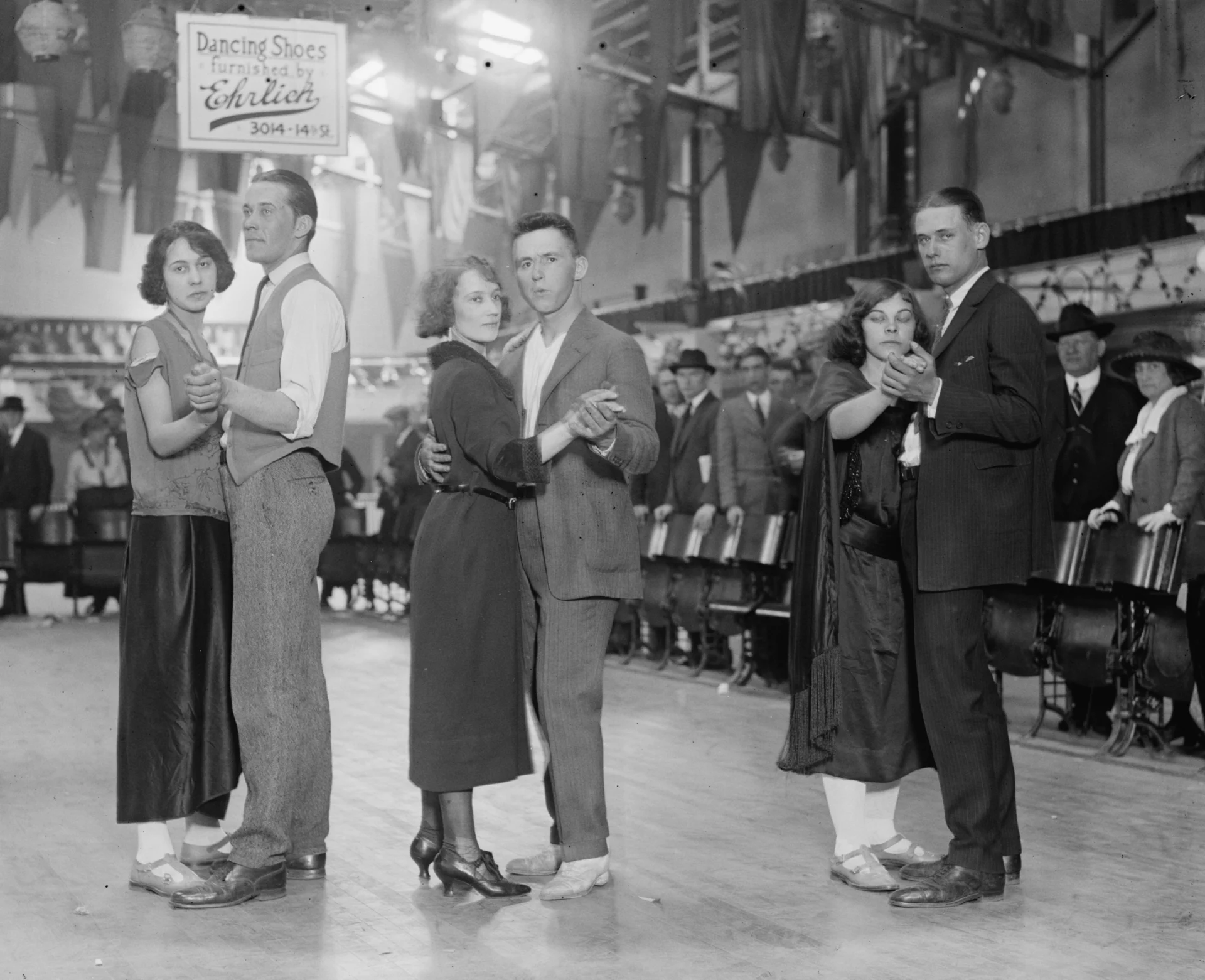
The Great Depression was a period of immense hardship that reshaped everyday life for millions of people across the United States and much of the world. Families lost their homes, savings disappeared overnight, and unemployment soared to levels previously unimaginable. In the midst of this widespread economic devastation, people searched desperately for ways to survive. Some relied on soup kitchens and government assistance programs, while others turned to unusual opportunities that promised food, shelter, and the faint hope of prize money. One of the strangest and most emotionally complex survival strategies to emerge during this era was the phenomenon known as the dance marathon.
Dance marathons were not simply entertainment events. They were brutal endurance contests that pushed participants to the limits of physical and mental stamina. Couples—often married pairs struggling to survive—would dance for days or even weeks at a time, competing for cash prizes while receiving food and temporary lodging from the organizers. The rules allowed only minimal breaks, and contestants had to remain in constant motion on the dance floor. When exhaustion became overwhelming, partners developed a remarkable system: one dancer would sleep while the other physically held them upright and continued moving. In this way, the pair could technically remain dancing while allowing each partner brief moments of rest.
For spectators, these events offered cheap entertainment during a bleak economic period. For contestants, however, the dance floor became something closer to a temporary refuge from hunger and homelessness. Behind the music, laughter, and applause lay a harsh reality—dance marathons were both a spectacle and a desperate survival strategy born from one of the most difficult chapters in modern economic history.
The Economic Desperation of the Great Depression
To understand why dance marathons became so widespread in the 1930s, it is essential to consider the devastating economic conditions of the Great Depression. Following the stock market crash of 1929, the United States entered a prolonged period of financial collapse. Banks failed in large numbers, businesses closed their doors, and millions of workers suddenly found themselves without employment. By 1933, nearly one quarter of the American workforce was unemployed, leaving families struggling to meet even the most basic needs.
Many households lost their homes as they were unable to pay mortgages or rent. Entire communities of makeshift shelters, often called “Hoovervilles,” sprang up on the edges of cities. Food insecurity became a daily reality, forcing people to stand in long lines at charity kitchens just to receive a single meal. Government relief programs existed but were often insufficient or difficult to access. In such an environment, people were willing to consider almost any opportunity that promised a few days of stability.
Dance marathons emerged as a peculiar response to these conditions. At first glance, they seemed like harmless competitions centered around dancing and entertainment. However, for contestants they served a much deeper purpose. Participants were usually given free meals, a place to sleep during short breaks, and a roof over their heads for the duration of the contest. For individuals who had nowhere else to go, this arrangement could mean the difference between starvation and survival.
The contests also offered the possibility of winning prize money, which sometimes reached several hundred or even thousands of dollars—a fortune for someone living through the Depression. Even if contestants did not win, simply remaining in the competition for a few days guaranteed food and shelter during that time. As a result, many couples entered dance marathons not because they loved dancing, but because they had run out of other options.
This economic desperation fundamentally shaped the atmosphere of the marathons. What appeared to audiences as lively entertainment was, for participants, an exhausting struggle fueled by hunger and necessity. The dance floor became a stage where the harsh realities of the Depression played out in full view of paying spectators.
How Dance Marathons Actually Worked
Although the basic concept of a dance marathon sounds simple—couples dancing continuously for extended periods—the structure of these competitions was surprisingly complex. Organizers carefully designed the rules to keep contestants moving while maintaining the appearance of fairness and excitement for the audience.
Typically, couples registered together before the event began. While married pairs were common, partners could also be friends or strangers paired together by organizers. Once the competition started, contestants were required to remain on the dance floor nearly all the time. The music played almost constantly, and dancers shuffled slowly in circles rather than performing energetic routines. The goal was endurance, not style.
Most marathons operated on a system of brief rest periods. For example, dancers might receive a fifteen-minute break every hour or two, during which they could sit, eat, or attempt to sleep. However, these breaks were rarely enough to fully recover. Contestants often became severely sleep-deprived after several days of continuous participation.
One of the most remarkable aspects of these contests was the technique partners used to manage exhaustion. Because both members of the pair had to remain on the floor, couples developed a system in which one dancer would hold their partner upright while they slept. The standing partner would continue shuffling to the rhythm of the music, effectively supporting the weight of the sleeping dancer. Later, they would switch roles.
Organizers frequently introduced additional challenges to keep spectators entertained. These might include short sprints, elimination rounds, or novelty dances designed to test the contestants’ remaining energy. Judges monitored the dancers closely, eliminating anyone who stopped moving, collapsed, or violated the rules.
The environment inside the marathon halls was chaotic and theatrical. Large crowds gathered to watch the dancers struggle through exhaustion, cheering for their favorites and placing bets on who might last the longest. Live bands provided music while announcers narrated the unfolding drama. In many ways, dance marathons resembled a strange combination of sporting event, reality show, and theatrical performance decades before such formats became common.
Despite the festive atmosphere, the physical toll on participants was immense. Blisters, swollen feet, muscle injuries, and severe fatigue were common. Yet contestants often continued pushing themselves forward, motivated by the promise of food, shelter, and the possibility of a life-changing prize.
Life on the Dance Floor: Endurance, Exhaustion, and Survival
The daily reality of participating in a dance marathon was far more grueling than spectators often realized. While audiences saw music, movement, and dramatic competition, the contestants themselves endured relentless physical strain that could stretch on for weeks. Some marathons lasted over a month, forcing dancers to exist in a constant cycle of exhaustion and determination.
Sleep deprivation was perhaps the greatest challenge. Even with scheduled breaks, contestants rarely received enough rest to fully recover. Many dancers learned to sleep while standing, leaning against their partners or resting their heads on their shoulders as they continued to shuffle slowly around the floor. Observers often described the eerie sight of competitors moving mechanically, eyes half-closed, barely conscious yet still participating.
Nutrition during the events was basic but vital. Organizers typically provided simple meals such as sandwiches, soup, or oatmeal. For participants who had been struggling to find food outside the contest, even these modest meals felt like a blessing. In some cases, dancers admitted they joined the marathon primarily because it guaranteed several meals each day.
Physical injuries were almost inevitable. Feet became blistered and swollen from constant movement, while legs cramped from prolonged standing. Contestants sometimes collapsed from sheer exhaustion. When this happened, judges would quickly remove them from the floor, eliminating them from the competition.
Yet despite these hardships, many dancers formed strong bonds with their partners and fellow contestants. The shared struggle created a sense of community among participants. Couples encouraged one another through difficult moments, while competitors sometimes helped rivals stay upright during particularly challenging rounds.
For some contestants, the dance marathon became a temporary refuge from the harsh outside world. While conditions inside the hall were difficult, they were often preferable to sleeping in the streets or going hungry. In this way, the dance floor represented both a grueling contest and a fragile sanctuary during one of the most desperate economic periods in modern history.
The Spectacle and Public Fascination
Dance marathons attracted enormous audiences during the 1930s, and their popularity reveals much about the social atmosphere of the Great Depression. For many spectators, these events provided affordable entertainment at a time when money was scarce and morale was low. Admission fees were usually inexpensive, allowing working-class families to attend for a few hours and temporarily escape the pressures of daily life.
Inside the marathon halls, the atmosphere often resembled a carnival. Bright lights illuminated the dance floor while live orchestras played upbeat music. Announcers narrated the contest dramatically, highlighting moments of tension, exhaustion, or unexpected triumph. The audience became emotionally invested in the dancers’ stories, cheering for couples who showed remarkable resilience.
Organizers frequently encouraged this emotional engagement by presenting contestants as characters in an unfolding drama. They shared personal backgrounds with the crowd, describing struggling newlyweds, unemployed laborers, or hopeful young dreamers seeking a better life. These narratives made the competition feel personal and compelling.
At the same time, critics argued that dance marathons exploited human suffering for profit. Promoters earned money from ticket sales, concessions, and publicity while contestants pushed their bodies beyond healthy limits. Some observers compared the marathons to endurance spectacles from earlier centuries, where audiences gathered to watch individuals test the boundaries of human endurance.
The media played a major role in amplifying the phenomenon. Newspapers published stories about particularly long marathons or dramatic moments when contestants collapsed from fatigue. Photographs of exhausted dancers leaning on one another circulated widely, capturing the strange mixture of determination and despair that defined these events.
Despite the controversy, dance marathons remained immensely popular for several years. They reflected a broader cultural fascination with endurance and survival—qualities that many Americans felt were necessary simply to endure the economic hardships of the era.
The Decline and Legacy of Dance Marathons
By the late 1930s, public attitudes toward dance marathons began to change. What had once been viewed as thrilling entertainment increasingly appeared cruel and exploitative. Reports of severe injuries, exhaustion, and occasional deaths raised serious concerns about the safety of these competitions.
Several state governments eventually introduced regulations or outright bans on dance marathons. Lawmakers argued that the contests endangered participants and encouraged unhealthy levels of physical strain. As public criticism grew, organizers found it more difficult to host events legally.
At the same time, the economic landscape of the United States slowly began to improve. New Deal programs introduced by President Franklin D. Roosevelt created jobs and expanded social support systems. As employment opportunities gradually increased, fewer people felt compelled to participate in extreme endurance contests simply to obtain food and shelter.
Cultural tastes were also evolving. New forms of entertainment, including cinema and radio programming, became increasingly popular. These alternatives offered audiences engaging experiences without the unsettling spectacle of watching exhausted contestants struggle to remain upright on a dance floor.
Although the dance marathon era faded relatively quickly, its cultural impact remained significant. The events inspired novels, films, and documentaries exploring the desperation of the Great Depression. Perhaps the most famous example is the 1935 novel They Shoot Horses, Don’t They?, which portrayed the psychological and physical toll of marathon competitions.
Today, dance marathons are remembered as one of the most unusual and revealing cultural phenomena of the 1930s. They demonstrated both the resilience of individuals facing extreme hardship and the complicated relationship between entertainment and exploitation. More than anything else, these contests serve as a powerful reminder of how economic crises can push people to extraordinary—and sometimes troubling—lengths in order to survive.
Conclusion
Dance marathons stand as one of the most striking examples of how desperation and entertainment intersected during the Great Depression. At first glance, these contests seemed like lively social events filled with music, dancing, and enthusiastic crowds. Yet beneath the surface lay a much more complicated reality. For contestants, the dance floor was not simply a stage but a lifeline—a place where they could secure food, temporary shelter, and perhaps the chance to win enough money to escape poverty.
The endurance required to participate in these events was extraordinary. Couples supported one another physically and emotionally as they navigated days or even weeks of exhaustion. The image of one partner sleeping while the other held them upright captures both the ingenuity and the desperation that defined the era.
At the same time, dance marathons reveal uncomfortable truths about the nature of public spectacle. Audiences were drawn to the drama of human endurance, even as contestants struggled with physical pain and fatigue. The competitions blurred the line between entertainment and exploitation, raising ethical questions that remain relevant today whenever human struggle becomes a form of public spectacle.
Ultimately, the decline of dance marathons reflected broader changes in society. As economic conditions improved and social protections expanded, fewer people were forced to risk their health simply to obtain basic necessities. What remained was a powerful historical memory of a time when survival sometimes required extraordinary—and exhausting—efforts.
Today, the story of the dance marathon reminds us that history is not only shaped by major political events or economic policies but also by the everyday experiences of ordinary people trying to endure difficult circumstances. Their resilience, creativity, and determination continue to offer valuable lessons about human survival in times of crisis.