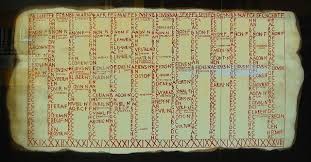
Have you ever stopped to think about whether all years are the same length? Most people assume a year is always 365 days — or 366 on a leap year. But there was one year in human history so extraordinarily long that it dwarfs everything else on the calendar. That year was 46 BC, and it lasted a staggering 445 days. Nicknamed the Year of Confusion, it remains the single longest year ever recorded in human history — and it was entirely deliberate. Behind this bizarre anomaly stands one of history’s most powerful figures: Julius Caesar, a man who didn’t just conquer nations but literally reshaped time itself.
The Broken Roman Calendar Before Caesar
To understand why 46 BC became such a monstrous year, you first need to appreciate just how badly the Roman calendar had fallen apart before Julius Caesar stepped in to fix it. The original Roman calendar, known as the pre-Julian Republican calendar, was a mess of political manipulation and astronomical ignorance that had been deteriorating for generations.
The Republican calendar was based on a lunar system of roughly 355 days per year. Since this fell about 10 days short of the actual solar year — the time it takes Earth to complete one orbit around the sun — Roman officials were supposed to periodically insert an extra month called Mercedonius to keep the calendar in sync with the seasons. This intercalary month was supposed to be added every two years or so, alternating between 22 and 23 days. On paper, it was a reasonable solution. In practice, it became a tool of political corruption on an almost comical scale.
The power to insert or withhold this extra month rested with the pontiffs, Rome’s priestly officials who managed religious and civil time. Over centuries, these men routinely manipulated the calendar for personal and political gain. If they wanted to extend the term of a favored magistrate, they simply added the extra month. If they wanted to cut short the term of a political enemy, they skipped it. There was no transparency, no public announcement system, and no accountability. Ordinary Romans frequently had no reliable way of knowing what the actual date was without consulting officials directly.
By the time Julius Caesar came to power in the mid-first century BC, the Roman calendar had drifted so severely out of alignment with the solar year that it was roughly three months behind the actual astronomical seasons. Dates that were supposed to correspond with the spring harvest were actually falling in winter. Religious festivals tied to agricultural seasons were being celebrated at the wrong time of year entirely. The calendar wasn’t just inconvenient — it was functionally broken. Trade, agriculture, religious practice, and civic administration all suffered as a result. Something had to change, and Caesar, with his characteristic decisiveness and ambition, was the man who chose to change it.
Caesar’s Astronomical Solution
Julius Caesar was not a man who did things halfway. When he decided to reform the Roman calendar, he didn’t tinker at the edges — he commissioned an entirely new system built from scratch on sound astronomical principles. To do this properly, he enlisted the help of one of the foremost scientific minds of the ancient world: Sosigenes of Alexandria, a Greek mathematician and astronomer.
Alexandria, in Egypt, was at this time the intellectual capital of the Mediterranean world. Its famous library housed centuries of accumulated knowledge, and its scholars had access to Egyptian astronomical records stretching back thousands of years. The Egyptians had long used a solar calendar of 365 days, which Sosigenes drew on heavily when advising Caesar. Sosigenes calculated that the true solar year — the time between two consecutive spring equinoxes — was approximately 365 and one-quarter days long. This was not perfectly accurate (the actual value is closer to 365.2422 days), but it was close enough to be a vast improvement over anything Rome had used before.
The system Sosigenes proposed was elegant in its simplicity. The year would consist of 365 days, divided into twelve months. To account for the extra quarter-day that accumulated each year, an additional day would be inserted into the calendar every four years — what we now call a leap year. Caesar also restructured the lengths of the months to make the year add up correctly, which is why we have the slightly irregular distribution of 28, 30, and 31-day months that we still use today, albeit with later modifications.
Caesar announced this reform officially and decreed that the new Julian Calendar — named in his honor — would take effect on January 1st, 45 BC. It was a rational, scientifically grounded solution to a problem that had plagued Roman civilization for centuries. But there was still one enormous, unavoidable practical problem: before the new calendar could begin, the old one needed to be corrected. Centuries of accumulated drift had to be erased in a single year, and that task fell entirely on the shoulders of 46 BC.
Why 46 BC Needed to Be 445 Days Long
This is where the story gets genuinely extraordinary. Caesar and Sosigenes calculated that the Roman calendar, as it stood in 46 BC, was running approximately three months behind the actual solar year. In other words, what the Romans were calling October was, astronomically speaking, already July. For the new Julian Calendar to begin on January 1st, 45 BC — correctly aligned with the astronomical seasons — the year 46 BC had to be artificially extended to make up the difference.
Caesar’s solution was drastic: he inserted not one but two extra intercalary months into 46 BC, in addition to the regular Mercedonius month that was already scheduled for that year. The first extra month, containing 33 days, was inserted after February. The second extra month, containing 34 days, was inserted between November and December. When you add these two extra months — totaling 67 additional days — to the already-present Mercedonius and the standard 355-day calendar, the total for 46 BC reaches a mind-boggling 445 days.
To put that in perspective, 46 BC was over 80 days longer than a standard year today. It was longer than fifteen months of our modern calendar. It contained almost as many days as a full year and a quarter combined. No year before or since in recorded human history has come close to this length. The Romans themselves were bewildered by it. Ancient sources record widespread confusion among the population, who genuinely struggled to keep track of where they were in the year. Religious festivals, legal deadlines, financial contracts, and agricultural schedules all had to be renegotiated or reinterpreted.
The nickname — the Year of Confusion, or in Latin annus confusionis — was not a compliment. It was the exasperated reaction of a population that had been told, essentially, that time itself was being stretched to accommodate a bureaucratic reform. And yet, as chaotic as it was to live through, it was a one-time disruption with a permanent payoff: after 46 BC, the Julian Calendar ran cleanly and accurately for centuries, and the Western world finally had a reliable, scientifically grounded way of marking the passage of time.
The Lasting Legacy of Julius Caesar’s Calendar Reform
The Julian Calendar that emerged from Caesar’s reform was nothing short of revolutionary, and its influence on Western civilization cannot be overstated. For over 1,600 years, from its introduction in 45 BC until the Gregorian reform of 1582 AD, the Julian Calendar was the dominant timekeeping system across Europe, the Mediterranean world, and later the European colonial world. Virtually every major event in Western history during the medieval and early modern periods — the fall of Rome, the Crusades, the Black Death, the Renaissance — was dated using the system Julius Caesar and Sosigenes designed in 46 BC.
Even after the Gregorian Calendar replaced the Julian Calendar in Catholic countries starting in 1582, the change was relatively minor — a refinement of Caesar’s system rather than a replacement. Pope Gregory XIII’s reform simply adjusted the leap year rule slightly (removing three leap years every 400 years) to correct a small drift that had accumulated over the centuries. The basic architecture — 365-day years, twelve named months, a leap year every four years — remained entirely Caesar’s. Even today, the calendar most of the world uses is fundamentally a Gregorian modification of a Julian original.
Caesar’s reform also had a profound cultural impact on how humanity conceptualizes time. Before the Julian Calendar, different regions of the ancient world used wildly different systems — lunar calendars, lunisolar calendars, and various local variations that made coordination across long distances genuinely difficult. By imposing a single, rational, solar-based calendar across the Roman Empire, Caesar created a shared temporal framework that helped unify an enormous and diverse civilization. This standardization of time was, in its own quiet way, as important to Roman administrative coherence as the standardization of weights, measures, and law.
It’s worth reflecting on the audacity of what Caesar actually did. He looked at a calendar that had been in use for centuries, declared it fundamentally broken, consulted the best scientific minds available, designed a replacement from first principles, and then implemented it — including deliberately stretching a single year to 445 days to correct accumulated errors. It was an act of breathtaking intellectual confidence, and it worked. The Year of Confusion was confusing in the short term and clarifying in the long term. In that sense, it’s a fitting monument to Caesar himself: disruptive, ambitious, and ultimately transformative.
Conclusion
The year 46 BC stands as one of the most peculiar episodes in the entire history of human timekeeping. At 445 days, it remains unmatched as the longest year ever recorded — not through accident or astronomical anomaly, but through deliberate political and scientific will. Julius Caesar looked at a broken system, consulted the greatest minds of his age, and made a correction that was bold enough to stretch time itself. The confusion it caused was real and significant, but it was the price of centuries of neglect finally being paid in a single extraordinary year. The next time January rolls around and the calendar ticks over as expected, it’s worth remembering that we owe that reliability, at least in part, to a Roman dictator who once decided that one year simply wasn’t long enough.
Research and further reading
For readers who want to verify details or continue researching this subject, these external reference collections provide useful starting points: