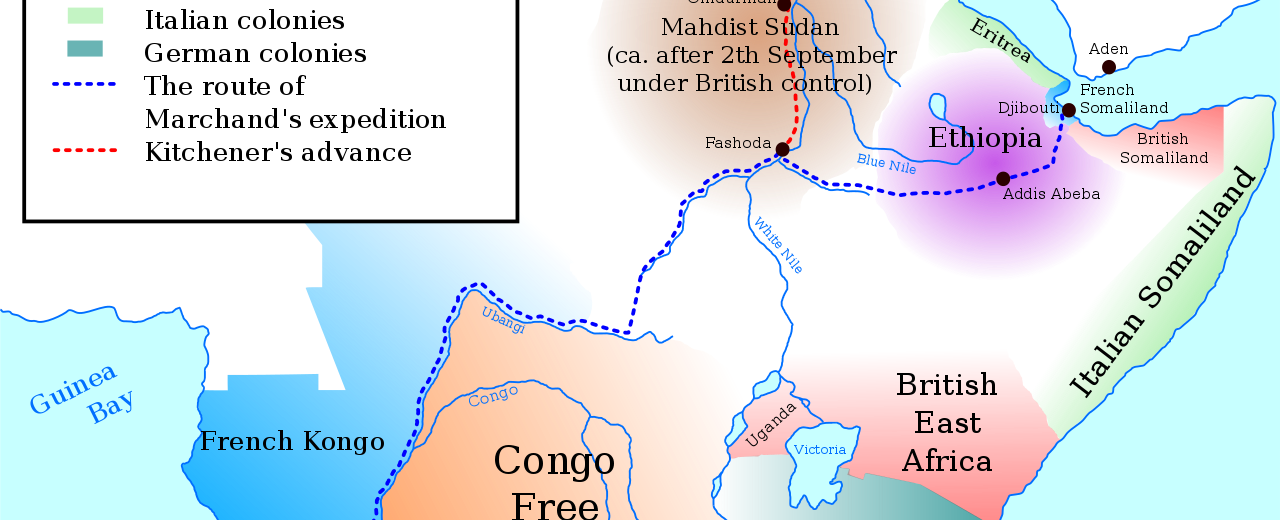
Fashoda Incident is a revealing historical subject because it opens a clear path into the people, events, and wider changes that shaped its era.
In the late summer of 1898, two imperial projects collided on a remote stretch of the upper Nile and brought Britain and France closer to war than either side wanted to admit. The place was Fashoda, a small outpost in the Sudan far from any European capital, yet it became the stage for a crisis that exposed just how dangerous the age of empire had become. A French expedition under Captain Jean-Baptiste Marchand reached the village first and planted the tricolor. A far larger British-led force under General Herbert Kitchener arrived soon after, fresh from the conquest of Sudan and determined to make clear that the Nile Valley belonged to Britain’s imperial design. For weeks, the two sides stared at one another across a political fault line that could have turned into a shooting war between the great powers.
The Fashoda Incident was never just about a patch of African riverbank. It was about prestige, strategy, and the logic of empire at the end of the nineteenth century. Britain wanted to secure a north-south corridor from Cairo to the Cape and protect the Nile as the lifeline of Egypt. France, meanwhile, hoped to build an east-west empire across Africa and connect its possessions from the Atlantic to the Red Sea. Their ambitions overlapped in Sudan, and Fashoda became the place where those imperial dreams met reality. The confrontation ended without gunfire, but its consequences rippled far beyond the Nile. It reshaped Anglo-French relations, exposed the limits of colonial adventure, and helped set the stage for the diplomatic reordering of Europe in the years before the First World War.
Why the Nile mattered so much to empire
To understand why the Fashoda Incident became so explosive, it helps to understand the central place the Nile held in imperial strategy. The river was not merely a geographic feature; for Britain, it was the artery that sustained Egypt, and Egypt was a cornerstone of British power after the occupation of 1882. Control of the Nile meant control of the agricultural and political stability of a territory that was essential to imperial communications and the route to India. In the era of steamships, telegraphs, and faster military logistics, the Nile Valley formed part of a broader strategic map stretching from the Mediterranean to the Indian Ocean.
The Sudan mattered because it sat upstream from Egypt. Any power that could influence the headwaters or the valley could threaten the economic and political order downstream. This was especially concerning after the Mahdist uprising transformed Sudan into a hostile and unstable zone. For British policymakers, allowing another European power to establish itself on the upper Nile would create a permanent risk to Egypt and therefore to Britain’s imperial position. The logic was as much about preventing danger as achieving dominance. Salisbury’s government understood that empire was often defended by denying space to rivals before a crisis became unavoidable.
France saw matters differently. French expansion in Africa was driven by its own strategic imagination, one that linked West Africa to the Red Sea and sought to restore national prestige after the defeat in the Franco-Prussian War. The French hoped to create a transcontinental belt of influence, and Sudan offered a bridge between scattered colonial possessions. Fashoda, then, was not a random outpost but a potential hinge between rival imperial systems. The broader setting was a continent being carved up by Europeans who treated African geography as a chessboard of corridors, buffers, and claims. That is why a small settlement on the Nile could suddenly feel like the place where empires themselves might collide.
Marchand’s expedition and the French imperial gamble
Captain Jean-Baptiste Marchand’s journey to Fashoda was one of the most daring and improbable expeditions of the age of empire. Sent by France to advance its position in Central and East Africa, Marchand led a small force across enormous distances, often relying on precarious supply lines and the cooperation of local communities. His mission was not simply military; it was political theatre, a demonstration that France still possessed the will and capability to project power across the African interior. The expedition was intended to establish a French presence before the rival British system could lock down the Nile corridor.
By the time Marchand reached Fashoda in July 1898, his men were exhausted, under-resourced, and isolated. Yet the symbolic power of arrival mattered enormously. The French flag was raised, and Marchand proclaimed the site a French possession. In practical terms, the position was weak. In diplomatic terms, it was highly provocative. Marchand had reached the Nile through a breathtaking overland trek, but his success depended on the assumption that France would back him up if challenged. That assumption would prove difficult to sustain once the British response became clear.
The French government had encouraged imperial ambition, but it had not fully reckoned with the risks of direct confrontation with Britain. France in the 1890s was politically divided and strategically cautious, even as nationalist voices urged firmness. Marchand’s mission thus embodied a familiar imperial tension: the gap between adventurous colonial action and metropolitan diplomacy. The expedition was heroic in narrative terms, but it was also a gamble that placed national honor on a fragile footing. When news reached Europe that a French officer had planted France’s claim on the upper Nile, it created excitement in Paris and alarm in London. The confrontation was now no longer theoretical. A French party stood on the river, and the British were on their way.
Kitchener’s advance and the British reconquest of Sudan
General Herbert Kitchener’s approach to Fashoda was shaped by a much larger military and political campaign: the British reconquest of Sudan. After years of conflict following the Mahdist revolt, Britain and its Egyptian allies sought to reassert control over the region. The campaign was not simply about vengeance or restoring lost authority. It was driven by the practical need to secure Egypt’s southern frontier and eliminate threats to the Nile system. Kitchener’s forces advanced methodically, relying on superior logistics, modern weaponry, and the construction of railways and supply lines that transformed the desert campaign into a model of imperial warfare.
The victory at Omdurman in September 1898 was decisive. Kitchener’s army defeated Mahdist forces in a battle that showcased the overwhelming advantage of modern military technology over traditional massed infantry. After that triumph, the British commander turned south toward Fashoda. His mission was not to fight the French, at least not if it could be avoided, but to assert British control over the river and make clear that Sudan would not be shared. Kitchener’s arrival created a dramatic face-to-face encounter between two imperial logics: Marchand’s symbolic possession and Britain’s force-backed claim.
What made the moment so delicate was that neither side wanted to start a war without authorization from home. Kitchener had an army behind him, but he also knew he was at the edge of political risk. Marchand, for his part, had no practical way to resist a British military column and no certainty of reinforcement from Paris. The result was a tense standoff in which both officers behaved with professionalism while their governments debated the larger implications. The Nile was no longer only a river; it was a line on the map that could determine whether European diplomacy remained manageable or descended into crisis. In that sense, the encounter at Fashoda was the visible endpoint of a far bigger imperial contest that had been building for years.
The standoff: diplomacy, pride, and the threat of war
For several weeks, Fashoda became a diplomatic pressure point watched closely in European capitals. Marchand and Kitchener met politely, exchanged formalities, and each remained in place while London and Paris weighed the consequences of backing down. The danger was not simply that two colonial detachments might clash. The real risk was that a local incident could trigger a broader international confrontation between Britain and France, each of which had naval, colonial, and political interests that made compromise difficult. In an era when imperial prestige was bound tightly to national credibility, retreat could feel humiliating.
Britain held the stronger hand. Kitchener had the military presence, and British policy enjoyed the support of a government determined not to let the Nile slip from its grasp. France, by contrast, was not well positioned for escalation. Its army was important, but it was also constrained by wider strategic concerns and internal political uncertainty. The French navy could not easily challenge Britain at sea, and French leaders had to consider whether Fashoda was worth the possibility of a larger war. Public rhetoric in both countries was sharp, but behind the scenes realism was beginning to prevail. The distance between colonial enthusiasm and national willingness to fight was becoming obvious.
The standoff also revealed how much modern imperial politics depended on communication and image. News traveled quickly, newspapers amplified every move, and ministers had to manage public emotion as well as strategy. Marchand became a symbol of French courage, while Kitchener represented British resolve. Yet both were, in some sense, prisoners of a system larger than themselves. They were officers on the scene, but the decision to stand firm or yield belonged to cabinets and foreign ministries thousands of miles away. Fashoda thus became a test of statecraft under the gaze of public opinion. The incident could have spiraled into war, but it also showed that even imperial powers had limits when diplomacy, logistics, and national interest pulled against theatrical defiance.
How Fashoda ended and what it changed in Europe
In the end, France withdrew. The decision was not made lightly, nor was it presented as a simple surrender. French leaders understood that forcing a confrontation over Fashoda would be risky and probably futile. Marchand was ordered to leave, and the French claim to the site collapsed. Britain’s control of the Nile Valley became firmly established, and Sudan entered the Anglo-Egyptian condominium that reflected British dominance in practice, if not always in formal language. The immediate crisis ended without a shot between the European powers, which was precisely what more cautious diplomats had hoped for from the beginning.
Yet the settlement had consequences that went far beyond the fate of one expedition. In France, the humiliation of Fashoda intensified reflection on the limits of imperial ambition and the dangers of overreach. In Britain, the episode reinforced confidence in strategic firmness and the importance of controlling key routes and river systems. More broadly, the crisis helped clear away some of the mistrust that had long complicated Anglo-French relations. The two countries had come frighteningly close to conflict, but they had also learned that rivalry need not be permanent. Over time, that lesson contributed to a new diplomatic landscape in Europe.
Fashoda did not instantly create friendship between Britain and France, but it did encourage a more pragmatic approach. The old imperial competition had shown its costs. As the years passed, both states became more willing to settle disputes through negotiation rather than confrontation. The incident is often remembered as a near-war over an obscure African station, yet its real significance lies in the way it exposed the fragility of great-power rivalries and the political importance of compromise. It marked the end of one phase of imperial competition and the beginning of another kind of diplomacy, one in which former rivals could eventually align against a common threat. For that reason, Fashoda stands as one of the most revealing political episodes of the age of empire: a moment when pride, geography, and strategy nearly produced war, but instead helped reshape the balance of European politics.
Looking back, the Fashoda Incident seems almost paradoxical. A remote Sudanese outpost, reached by exhausting expeditions and defended by flags and dispatches, became a turning point in international relations. The crisis was born from imperial ambition, but it ended by revealing imperial restraint. Britain secured the Nile, France preserved its dignity by withdrawing, and Europe stepped back from the edge. The episode remains a powerful reminder that political history is often made in places that seem peripheral until the moment they are not. Fashoda mattered because both empires believed the Nile mattered, and because in the late nineteenth century, control of a river could bring nations to the brink of war.
Related reading: Adolf Hitler’s nephew fought against the Nazis in World War II, Presidents John Adams and Thomas Jefferson died within hours of each other.
Research and further reading
For readers who want to verify details or continue researching this subject, these external reference collections provide useful starting points: